
The Right-Wing Marx
An Introduction to William Morris

I. Why William Morris Is Being Revisited
What if Marx wasn’t a loser?
William Morris is usually encountered as wallpaper. Floral repeats. Museum gift shops. A Victorian beard softened into background noise. This treatment is a quiet burial. Morris was not a decorative figure. He was a civilizational critic who believed industrial society was constructing a world that would eventually exhaust and embitter the people living inside it.
The present moment explains his return. Cities are costly and dispiriting. Work is abstract, managed, and emotionally thinning. People sense that something essential has been traded away for speed and scale, though they lack a language for the loss. Morris supplied that language. He argued that political breakdown begins far upstream, inside daily work, built form, and the texture of ordinary life. When labor becomes humiliating and surroundings become ugly, politics follows suit.
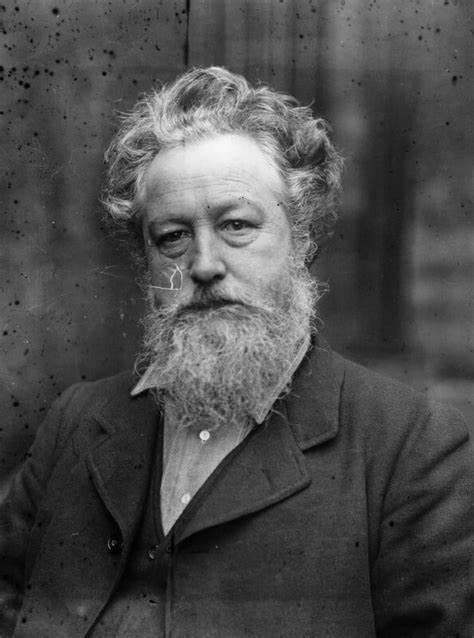
Morris matters because he rejected the modern habit of compartmentalization. Art was not separate from labor. Labor was not separate from morality. Morality was not separate from politics. He treated beauty as a public obligation and work as a formative discipline. This position makes modern readers uneasy. It demands judgment. It refuses neutrality. Systems that degrade the soul are named as such.
Serious scholars have long understood this. E. P. Thompson described Morris as launching a moral revolt against industrial capitalism rather than a technical or managerial one, grounded in life rather than abstract theory1. Fiona MacCarthy later emphasized that Morris saw industrialism as a force that reshaped desire itself, training people to tolerate ugliness and meaninglessness as normal2. That insight has aged like milk. We drink it daily.
The Right ignored Morris because he criticized capitalism. The Left misunderstood him because he demanded standards. Both preferred him ornamental.
He is being revisited because the invoice he warned about has arrived. The total is visible everywhere.
II. A Brief Life in Plain Terms
Morris was the only artist worth following.
William Morris was born in 1834 into comfort. His family had money. He received an elite education. He could have lived quietly among polite abstractions. Instead, he spent his life collapsing boundaries that polite society worked hard to maintain.
Morris refused to specialize. He wrote poetry, designed textiles, built furniture, printed books, restored manuscripts, organized workers, delivered speeches, and ran workshops. This was not dilettantism. It was coherence. He believed a civilization reveals its truth through what it makes and how it makes it. A man who delegates creation forfeits judgment.
His career followed a pattern that confounds modern categories. He began as an artist and ended as a political organizer, though the underlying concern never changed. He wanted ordinary people to live among beautiful things and take pride in their work. Politics entered only when he realized that private virtue could not survive public ugliness.
Biographers often note the physical stamina of Morris’s life. He labored long hours at presses. He traveled constantly to lecture halls and workshops. He involved himself personally in production rather than management. This mattered. Morris distrusted systems run at a distance. Authority, in his view, had to smell like ink and wood shavings.
Scholars emphasize that Morris’s politics emerged from practice rather than doctrine. Peter Stansky notes that Morris “arrived at socialism through work, not theory,” and that his activism grew directly out of frustration with industrial methods that degraded both maker and product3. This helps explain his impatience with armchair reformers and paper programs.
Morris did not live as a thinker commenting on society. He lived as a maker embedded inside it. That posture shaped everything. His biography is not a preface to his ideas. It is the argument itself.
III. Victorian England and the Shock of Industry
“I was there. Three thousand years ago, when the Shire was scoured.”
William Morris came of age as England underwent a transformation so fast it felt like an ambush. The countryside emptied. Cities thickened. Machines multiplied. Time itself changed texture. Work was no longer measured by seasons or skill but by output and hours. This was a cultural rupture.
Industrial England promised abundance and delivered cheapness. Goods flooded markets. Quality collapsed quietly. The Kingdom of Quantity came. Objects became disposable. Workers followed the same path. Labor was broken into fragments so small that mastery became impossible. Pride had nowhere to stand. Morris did not romanticize the past. He observed the present with clear eyes and found it spiritually thinning.
Contemporary observers noticed the same conditions but drew different conclusions. Many accepted ugliness as the price of growth. Others treated it as temporary disorder on the way to comfort. Morris rejected both stories. He believed environments train people. Factories that treated men as parts produced men who felt replaceable. Streets built without care bred indifference and anger. Morality matures within the design of everyday things.
Historians note that Morris’s critique aligned with a broader Victorian unease that never fully consolidated into policy. Asa Briggs describes the period as one where material output surged while “the moral and aesthetic consequences remained unresolved,” creating a society rich in goods and poor in meaning4. Morris stepped directly into that unresolved space.
He saw that industrialism was not neutral. It carried values. Speed over care. Quantity over excellence. Profit over pride. Once embedded, those values reproduced themselves automatically. Politics arrived too late to correct what workshops and streets had already taught.
Morris’s response was neither despair nor nostalgia. It was resistance through attention. He treated the industrial city as a diagnostic image. A society that builds this way thinks this way. Change the form, or accept the fate.
IV. John Ruskin and the Moral Critique of Capital
Wealth becomes a problem when it becomes abstract.
John Ruskin was the hinge on which William Morris turned. Before Ruskin, Morris sensed something was wrong. After Ruskin, he could name it. Ruskin taught that economics was never a neutral science. It was a moral system that rewarded certain behaviors and punished others, whether it admitted this or not.
Ruskin rejected the idea that value could be measured by price alone. He insisted that the conditions under which a thing was made mattered more than how cheaply it could be sold. A chair produced through drudgery was a degraded object, no matter its polish. A building erected without care trained people to live carelessly. Capital, when left to itself, rewarded speed and scale while quietly penalizing dignity.
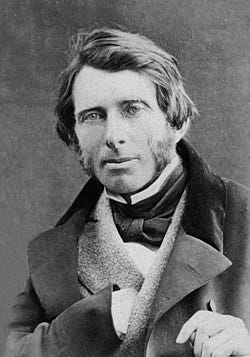
This was a dangerous claim. It implied judgment. It implied that some forms of wealth were corrupting even when legal. Ruskin made these arguments in plain language, grounded in examples drawn from architecture, painting, and labor. He spoke of stones laid by free men and walls raised by coerced hands. The difference could be felt, even if it could not be priced.
Morris absorbed this lesson completely. Scholars agree that Ruskin provided Morris with a moral vocabulary capable of opposing industrial capitalism without retreating into sentiment. As Timothy Hilton observes, Ruskin framed beauty as a social duty and labor as a moral relationship rather than a transaction5. This framing allowed Morris to see socialism as restoration rather than revolt.
Ruskin did not give Morris a political program. He gave him a standard. Measure systems by the kind of people they produce. Measure wealth by its effect on character. Once learned, this standard could not be unlearned. Morris carried it into workshops, guilds, and politics.
Capital was no longer an abstract engine. It had fingerprints.
V. The Arts and Crafts Movement Explained
Etsy is critical infrastructure.
The Arts and Crafts Movement rejected the assumption that mass production was destiny and that ugliness was the unavoidable tax paid for abundance. Morris and his circle treated making as a moral activity carried out in public view.
The movement favored hand production, honest materials, and visible skill. These preferences were were diagnostic. A chair that reveals how it was made invites respect for the maker. A printed page that honors spacing, ink, and proportion trains the eye to expect order. Objects teach. They do so silently and constantly.
Workshops associated with the movement were organized around mastery rather than output. Apprenticeship mattered. Skill took time. Authority followed competence. This was hierarchy without abstraction. No flowcharts. No distant managers. The chain of responsibility could be traced from hand to hand. Morris believed this transparency restrained abuse better than rules ever could.
Historians emphasize that the Arts and Crafts Movement was consciously anti-industrial without being anti-technology. It did not reject tools. It rejected systems that severed thinking from doing. Alan Crawford notes that the movement functioned as a “cultural counter economy,” offering an alternative standard of value rooted in workmanship rather than price6.
Critics then and now accuse the movement of elitism. Beautiful things cost more when they are made well. Morris accepted this tension rather than denying it. His answer was not to cheapen beauty but to rebuild society so fewer things needed to be cheap. Fewer objects. Better ones. Fewer hours wasted producing trash.
The Arts and Crafts Movement was politics conducted through workbenches and printing presses. It proved that resistance did not require slogans. It required standards. That made it dangerous. Standards always do.
VI. Craft as a Theory of Man
Morris saw theosis in Anglovision.
For William Morris, craft was not nostalgia. It was anthropology. He believed the way a person works shapes the kind of person he becomes. Repetitive, fragmented labor trains passivity. Skilled work trains judgment, patience, and self respect. This was cause and effect.
Craft demanded wholeness. The worker understood the material, the process, and the final form. Mistakes were visible. Excellence was earned slowly. Pride followed effort rather than title. Morris believed this alignment between effort and outcome was the foundation of social health. Break it, and resentment rushes in to fill the gap.
Industrial labor severed this alignment. The worker performed a gesture without owning the result. Responsibility floated upward. Blame flowed downward. Morris saw that this structure produced a specific personality type: obedient at work, resentful in private, volatile in crowds. Political disorder, in his view, was downstream from degraded labor.
Scholars have emphasized that Morris treated craft as a moral educator. Raymond Williams argued that Morris understood productive work as a “training in freedom,” where limits sharpened rather than constrained the human spirit7. Skill imposed discipline. Discipline created dignity. Dignity stabilized communities.
This helps explain Morris’s hostility to make work and busywork. Labor without meaning was worse than leisure. It trained dependence and contempt. A society filled with such work could not govern itself well, no matter how clever its laws.
Craft, then, was not an economic preference. It was a theory of man. Change how people work, and you change how they think, behave, and rule. Morris built his politics on that premise. Everything else followed.
VII. Beauty as Social Order
Cities shred more than IQ.
William Morris treated beauty as a governing force rather than a private pleasure. Streets, homes, tools, and books instructed people long before schools or laws did. Form trained expectation. Repetition trained character. A society surrounded by careless design learned to accept carelessness as normal.
Morris rejected the idea that taste was subjective and harmless. He believed ugliness functioned like pollution. It accumulated quietly, corroding standards and dulling attention. When buildings were thrown up without care, people learned that permanence was a joke. When objects were designed to be replaced, loyalty became irrational. Disorder followed as habit, not rebellion.
This view placed Morris at odds with liberal neutrality. He insisted that environments carry moral weight whether acknowledged or not. Architecture that elevates encourages restraint. Tools made with pride invite responsibility. Public spaces shape public behavior without speeches or police. Beauty governed silently.
Urban historians have since validated this intuition. Studies of Victorian and early modern cities show that built environments influenced social cohesion, crime, and civic pride more consistently than formal policy. Lewis Mumford argued that Morris grasped this earlier than most, seeing cities as “moral instruments” whose design either sustained or exhausted communal life8.
Morris’s insistence on beauty unsettled allies and enemies alike. It implied obligation. Someone had to decide what was worthy of preservation. Someone had to say no to cheapness and speed. Liberal societies prefer markets to make those decisions invisibly. Morris believed that abdication was itself a decision, one with predictable consequences.
Beauty, in his view, was maintenance. Neglect it long enough and disorder ceased to surprise anyone. The shock came later, when people wondered how things had fallen so far without noticing.
VIII. Why Morris Chose Socialism
The marketplace has a product: consoomers.
William Morris arrived at socialism through observation. Industrial capitalism, as practiced in Victorian England, rewarded systems that degraded work, cheapened objects, and severed responsibility from reward. Morris concluded that this arrangement was not a temporary distortion. It was the logical outcome of ownership divorced from making.
His socialism was not built around redistribution charts or parliamentary maneuvering. It began with a simpler claim. People should take pride in their work and live among things made with care. When ownership structures made that impossible, those structures had to change. Socialism, for Morris, was a means to restore dignity to labor and coherence to daily life.
This placed him at odds with both liberals and many socialists of his time. Liberals treated the market as morally neutral. Morris rejected that fiction. Markets taught values. They trained people to accept speed, cheapness, and disposability as virtues. Many socialists, meanwhile, focused on wages and control while ignoring the quality of work itself. Morris found this empty. A worker paid more to do degrading labor remained degraded.
Scholars emphasize that Morris’s socialism was cultural first and economic second. Ruth Kinna notes that Morris framed socialism as a “reordering of social life around pleasure in work and shared standards,” rather than as a program for state management or mass administration9. This explains his impatience with bureaucratic solutions and electoral shortcuts.
Morris chose socialism because he saw no other way to defend craft, beauty, and human scale against systems optimized for accumulation alone. He did not promise comfort. He promised meaning. That promise has always been politically dangerous. It demands limits. It demands taste. It demands saying that some forms of wealth cost more than they deliver.
IX. Guild Socialism and Human Scale
Toward a Right-wing socialism.
Guild socialism emerged as the political form most compatible with Morris’s instincts, even after his death. It attempted to answer a problem both capitalism and state socialism failed to solve. How could modern societies preserve skill, pride, and responsibility without retreating into peasant isolation or submitting to managerial rule.
The guild socialists took Morris seriously when he said that labor shapes character. They rejected nationalization run from offices and ledgers. They also rejected markets that treated workers as interchangeable parts. Their solution was structural. Industries should be organized as self governing guilds composed of skilled workers who controlled standards, training, and internal discipline. Ownership mattered less than mastery. Authority flowed from competence.
Figures such as G. D. H. Cole10 developed these ideas in explicit contrast to both parliamentary socialism and liberal economics. Cole argued that democracy without control over work was hollow. People trained all day in obedience could not be expected to rule themselves wisely at night. Governance had to exist where people spent their lives.
Historians note that guild socialism was less a mass movement than a serious institutional proposal. It aimed to re-anchor power at the human scale. Workshops instead of ministries. Standards instead of incentives. Responsibility that could not be abstracted away. A bad decision had a face attached to it.
This model appealed to Morris’s moral logic. Guilds preserved hierarchy without aristocracy. Apprenticeship replaced credential inflation. Pride replaced grievance. Economic life became legible again. One could see who made what, how, and why it mattered.
Guild socialism failed politically, crowded out by the rise of centralized states and corporate management. Its failure was logistical and temporal. Large systems moved faster. They promised comfort sooner. The cost appeared later.
The idea lingers because the problem never vanished. Scale still erodes responsibility. Abstraction still hollows work. The guild remains an unanswered question, waiting for conditions that make speed less seductive than dignity.
X. Why the Right Rejected Him
The empire devours the nation devours itself.
The Right did not reject Morris by accident. It rejected him because he exposed a fault line it preferred to paper over. As industrial capitalism matured, conservatism fused property, profit, and national strength into a single moral story. Factories meant power. Exports meant greatness. Disruption became destiny. Morris shattered that story by treating capital as corrosive to culture rather than its guarantor.
He refused the conservative bargain of the age. Growth in exchange for ugliness. Wealth in exchange for meaning. Comfort now, consequences later. Morris insisted that a civilization incapable of making beautiful things could not claim to conserve anything worth keeping. That claim was intolerable to a Right increasingly invested in defending outcomes rather than standards.
Morris also made hierarchy conditional. He believed authority had to be earned through mastery and contribution. Ownership without skill impressed him not at all. This placed him at odds with elites who had learned to justify themselves through accumulation alone. Morris respected excellence. He despised vulgar success. Many recognized themselves in the latter category and took offense.
There was also a deeper discomfort. Morris demanded judgment. He said some buildings should not exist. Some goods should not be made. Some jobs should disappear. Conservatism had begun outsourcing such decisions to markets and inertia. Let price decide. Let demand excuse everything. Morris called this abdication cowardice disguised as prudence.
Historians have noted that late Victorian conservatism increasingly aligned itself with industrial modernity while abandoning older cultural standards. Martin Wiener argues that English elites defended economic expansion even as it undermined the very traditions they claimed to inherit, creating a conservatism that preserved wealth while surrendering culture11. Morris stood in the way of that surrender.
So the Right minimized him. Labeled him sentimental. Filed him under art. Better a harmless socialist than a moral critic with a ruler in hand.
He was rejected because he would not flatter power. He asked what it was for.
XI. Why the Left Misused Him
It does not matter what the system is if everyone in it is a sociopath.
If the Right shelved Morris, the Left embalmed him. It kept his anger and discarded his standards. Over time, Morris was absorbed into a tradition that treated economics as a technical problem and politics as a numbers game. His insistence on beauty, discipline, and mastery sat awkwardly inside movements increasingly focused on administration and scale.
Modern socialism drifted toward management. Ministries replaced workshops. Credentials replaced apprenticeship. Output replaced excellence. Morris had warned against this trajectory. He believed that systems run from a distance inevitably lose moral contact with the work they govern. The Left ignored that warning because distance felt powerful. It promised speed. It promised reach. It promised control.
Morris’s socialism demanded judgment. Some work was degrading even if profitable. Some goods were corrupting even if popular. Some desires needed restraint rather than satisfaction. These claims made administrators nervous. Bureaucracies prefer neutrality. Morris refused it. He believed culture could not survive without standards enforced by taste and courage.
Scholars have noted that Morris’s legacy was selectively interpreted to fit later ideological needs. Norman Kelvin observed that twentieth century socialism emphasized Morris’s critique of private property while muting his hostility to bureaucracy and mass production, turning a craftsman’s revolt into a managerial doctrine12. What remained was a slogan without a spine.
The Left also struggled with Morris’s embrace of hierarchy. He believed skill created rank. Masters taught apprentices. Excellence commanded respect. Equality existed in dignity, not in outcome. This position fit neither revolutionary fervor nor administrative leveling. It was easier to speak of justice than of excellence.
In the end, Morris became a symbol rather than a standard. His name appeared in footnotes. His demands were ignored. The Left kept his protest and lost his prescription. The result was a politics fluent in critique and incapable of building.
XII. An Inheritance Still Unclaimed
Enjoy the silence no longer.
William Morris did not leave behind a program. He left behind a demand. Civilizations must decide what kind of people they are trying to produce and then build accordingly. That decision cannot be outsourced to markets, ministries, or momentum. It requires standards enforced through form, labor, and taste.
Morris’s inheritance remains unclaimed because it is inconvenient. It asks societies to slow down. It asks them to refuse cheapness even when cheapness flatters the poor and enriches the powerful. It asks them to rebuild institutions around mastery rather than metrics. These demands collide with systems organized around scale and speed.
The relevance is no longer subtle. Cities exhaust their inhabitants. Work produces resentment rather than pride. Elites speak endlessly about values while surrounding themselves with ugliness. Politics grows more vicious as daily life grows more degrading. Morris predicted this pattern. He described it as mechanical, not moral. Systems that train contempt eventually receive it.
Contemporary scholars increasingly recognize Morris as a thinker of structure rather than sentiment. Anna Vaninskaya argues that Morris understood socialism as a civilizational project aimed at restoring coherence between work, beauty, and meaning, rather than a temporary correction to distribution13. That coherence remains absent.
Morris offers no comfort. He promises no painless transition. He insists that beauty costs effort, that dignity requires limits, and that freedom without form collapses into noise. His vision stands unresolved because resolving it would require real sacrifice.
The inheritance remains on the table. Either societies relearn how to make things worth keeping, or they continue perfecting systems that cannot love what they build. Morris knew which path ended in silence. The choice has been deferred long enough to feel permanent.
E. P. Thompson, William Morris: Romantic to Revolutionary
Fiona MacCarthy, William Morris: A Life for Our Time
Peter Stansky, Redesigning the World: William Morris, the 1880s, and the Arts and Crafts
Asa Briggs, Victorian Cities
Timothy Hilton, John Ruskin: The Later Years
Alan Crawford, C. R. Ashbee: Architect, Designer and Romantic Socialist
Raymond Williams, Culture and Society 1780–1950
Lewis Mumford, The Culture of Cities
Ruth Kinna, William Morris and the Politics of Romanticism
G. D. H. Cole, Guild Socialism Restated
Martin J. Wiener, English Culture and the Decline of the Industrial Spirit
Norman Kelvin, The Collected Letters of William Morris: Introduction and Commentary
Anna Vaninskaya, William Morris and the Idea of Community
The last paragraph was the most powerful. Virtuous societies are those which producing people worth keeping. Ours treat people as the opposite and the decay, and reaction by people, is readily observable.
Phenomenal introductory chapter