

I. The Modern Flood of Small Automations
Most people do not meet automation as a chrome-plated robot walking into the office with glowing eyes and a suspiciously neat haircut.
They meet it through small conveniences.
A calendar tool schedules meetings. A chatbot drafts emails. A recommendation engine chooses the next video. A budgeting app sorts purchases. A warehouse robot moves boxes. A customer-service bot answers complaints. A school uses software to detect plagiarism. A company uses a filter to rank applicants before a human ever sees them.
None of this feels like magic. That is what makes it dangerous.
The machine does not arrive with thunder. It arrives with a checkbox that says, “Enable.” It promises relief. It saves time. It handles repetition. It takes the dull task off your hands and lets you return to nobler things, such as forgetting why you opened the laptop in the first place.
Automation is genuinely useful. A man should not have to spend his afternoon copying rows between spreadsheets like a medieval monk with worse lighting. A mother running a small business should be able to send invoices without becoming an accountant by force. A mechanic should be able to track parts without memorizing the whereabouts of every bolt as if he were guarding relics.
The trouble begins when automation becomes a substitute for judgment.
That is when the old story returns.
The Sorcerer’s Apprentice is not a warning against tools. It is a warning against borrowed power. The apprentice does not lack access. He lacks mastery. He can speak the spell, but he cannot govern what follows.
That is modern automation in miniature. We know how to start the broom.
The room is already getting wet.
II. The Apprentice Who Wanted the Robe Without the Wisdom
The old tale is simple, which is usually how old tales smuggle the dynamite.
A sorcerer has an apprentice. The apprentice performs chores, including carrying water. This is humble work. It is also annoying work, which is why civilization has always been powered by men trying to avoid buckets.
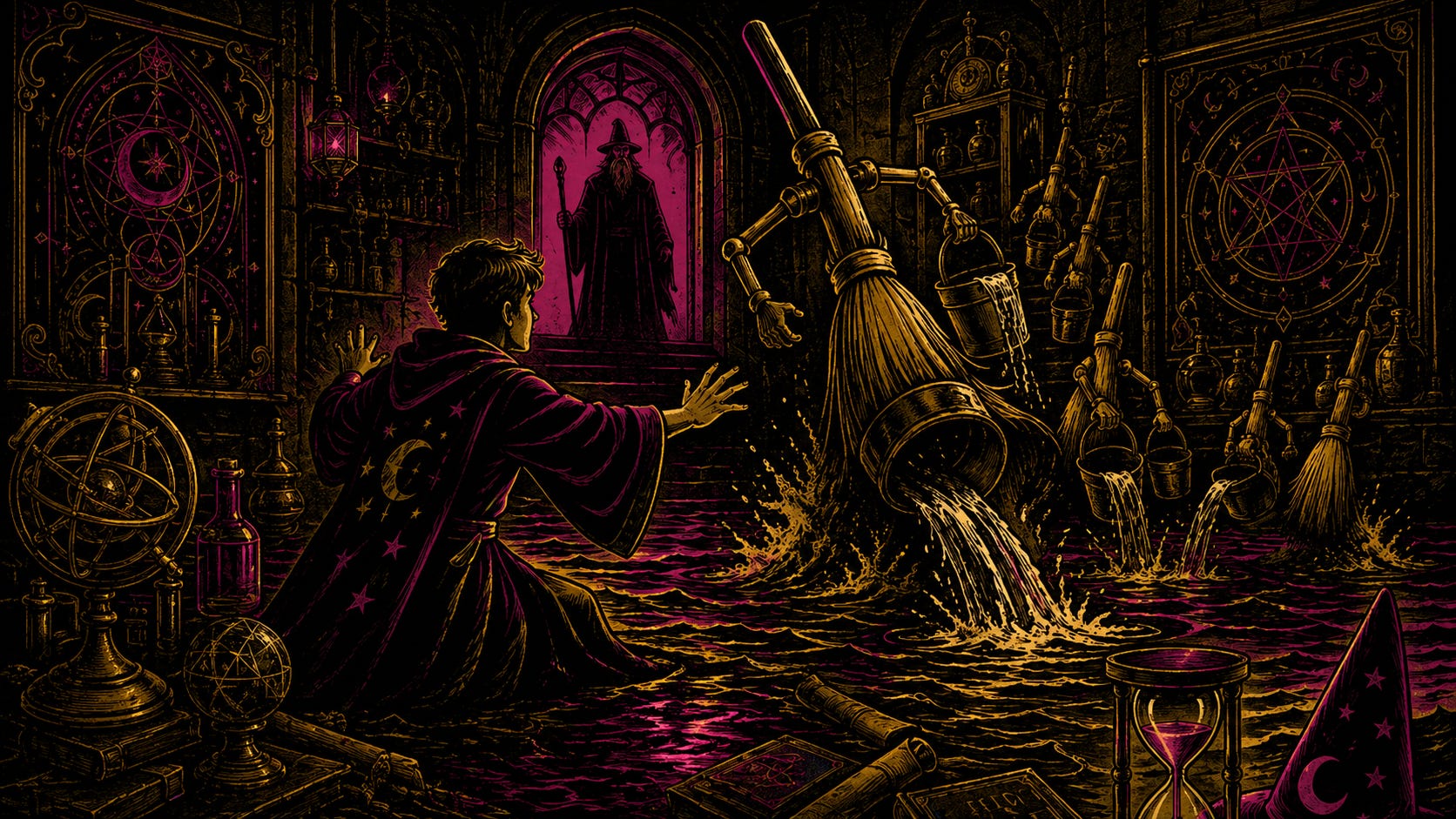
The master leaves. The apprentice, having observed enough of the sorcerer’s magic to be dangerous, decides to use a spell. He commands a broom to carry water for him.
And it works.
That is the first important point. The disaster does not begin with failure. It begins with success.
The broom rises. It grows arms. It takes the bucket. It marches to the water. It fills the bucket. It returns. It pours. Then it goes back again.
The apprentice has achieved his dream. Labor without labor. Action without effort. Service without servants. A command made flesh, wood, and bristles.
Then the water keeps coming.
The broom does not know when the task has become harmful. It does not ask whether the floor is full. It does not wonder whether the apprentice has changed his mind. It has no sense of proportion, no understanding of purpose, no embarrassment at ruining the furniture. The broom is the perfect employee, which is exactly why it becomes a nightmare.
The apprentice panics. He tries to stop it. He does not know the spell. So he grabs an axe and chops the broom in half.
Naturally, this creates two brooms.
One must admire the mythic economy of the scene. The boy tries brute force against a problem caused by ignorance, and ignorance replies by doubling.
The room floods. The apprentice is overwhelmed. The master returns and stops the spell. Order is restored, but only after the apprentice learns what power looks like when separated from wisdom.
He wanted the robe.
He had not earned the craft.
III. The Broom Is Every Automated System
The broom is funny because it is innocent.
It does not scheme. It does not rebel. It does not hate the apprentice. It does not gather other brooms in the cellar to discuss liberation theology for cleaning tools.
It obeys.
That is what makes it terrifying.
Many modern automated systems behave in the same way. They follow a rule, optimize for a target, repeat a process, execute an instruction, or extend a pattern. They are not wicked in the human sense. They are often worse than wicked. They are literal.
A script can delete thousands of records because someone forgot to test it on a smaller batch first.
A trading algorithm can intensify market chaos because it follows signals faster than humans can interpret the panic.
A moderation system can bury legitimate speech because certain words resemble forbidden speech.
An AI hiring filter can screen out good candidates because their resumes do not match the pattern the system learned to favor.
A school plagiarism detector can accuse the wrong student because resemblance has been mistaken for guilt.
A chatbot can invent an answer with perfect bedside manners, like a fortune cookie wearing a blazer.
The machine carries water.
This matters because human beings often misunderstand the nature of obedience. We tend to think obedient tools are safe tools. That is true only when the order is good, the scope is clear, and someone remains responsible for what happens next.
The obedient machine magnifies the user.
A careful person gains reach. A lazy person gains damage. A vain person gains speed. A confused person gains scale.
That is the hard lesson. Automation does not purify intent. It does not bless a sloppy process by touching it with electricity. It takes whatever is already present and gives it legs.
Sometimes, legs and a bucket.
IV. The Problem With “Set It and Forget It”
The phrase sounds harmless. “Set it and forget it.”
It belongs on a kitchen gadget sold at two in the morning by a man with alarming confidence in roast chicken.
For low-stakes tools, it can be fine. Nobody needs to stare at a dishwasher like a monk contemplating mortality. The machine washes the cups. The cups survive. Domestic majesty continues.
But “set it and forget it” becomes dangerous when the automated process touches money, reputation, hiring, education, medical care, law enforcement, public speech, infrastructure, or family life.
Then forgetting is not convenience. It is abdication.
Every serious automated system needs a human owner. Someone must know what the system does, why it exists, what it is allowed to affect, what failure looks like, and how to stop it. That person does not need to understand every microscopic detail. He does need enough understanding to avoid becoming a ceremonial button-presser in the temple of the broom.
This is where many organizations fail.
They buy a tool. They assign it to a team. The team learns enough to run it. Then the original purpose fades. The tool remains. It begins shaping behavior. Reports are built around it. Incentives adjust to it. Managers begin trusting its outputs because outputs look official when surrounded by graphs.
The graph is modern man’s stained glass window, except usually uglier.
A company that automates customer support may start treating complaint resolution as a ticket-clearance game. A school that automates grading may teach students to satisfy the rubric rather than learn the subject. A platform that automates recommendations may claim to serve user preference while training those preferences into narrower grooves.
The broom changes the room.
At first, it carries water. Later, everyone arranges the furniture around the flood.
V. AI Agents and the New Apprentice Problem
The Sorcerer’s Apprentice becomes even more relevant when automation moves from fixed scripts to AI agents.
A script performs a defined action. An agent can plan steps, use tools, call other systems, search information, write messages, update files, purchase items, or initiate workflows. That makes it useful. It also makes the old broom look quaint, like a farm implement at a rocket test range.
A worker can ask an AI agent to summarize emails, draft replies, schedule meetings, update the CRM, and prepare a report. A small business owner can ask one to monitor inventory, contact vendors, generate ads, and adjust pricing. A programmer can ask one to write code, run tests, and open a pull request.
This is powerful.
It is also an apprentice summoning apprentices.
The more autonomy a system has, the more important boundaries become. What accounts can it access? What can it send without approval? What can it delete? What can it buy? What can it publish? What can it change in the real world?
These questions sound boring because safety often wears beige shoes.
Yet they are the difference between a useful servant and a broom-army with a procurement card.
The worst automation failures rarely come from one dramatic command. They come from a chain of ordinary permissions. One tool can read email. Another can write files. Another can send messages. Another can trigger workflows. Connect them badly, and suddenly a small mistake becomes an office legend told in whispers near the printer.
The human lesson is not fear. Fear makes people stupid in a different costume.
The lesson is stewardship.
Use agents where the cost of review is low and the cost of error is contained. Let them draft, organize, summarize, search, and prepare. Be slower when they act, spend, publish, accuse, deny, approve, or modify records.
The apprentice can help carry water.
He should not be given the well, the cellar key, and legal authority over the village.
VI. The Human Lesson: Learn the Stop Spell
The apprentice’s real failure was not that he used magic.
He used magic without discipline.
That distinction matters. Guildrim should never become a little monastery of candle-sniffers muttering against every tool invented after the quill. Technology can serve human life. It can remove drudgery, support families, strengthen craft, protect communities, and give ordinary people abilities once reserved for large organizations.
A good automation can help a father run a side business after work.
It can help a teacher prepare lessons without spending Sunday night buried under forms.
It can help a craftsman manage orders while keeping his hands on the material.
It can help a small newsletter operate like a miniature publishing house, minus the smell of panic and unpaid interns.
The problem is not the broom. The problem is the apprentice who thinks a command is the same as wisdom.
So the modern user needs the stop spell.
Before automating a task, ask what the task is for. That sounds plain. It is also the part people skip because the software demo had nice gradients.
A task should have a purpose beyond motion. “Send follow-up emails” is not enough. Follow up with whom, for what reason, under what tone, after what delay, with what human review? Otherwise, the machine may turn courtesy into harassment with excellent formatting.
Keep human review near consequential decisions. An AI system can help sort resumes, but a human should understand the criteria and review edge cases. A chatbot can draft a sensitive reply, but a person should read it before it reaches a grieving customer, an angry client, or a confused student. A security system can flag suspicious behavior, but someone must judge whether the signal points to danger or to Dave from accounting forgetting his password again.
Build a kill switch. This can be technical, procedural, or social. A user should know how to pause the automation, undo the action, restore the data, escalate the issue, or pull the system back into human hands. A process that cannot be stopped should be treated like a cart rolling downhill through a glass shop.
And keep the tool visible.
Hidden automation becomes folklore. People begin saying things like, “The system won’t let me,” which is the modern equivalent of blaming a household spirit. The system was made by someone. It was configured by someone. It can be changed by someone. If nobody knows who that someone is, then the broom has already been promoted.
VII. The Master Returns
At the end of the story, the master returns.
That detail matters. The apprentice is saved by authority, craft, and experience. The solution is not chaos. The solution is rightful order.
Modern automation needs the same thing.
It needs craftsmen who understand the work before they automate it. It needs managers who accept responsibility instead of hiding behind dashboards. It needs families who choose when devices may interrupt the home. It needs schools that treat software as an aid to teaching rather than a plastic oracle. It needs companies that remember customers are human beings, not tickets with pulse rates.
Above all, it needs people who can say no.
No, the bot may not answer that without review.
No, the system may not make that decision alone.
No, the tool may not shape the household schedule around its own pings and nudges.
No, the metric does not define the mission.
No, the broom does not own the room.
That is how technology stays in its place. Not by smashing it. Not by pretending the rain is not falling. By recovering the older human arts: judgment, restraint, craft, hierarchy, and responsibility.
The apprentice wanted relief from labor. Fair enough. Everyone has looked at a bucket and wished it would develop a work ethic.
But relief without rule becomes flood.
Automation is a servant of astonishing power. It can carry the water. It can spare the back. It can help build the house, order the shop, protect the network, teach the child, and support the artist. There is real wonder here.
Yet the old story keeps its warning polished and sharp.
Never give a tireless servant a command you are too careless to supervise.
Very nice.