

I. The Age of Borrowed Voices
We have entered the age of borrowed voices.
A dead singer can be made to perform a song he never heard. A scammer can call a grandmother using the copied voice of her grandson. A podcaster can clone himself and generate an episode while making coffee in another room. The machine speaks, and the room accepts it. The old test of presence, “I heard it from his own mouth,” now has a trapdoor beneath it.
AI voice tools are astonishing. They can help a man with a damaged throat speak again. They can translate a lecture into another language while preserving the speaker’s cadence. They can let a small creator produce audiobooks without hiring a studio. Used properly, they carry a kind of craft. There is real wonder here.
Yet the voice is not ordinary property.
A voice is intimate. It is breath shaped into identity. It carries age, region, class, temperament, grief, humor, and all the little cracks a person never meant to reveal. The face can pose. The résumé can posture. The voice betrays the soul with the carelessness of an honest dog.
That is why “The Little Mermaid” matters now.
Hans Christian Andersen’s tale is remembered as a story about love, sacrifice, and longing. It is also a story about what happens when a young woman gives up her voice in exchange for entry into a world that does not understand her.
The bargain is old.
The machinery is new.
II. The Mermaid’s Bargain
The little mermaid lives beneath the sea, where everything is strange, beautiful, and unreachable to human beings. She is drawn upward. She wants the world above the water. She sees a prince. She wants him, yes, but she wants more than romance. She wants a soul. She wants an immortal destiny beyond the shifting life of the sea.
This is no small desire. She is not a bored girl with seashell décor. She is a creature aching toward another order of being.
To reach it, she visits the sea witch.
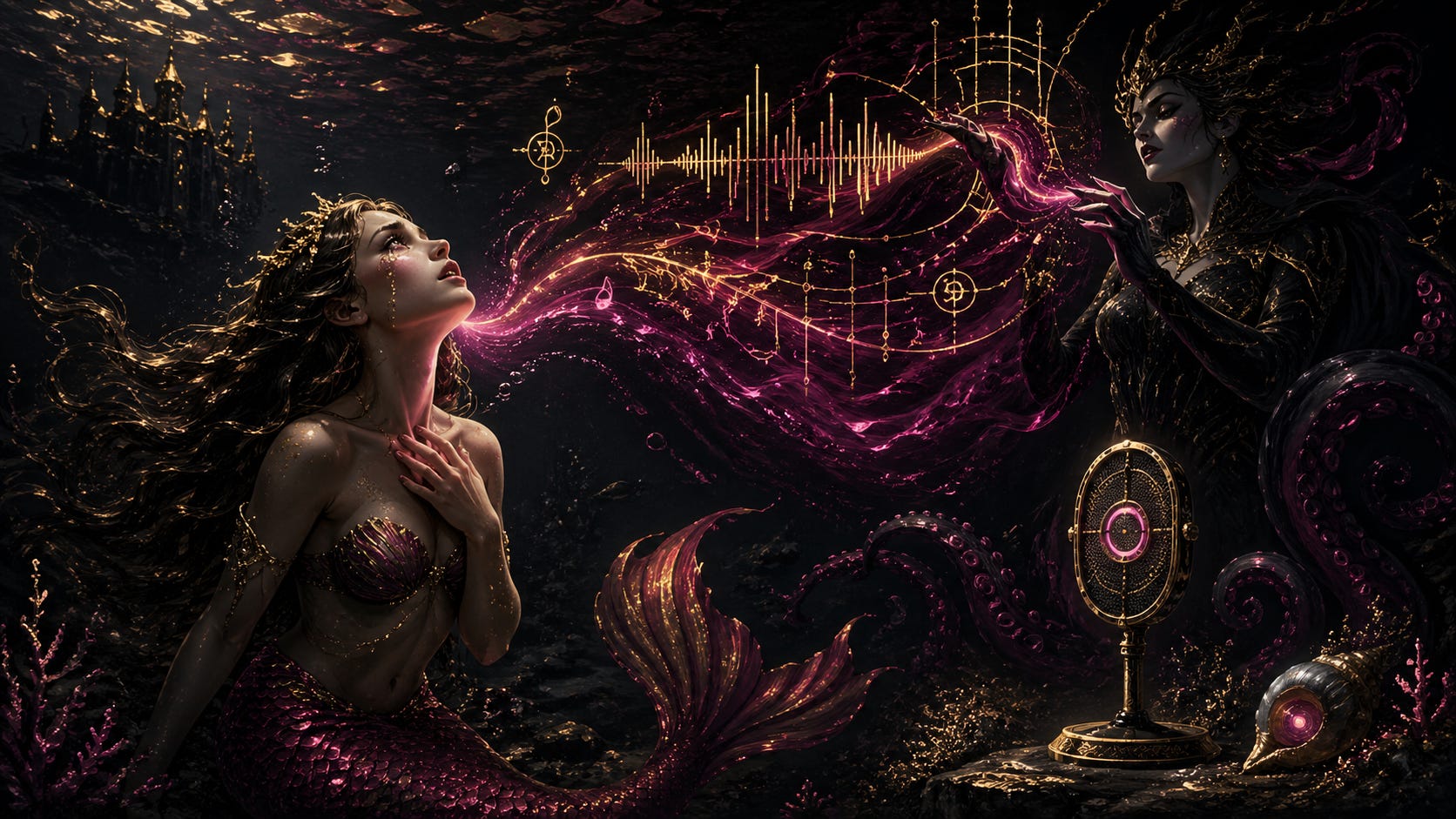
The witch offers a bargain. The mermaid may receive human legs, but the price is terrible. Every step will feel like walking on knives. Worse, she must surrender her voice. The witch cuts out her tongue and takes the most beautiful thing about her.
The mermaid rises to the human world silent.
She can move among men, but she cannot tell her story. She can dance, but each movement costs her pain. She can gaze at the prince, but she cannot explain who she is, what she gave up, or why she matters.
Her body gains access.
Her voice remains below.
There is the tragedy. Not that she wanted too much. Wanting greatness is often the first sign of life. The tragedy is that she surrendered the one gift that could have carried her inner world into the new one.
She gained entry at the cost of expression.
The sea witch understood the nature of power. She did not ask for a necklace, a crown, or a palace. She asked for the voice.
The witch knew where the treasure was kept.
III. The Sea Witch With a Software License
AI voice tools are a sea witch with a software license.
They offer access. They promise reach. They tell creators, teachers, companies, and lonely people that the hard parts can be bypassed. Record a few minutes. Upload your sample. Train the model. Now your voice can speak without you.
The first use cases sound harmless, even helpful.
A history teacher can turn written lectures into audio for students who learn better by listening. A pastor can convert sermons into multiple languages for parishioners who speak Spanish, Korean, or Ukrainian. A small business owner can create training videos without spending two weeks in microphone purgatory, that padded closet where human dignity goes to wheeze.
Then the shadow appears.
A fraudster clones a daughter’s voice and calls her parents in panic, begging for money. A political operative releases fake audio before an election. A company uses a performer’s voice after a contract expires. A grieving man builds a synthetic version of his dead wife, then slowly prefers the obedient ghost to the painful reality of mourning.
The machine has no reverence for the boundary between assistance and impersonation. It will cross that boundary if people ask it to cross. It has the moral instincts of a vending machine with theater training.
The real danger is not that synthetic voices sound fake.
The danger is that they sound close enough.
Close enough is powerful. Close enough can shame, seduce, scam, persuade, and confuse. Close enough can ruin reputations before truth has found its shoes.
And because the voice feels personal, people trust it faster than text.
A fake email may raise suspicion. A fake voice melts the guard at the gate. People hear trembling, urgency, affection, or authority, and their judgment kneels before recognition.
The old mermaid bargain returns.
To enter the new world, people give the machine their voice.
The question is whether they understand what they have handed over.
IV. Voice Is Presence
A voice is more than sound.
It is one of the main ways a person becomes present to another person. A mother hears her child cry in a crowded room and knows the cry before she sees the child. A husband recognizes the slight change in his wife’s tone before she admits something is wrong. A friend hears forced cheerfulness and knows the grief hiding behind it.
The voice carries the body into the room.
AI voice tools separate the voice from the body.
That separation can serve mercy. Someone who has lost the ability to speak may recover a familiar sound through voice banking. A man with ALS may preserve something of his vocal identity for his children. A stroke survivor may use a synthetic voice that resembles his own instead of a generic robotic tone. In these cases, technology serves the person. The machine acts as a crutch, not a mask.
That distinction matters.
The tool becomes corrupt when the voice is detached from responsibility. A synthetic voice should never become a roaming puppet, saying things the speaker did not approve, endorsing products the speaker would despise, or comforting loved ones from beyond the grave with words no living person chose.
A person’s voice should remain tied to consent.
That sounds simple. It will be treated as complicated, because money is a gifted fog machine. Platforms, agencies, studios, and app makers will say the questions are difficult. They will convene panels. They will invent policies with the texture of wet cardboard. Somewhere in the paperwork, someone’s voice will be sold.
The mermaid’s story gives us a cleaner standard.
Do not trade away the part of you that carries your soul into the world.
Use voice tools to extend human presence, not counterfeit it.
Use them to restore speech, translate speech, preserve speech with permission, or assist speech when the speaker remains accountable.
Do not use them to impersonate the absent, manipulate the vulnerable, or replace the living.
The witch always begins with convenience.
She ends with silence.
V. The Creator’s Temptation
Creators face a special version of this bargain.
A writer can now generate an audiobook in his own voice without reading it aloud. A YouTuber can produce three channels’ worth of narration using cloned speech. A company can build an entire content mill around one charismatic voice, then keep that voice running after the person burns out, quits, or spiritually evaporates into analytics.
The temptation is obvious.
Voice work is slow. Recording is annoying. Editing mouth noise is a punishment fit for a minor Greek criminal. AI can remove the friction. It can make the creator sound rested, clear, and tireless.
That is useful for drafts.
It is dangerous as a replacement for presence.
People do not follow a voice because it is acoustically pleasant. They follow it because they sense a person behind it. They hear risk. They hear judgment. They hear that someone has lived with the words long enough to speak them honestly.
A cloned voice can imitate the surface of authority. It cannot carry the burden of having meant the words.
That does not mean creators should reject the tool. A newsletter writer may use an AI voice to create an audio version for readers commuting to work. A teacher may generate practice recordings. A creator with a cold may use a synthetic read for a minor update. A small studio may use temporary voice placeholders before hiring actors.
Fine. The screwdriver may remain in the drawer without being crowned emperor.
But the creator should keep certain things human.
The main essay. The confession. The apology. The vow. The blessing. The warning. The farewell.
Some words should pass through lungs.
A machine can read a sentence. It cannot stand behind one.
The little mermaid could dance beautifully, but she could not speak. Many creators are now tempted to reverse the tragedy. They may speak everywhere and be present nowhere.
That is still a kind of muteness.
VI. The Human Rule
The lesson of “The Little Mermaid” is not that desire is evil. The mermaid’s desire has greatness in it. She wants a higher life. She wants to cross a boundary. She wants to become more than she was.
Modern people want the same from technology.
They want reach, speed, beauty, translation, accessibility, and creative force. These are not wicked desires. A good tool can help a small creator sound professional. It can help the disabled speak. It can help families preserve a loved one’s stories. It can help language barriers shrink without flattening every accent into airport English.
The moral question is whether the tool serves the person or consumes the person.
So the rule should be clear.
Never clone a voice without explicit consent.
Never use a synthetic voice to make someone appear to say what they did not approve.
Never treat the voice of the dead as raw material for emotional theater.
Never let convenience train you to distrust your own living presence.
And never forget that the most powerful part of a person’s voice is not the sound. It is the responsibility attached to it.
The little mermaid gave up her voice to enter the human world. In the age of AI voice tools, many people will be asked to make the same bargain in reverse. They will be told to surrender their embodied speech so their synthetic voice can travel farther, faster, smoother, and cheaper.
Some will accept. Some will call it growth. Some will point to the numbers and grin like a sea witch balancing accounts.
But the old story remains stubborn.
A voice is not a costume.
A voice is a covenant between the inner life and the outer world. It carries the strange majesty of being a person among persons. Once severed from truth, it becomes a beautiful fraud.
The machine may speak with your sound.
Make sure it never speaks in your place.