

They tore the walls down in freedom’s name,
Then watched each worker act the same.
The open-plan office was sold as a cure for hierarchy.
Walls would come down. Executives would sit beside junior staff. Conversation would flow. Collaboration would become spontaneous. The old corner office, with its polished door and quiet authority, would give way to a democratic room where everyone could see everyone else.
The result often feels less like equality than exposure.
A worker arrives at a shared desk beneath bright lights. Conversations cross the room. Someone is always walking behind the monitor. A manager may be ten feet away, though no meeting has been scheduled. Status lights glow inside workplace chat. Calendars display availability. Software records response times. Badge systems log entry. Performance dashboards count visible activity.
Very little of this resembles direct command.
No supervisor says, “Remain visibly busy at every moment.” The room says it instead.
The worker learns to keep a document open during slow periods. He answers messages quickly so no one mistakes reflection for idleness. He joins meetings that require little from him because absence has become more conspicuous than useless attendance. He takes lunch at his desk. He lowers his voice during personal calls while hearing every cough, complaint, and whispered salary negotiation around him.
The office has removed many physical barriers while multiplying social ones.
Its governing pressure is visibility. The worker must appear available, responsive, agreeable, and occupied. He may possess more freedom in formal policy than his father had in a closed office. In practice, he experiences a thousand small judgments with no clear judge.
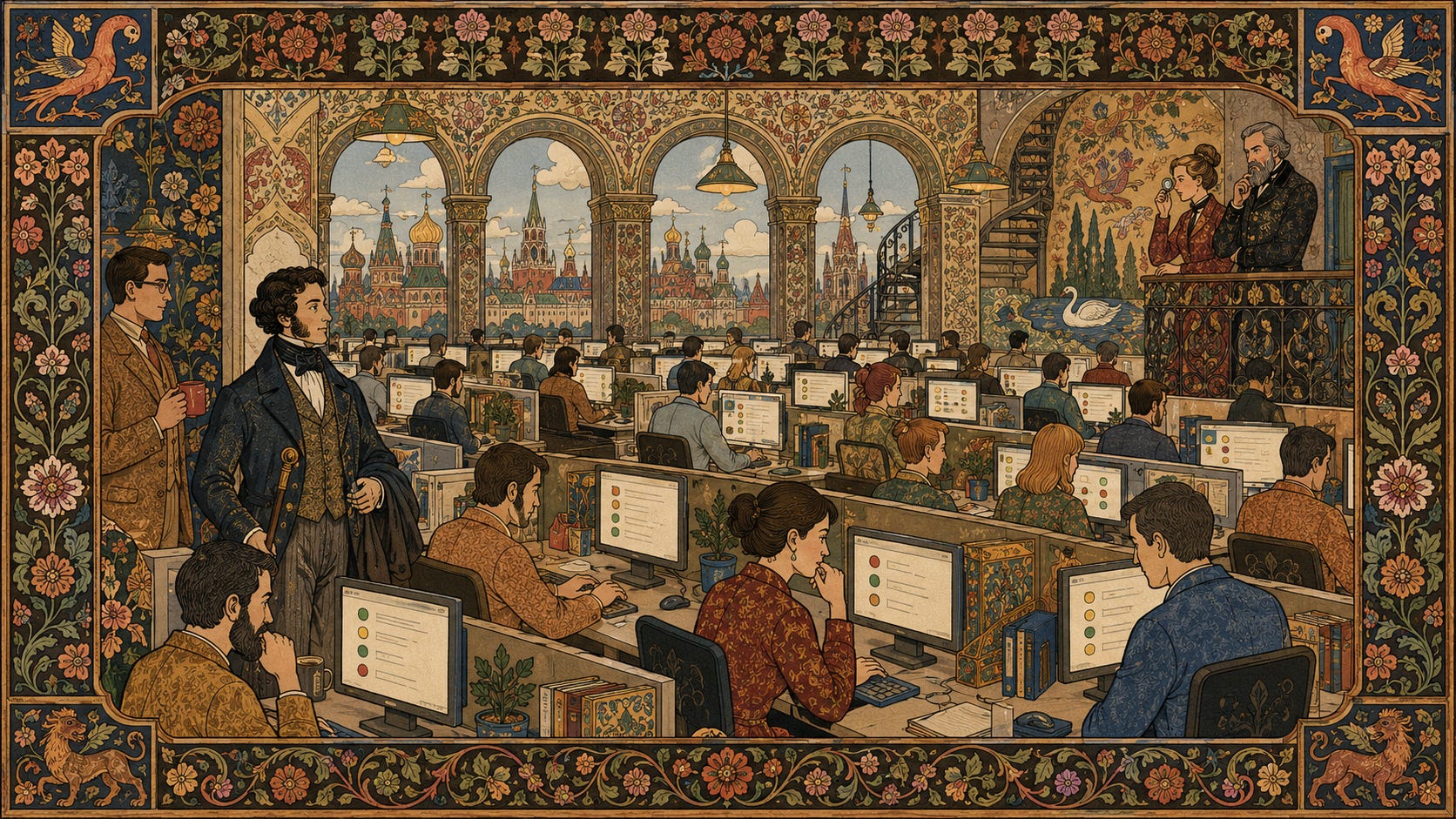
Tocqueville Sees the Gentle Hand
Alexis de Tocqueville understood that modern control would often arrive without the costume of tyranny.
In Democracy in America, he described a form of soft despotism that did not crush citizens with open violence. It surrounded them, directed their conduct, supplied their needs, and gradually weakened their ability to act without guidance. The power remained mild in appearance. Its effects were grave.
Tocqueville’s concern was larger than office design. He feared a social order in which people became isolated, administratively managed, and increasingly dependent on distant systems. Public life would shrink. Personal courage would soften. Citizens might retain the language of freedom while losing the habits required to exercise it.
The open-plan office repeats this pattern in miniature.
The modern employee is rarely ordered to obey every preference of management. He is surrounded by signals, measurements, conventions, and ambient expectations. These forces guide conduct without always declaring themselves.
The shared room also encourages a peculiar kind of conformity. Since everyone can see everyone else, workers begin policing themselves. They learn which topics cause silence. They notice who leaves early. They remember whose camera remained off. They observe which phrases senior leaders repeat and adopt them with the speed of birds changing direction.
Tocqueville saw that social pressure in democratic societies could become more penetrating than formal authority. A king may punish disobedience. A crowd can make independence feel embarrassing.
The open office gives the crowd a floor plan.
Equality Can Become Exposure
There is a real good buried inside the open office.
Leaders should remain accessible. Departments should communicate. Junior staff should not need a ceremonial summons to ask a practical question. Private offices can breed territorial habits, information hoarding, and petty lordship over carpeted kingdoms.
Tocqueville would not defend hierarchy merely because it had doors.
His warning concerns the confusion of equality with sameness.
People performing different kinds of work require different conditions. A recruiter may need constant conversation. A detection engineer may need two hours of uninterrupted concentration. A manager may benefit from hearing the room. A writer may produce his best work only after escaping it.
A uniform floor plan ignores these differences while pretending to honor equality.
It also grants management an unusual advantage. Leaders can claim informality while retaining every decisive power. The executive sits at an ordinary desk, yet still controls promotions, assignments, budgets, and layoffs. The visible symbols of rank disappear. The rank itself remains.
This can make authority harder to question.
A formal hierarchy at least admits that hierarchy exists. An allegedly flat workplace often disguises power beneath friendliness, casual clothing, and communal tables. The worker is told that everyone has a voice. He soon discovers that some voices approve salaries while others approve lunch orders.
Freedom at work requires clear authority, defined privacy, and room for independent judgment. Constant exposure weakens all three.
The Architecture of Quiet Compliance
The deepest problem is not furniture. It is the transfer of judgment from the worker to the surrounding system.
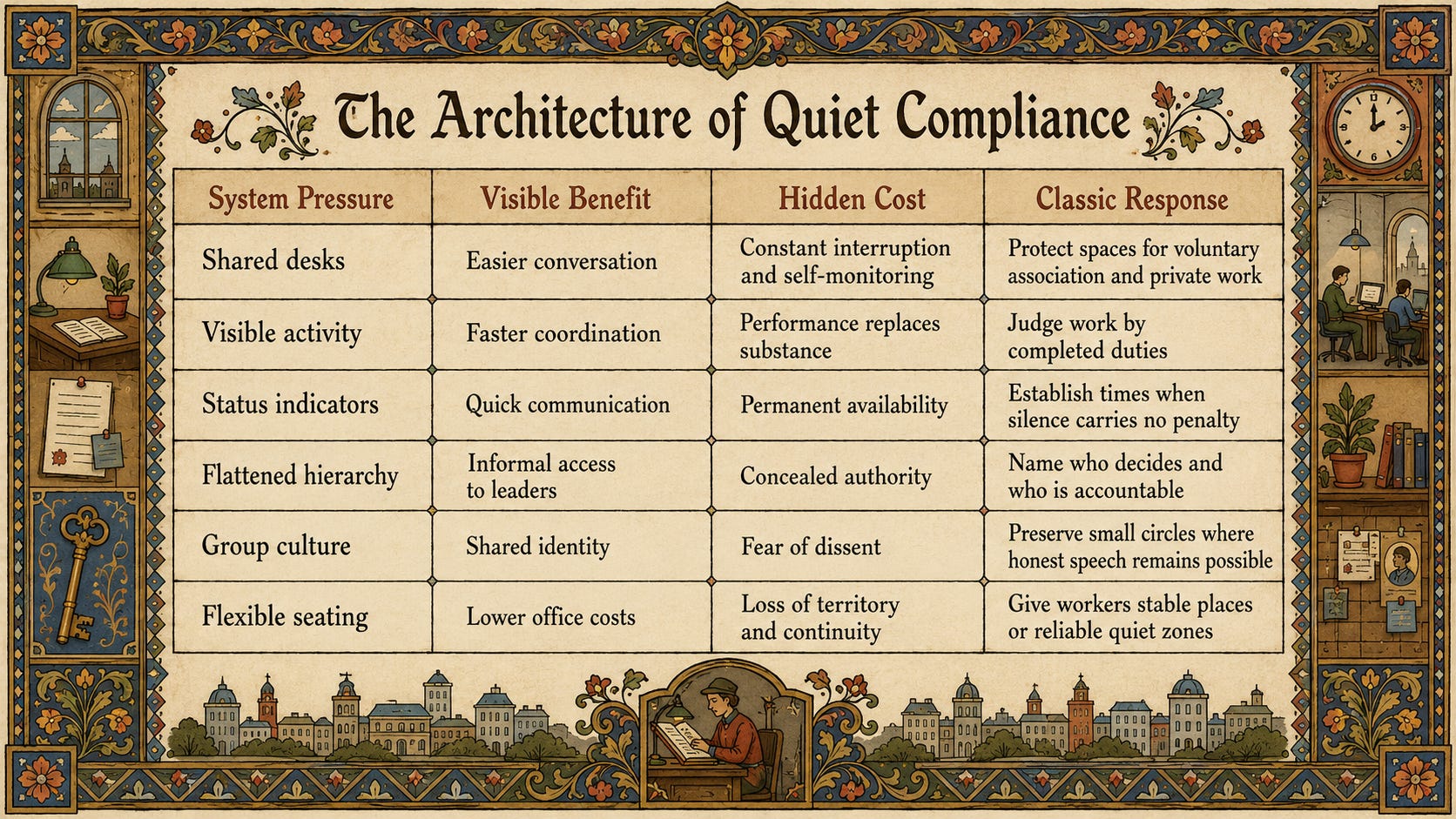
When employees cannot control their surroundings, they spend energy managing appearances. They choose visible tasks over important ones. They respond before thinking. They remain near the group because withdrawal looks suspicious. The office becomes crowded with motion and starved of completed thought.
Tocqueville believed that freedom depended on intermediate bodies: families, churches, local associations, clubs, and civic groups where people could act together without waiting for central permission.
The workplace needs similar buffers.
Small teams should be able to set their own rhythms. Individuals should have places where concentration is protected. Managers should judge output rather than theatrical busyness. Colleagues should be able to speak honestly without converting every disagreement into a cultural offense.
The worker needs a small province of responsibility. Without it, initiative dries like ink left uncapped.
Rules for Recovering a Private Mind
Reserve two periods each workday for uninterrupted labor. Close workplace chat, silence notifications, and mark the calendar as focused work rather than vaguely unavailable.
Ask your manager which outputs matter most each week. Write them down. Use completed work as the basis for discussion instead of response speed or visible activity.
Move difficult work away from the busiest part of the office when policy allows. Use a quiet room, library space, unused conference room, or remote-work day.
Stop answering nonurgent messages immediately. Establish a reasonable response rhythm and keep it consistent. A five-minute delay is not a rebellion.
Wear headphones only during declared concentration periods. Remove them when collaboration is actually required. The goal is chosen attention, not permanent withdrawal.
Schedule sensitive conversations in private rooms. Do not discuss health, salary, conflict, discipline, or family trouble in a space designed for accidental listening.
Build a small circle of trusted colleagues who can speak plainly about workload, policy, and morale without turning every concern into gossip.
Ask for clear decision rights. When a project stalls, identify who owns the final judgment. Hidden authority breeds endless meetings.
Keep a weekly record of finished work, unresolved obstacles, and decisions needed from management. This protects substance from disappearing beneath visible commotion.
Leave the office at the agreed time unless a genuine emergency requires more. Repeated unnecessary lateness trains the room to treat poor planning as devotion.
The Vanity of Withdrawal
The cure can become its own performance.
A worker may begin treating privacy as a mark of superiority. He refuses ordinary conversation, mocks colleagues who enjoy the shared room, and turns concentration into a private religion. He becomes known as serious mainly because he looks irritated.
This is another form of social theater.
Tocqueville valued association. He did not praise isolation. Freedom grows through people acting together, speaking honestly, and accepting responsibility for common goods. The answer to the open office is not the sealed chamber where no colleague may enter.
The aim is proportion.
Conversation should occur by choice and for a purpose. Privacy should support good work. Authority should be visible enough to answer for its decisions. Equality should respect differences in task, temperament, and responsibility.
The worker who regains control of attention also regains a portion of character. He becomes less governed by glances, pings, and ambient pressure. He can finish what he begins. He can disagree without staging a revolt. He can cooperate without dissolving into the room.
Repeated habits create a type of person. Constant exposure produces caution, imitation, and nervous motion. Chosen boundaries produce steadiness.
The office need not become a monastery. It merely needs doors somewhere.
Its also a intentional design matter. it turns out that America's diversified, wide and dense associational life were deeply integrated with its economic, governmental, and cultural management functions of the old system.
A key enabler of this was their roles in capital allocation. The modern academe tells us they were terrible at that role, it turns out theres indisputable evidence that simply cannot be true, they were a very significant share of the investment decision making in decision making related to things ranging from infrastructure to science R&D to culture funding; America was very good at all those things It also turns out these were structurally generated the whole, time, with a group of groups known as the Jacksonians updating their generating structures for modernity and locking them in for hundreds of years. Americans were told at that time that world had become too advanced, and that they were just dying a natural death; Americans pointed out that the structures they were tols they inevitable had to replace America' structures with were also quite old, in fact their actual financial mechanics could somewhat fairly argued to have direct lineage to Bronze Age Ziggurats (really actually, its interesting how they described them) and that all institutional linages and the broader systems that they are contained within (but different lineages require compatible systems which can differ) are all updated over time in practical functionings to fit condition changes