

May the boy who stole the sky
teach the hand to honor wax.
May wonder rise with wisdom near,
and may every wing remember
the sun is older than flight.
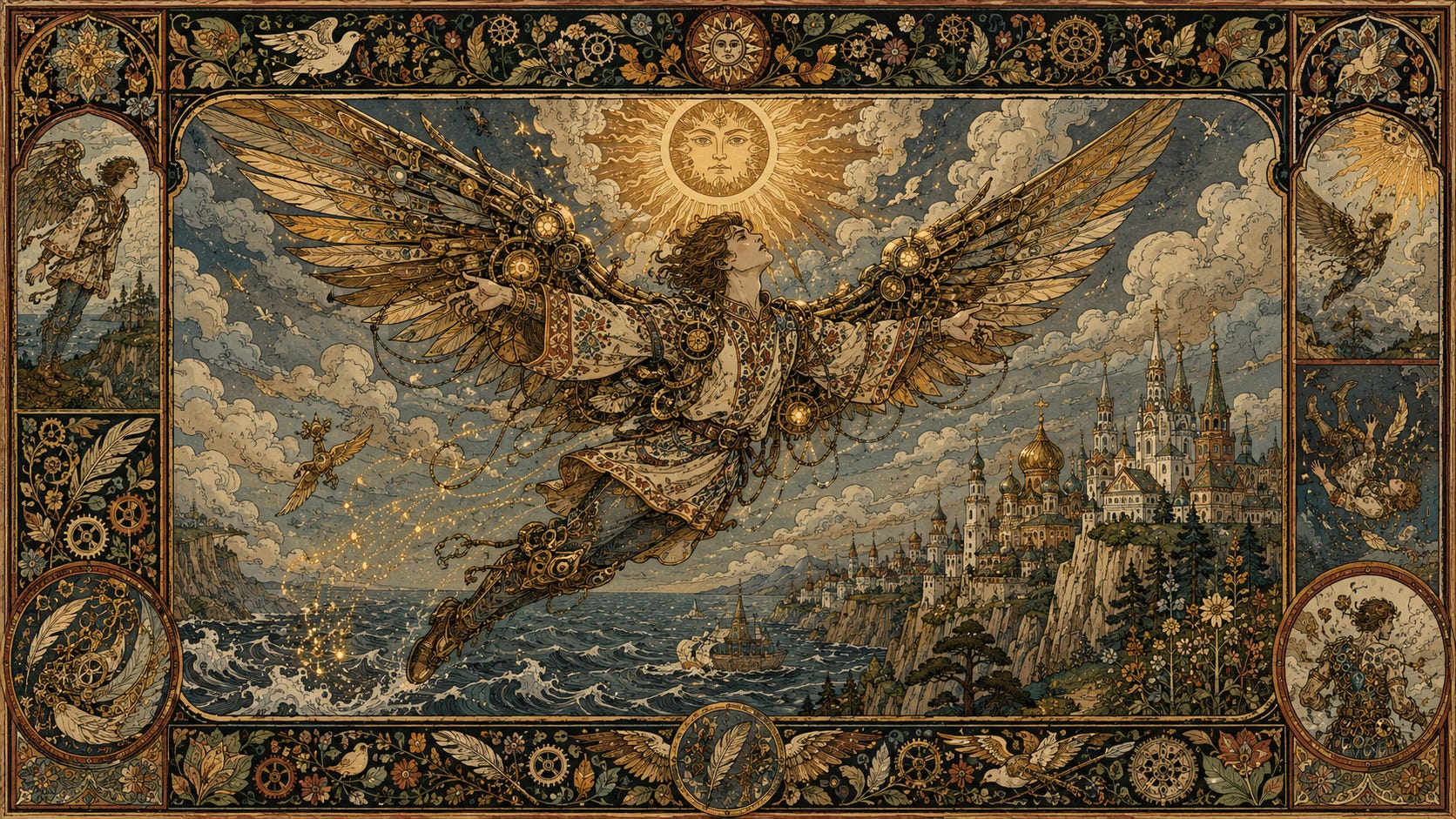
There is a kind of height that makes a man forget the ground.
At first, it feels like rescue. The tower drops beneath him. The old walls lose their authority. The sea becomes silver. The air, once empty, becomes a road. Then the warmth gathers on his face, the wax softens, and one bright feather slips away.
That is the old warning. The wing works. That is why the sun matters.
The story of Icarus is usually flattened into a schoolroom lesson about pride. A boy flies too close to the sun, his wings melt, and he falls into the sea. Pride goes up. Pride comes down. It is tidy, portable, and almost useless, like a moral carved into a paperweight.
The older story is stranger and better.
Daedalus, the master craftsman, is trapped with his son in a tower on Crete. He has already built the Labyrinth for King Minos, a maze designed to hide the Minotaur, the shame at the heart of the kingdom. That detail matters because Daedalus is no innocent tinkerer polishing little gadgets under a vine-covered window. He is a genius whose craft has already served power. He has made a wonder that became a prison.
Then the prison takes him too.
The ordinary exits belong to Minos. The roads, the ships, the soldiers, the island’s visible paths, all are closed. Daedalus studies the birds and gathers what he can: feathers, wax, time. From scraps, he makes a way out through the sky. The wings are neither cheap magic nor ordinary tools. They are craft at the edge of wonder. They give human beings a borrowed power.
That is why the myth speaks so cleanly to artificial intelligence.
AI is a working wing. It writes, sketches, explains, imitates, translates, summarizes, predicts, and persuades. It can give a small business the reach of a department. It can help a student through a difficult lesson at midnight. It can help a writer find the weak joint in a paragraph. It can help a programmer catch the gremlin hiding in the code, that tiny beast with spectacles and a pension plan.
For ordinary people, the old tower has begun to look less final.
A person without a staff can produce more. A teenager with curiosity can study with a tutor that never grows tired. A father can build a side business after the children go to sleep. A local artist can test ideas without begging for access to expensive tools guarded by a committee of people who speak fluent beige.
There is real greatness in this.
The danger begins when the miracle is mistaken for permission.
Daedalus warns Icarus to fly the middle path. Too low, and the sea will soak the feathers. Too high, and the sun will melt the wax. The lesson is often treated as moderation, but that word has grown pale from overuse. The deeper point is that borrowed powers have terms attached. Wax has a nature. Feathers have a nature. The sun has a nature. No thrill cancels those facts.
AI has a nature too.
It can produce language without understanding. It can create polish without judgment. It can offer companionship without obligation. It can answer quickly while quietly training the user to hate the slower motions of thought. The first experience feels generous. A hard task shrinks. The blank page becomes less hostile. The user rises.
Then he begins to climb.
A student asks AI to explain a book, then stops reading books with patience. A worker lets it answer every email, then finds his own voice clumsy and slow. A lonely man talks to an artificial companion that never withholds affection, then begins to see real people as defective machines. A citizen asks for summaries of the news, then knows many conclusions and almost no causes.
The wing holds long enough to change his appetite.
This is the real mechanism. AI does more than save time. It trains desire. Fast answers make slow learning feel broken. Instant images make patient craft feel archaic. Automated affection makes human friendship feel inefficient, as if the soul were a customer service department with poor response times.
The system rewards speed, volume, and frictionless output. It punishes hesitation, apprenticeship, silence, and the awkward human effort required to build taste. A person can become more productive while becoming less formed. That is the trick. The tower is escaped, but the sky becomes its own maze.
Daedalus understood the tool because he built it. His warning came from knowledge, not fear. He did not hate flight. He knew the wing’s materials. He knew what would happen if delight outran discipline.
That is the posture our age needs.
The sensible response to AI is neither panic nor worship. Smashing the wings would be cowardice dressed as wisdom. Flying into the sun would be stupidity wearing a brass helmet. The better path is harder because it requires judgment. Learn the tool. Use it. Then ask what human faculty must remain under your own command.
A writer can use AI to test structure, sharpen a sentence, or expose a weak transition. He should still supply the convictions. A student can use it to clarify a concept. He should still wrestle with the original problem. A business owner can use it to draft copy. He should still protect trust, taste, and the living voice of the enterprise. Otherwise, every message begins to sound like it was extruded from a conference hotel printer at 2:17 in the morning.
The middle path is not a ban. It is a discipline.
Before using AI, name the human skill at stake. If the task is writing, protect judgment. If the task is study, protect understanding. If the task is friendship, protect presence. If the task is art, protect taste. The tool should carry dead weight, not training weight. Dead weight exhausts the body. Training weight strengthens it. Confusing the two is how people become smooth, capable, and strangely hollow, like a marble statue commissioned by a committee that feared cheekbones.
Human beings need resistance.
A child learns balance by wobbling. A craftsman learns by ruining material. A speaker learns by hearing his own weak sentence collapse in public, which is unpleasant but medicinal. A thinker learns by sitting with confusion long enough for the fog to reveal its furniture. Remove every difficult edge and the person loses shape.
This is why the myth’s father-son structure matters. Icarus does not fall in solitude. He falls after rising beyond the reach of his father’s voice. Instruction becomes faint. The rush of air replaces counsel. The same thing can happen to a culture under acceleration. Parents seem slow. Teachers seem obsolete. Tradition seems like a heap of old warnings left by people who never saw the sky.
Yet many old warnings were written by people who had already buried someone.
The task, then, is to keep wonder within hearing distance of wisdom.
Families should teach children to use AI without letting it steal the work that makes them stronger. Workers should learn the wings before the sky belongs entirely to men with fewer scruples and better slide decks. Creators should use the tool to clear brush, then build something with a pulse. Citizens should remember that a fast summary is no substitute for knowing where an argument came from and who profits when it spreads.
The machine can imitate style. It cannot inherit conscience.
That remains the human treasure.
Icarus falls because he forgets relationship. He forgets his father. He forgets the materials. He forgets the sun. He forgets the sea. His ascent becomes private intoxication, cut loose from the limits that made flight possible.
Our danger is similar. AI can make each person feel sovereign, surrounded by instant answers, instant images, instant praise, instant companionship, and instant production. Yet a life built entirely from instant things becomes thin. Some goods require ripening. Trust requires time. Skill requires repetition. Love requires presence. Wonder requires attention. No machine can hurry these without changing what they are.
The answer to Icarus is disciplined flight.
Use the wings to escape the tower. Use AI to learn, build, repair, draft, test, and discover. Let it carry burdens that bend the back. Guard the labors that strengthen the soul. Keep one sentence written by hand. Keep one hard book unsummarized. Keep one conversation unautomated. Keep one hour of attention whole.
The old sea still shines beneath us. The old sun still burns above us. Between them, the wing rustles.
The tower is behind us. The sky is open. The wax is real.
I really appreciate your take on AI.