

Here lies the self that tried to fit the slipper.
It trimmed its truth for strangers, polished its loneliness into charm, and mistook being chosen for being known.
May it rest beneath the ruins of the digital ballroom.
May it rise again with its whole foot, its whole face, its whole soul.
And may it never bleed for a glass shoe again.
In older versions of Cinderella, the stepsisters do something grotesque. One cuts off her toes. Another cuts off part of her heel. They are trying to force themselves into the glass slipper because the slipper has become the measure of worth. The shoe does not ask who they are. It asks whether they fit.
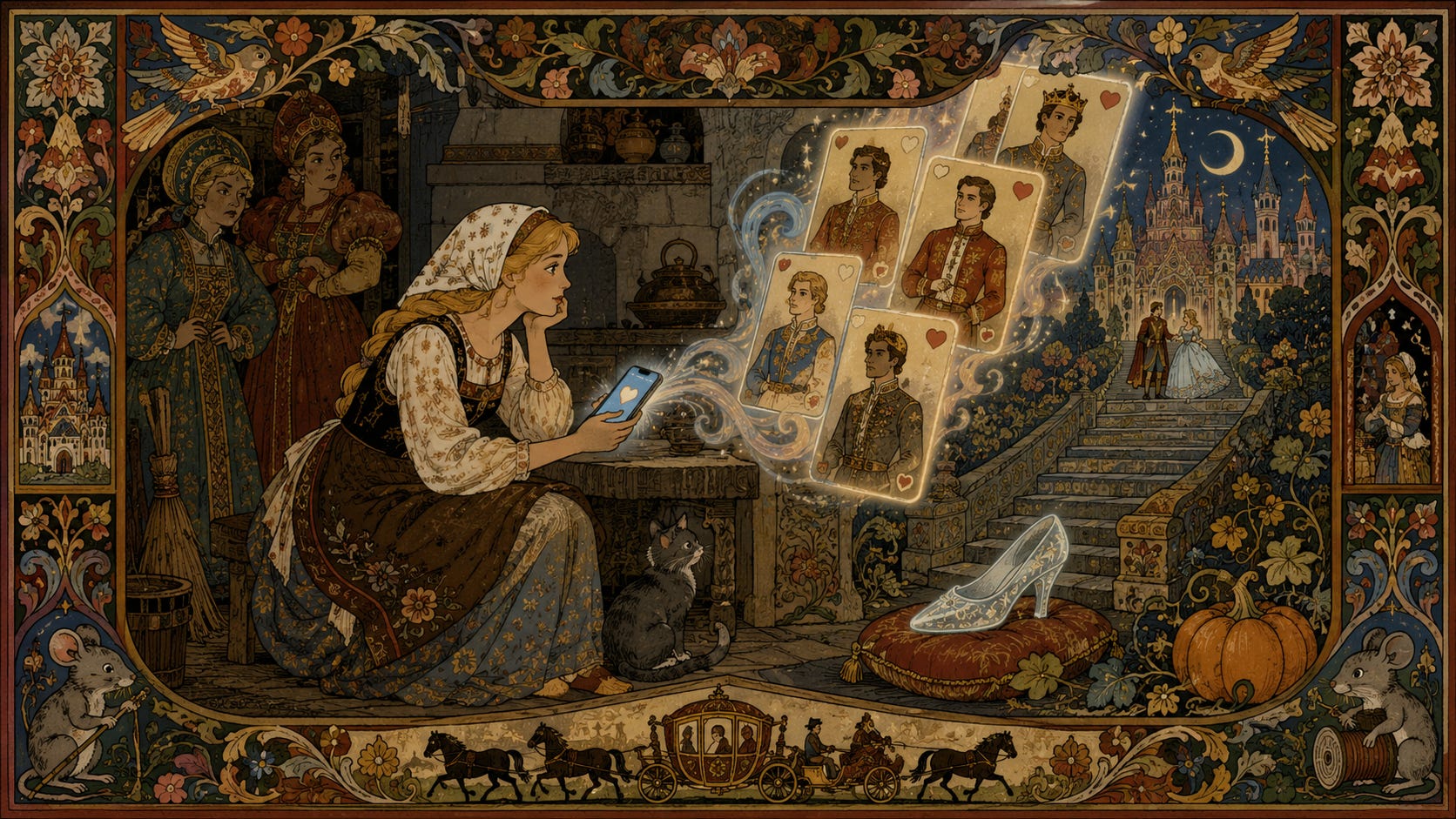
That is the dating app problem in miniature.
The app creates a visible standard, then invites everyone to contort themselves toward it. Women learn which photos get attention. Men learn which status signals matter. Everyone learns the tiny grammar of desirability: angle, lighting, height, income, humor, politics, hobbies, body type, job title, travel pictures, and the all-important illusion that one has a rich social life without ever appearing needy enough to say so. Romance becomes a compliance test administered by strangers in soft lighting.
The stepsisters are not merely vain. They are desperate. That makes them more modern than Cinderella herself.
A dating app user does not need a cruel stepmother to whisper poison in the ear. The interface does the whispering. It says: someone better is nearby. It says: you are being compared. It says: the next profile may be richer, prettier, calmer, taller, thinner, funnier, less complicated, more photogenic, more available, more mysterious, more edited by God’s least supervised intern.
Research on dating apps supports that anxiety. Pew Research Center found that roughly nine-in-ten recent online daters reported feeling at least sometimes disappointed by the people they saw on dating platforms, while about eight-in-ten reported feeling at least sometimes excited. The machine produces hope and discouragement together, like a candy dispenser filled with gravel.
Pew also found that many users encounter unwanted behavior on dating platforms, especially younger women. A majority of women under 50 who have used dating sites or apps say they have received unwanted sexually explicit messages or images. About four-in-ten say someone continued contacting them after they said they were not interested. This matters because comparison does not remain clean and mathematical. It gets rude. It gets sexual. It gets threatening. The ballroom has bouncers, but half of them are asleep under the dessert table.
The deeper issue is comparison overload. A study published in Computers in Human Behavior found that high partner availability on dating apps increased fear of being single, lowered state self-esteem, and increased partner choice overload. In plain English: when people see too many possible partners, they may feel less secure, less settled, and less able to choose.
That finding matters because the stepsister story is about the psychological violence of too much comparison. The kingdom has decided that one woman fits the slipper. Every other woman must now measure herself against the missing ideal. A person who once had a face, a history, a household, a temperament, and a soul is reduced to a single failed test.
Dating apps build that test into daily life.
The profile becomes the slipper. The algorithm becomes the herald. The kingdom becomes the user base. The stepsisters become everyone who has ever deleted a photo because it looked too honest.
This angle gives the essay moral force because it avoids the lazy claim that dating apps make people shallow. The sharper claim is that dating apps train people to become legible to shallow judgment. That is worse. A shallow person is one problem. A system that rewards millions of people for flattening themselves is a plumbing disaster in the palace.
The essay could argue that Cinderella survives because she does not mutilate herself to fit the sign. She fits the slipper because the slipper belongs to her. Her identity precedes the test. The stepsisters fail because they treat identity as something to be cut into shape after the market has spoken.
That is the Guildrim lesson: stay human by refusing to let the platform decide which parts of the self are worth keeping.
A strong ending would say that the goal is not to flee dating apps like a monk chased by confetti. They can introduce people. They can widen the pool. Pew found that among Americans who have used dating sites or apps, slightly more describe their experience as positive than negative, 53 percent versus 46 percent. The tool has real value.
The danger begins when the app becomes the judge of the person.
Cinderella teaches that love requires recognition, not mere selection. The prince must eventually leave the spectacle of the ball and enter the ordinary house. That movement matters. Romance must move from display into reality, from profile into presence, from competition into knowledge.
The stepsisters teach the warning: once the slipper becomes the standard, people will bleed to fit it.
And dating apps, with all their glowing little shoes lined up in a row, have made that temptation available before breakfast.