

You are currently standing in the Plaza of Unfinished Business, that overcrowded district of Instantopolis where every shopkeeper waves a flag, every clerk rings a bell, and every pigeon carries a summons from a committee you never joined.
The trouble begins with a dot.
It is blue, or red, or orange, or some other color chosen by the Ministry of Harmless Decorations. It sits beside an app like a polite little button on a clerk’s coat. It does not roar. It does not seize your hand. It merely waits.
Then your eye sees it.
The tiny herald has done its work. You were making breakfast, reading a page, walking through a hallway, speaking with your wife, sharpening a pencil, or returning from the rare and noble Kingdom of Having One Thought. Suddenly, the dot is there. A speck of unfinished business. A crumb of command. A flea in ceremonial armor.
The machine tells you this is convenience.
The Wizard advises suspicion.
Convenience is often the velvet glove worn by the Bureau of False Urgency. It has exquisite manners, a clean desk, and a thousand stamped forms explaining why your attention now belongs to something trivial.
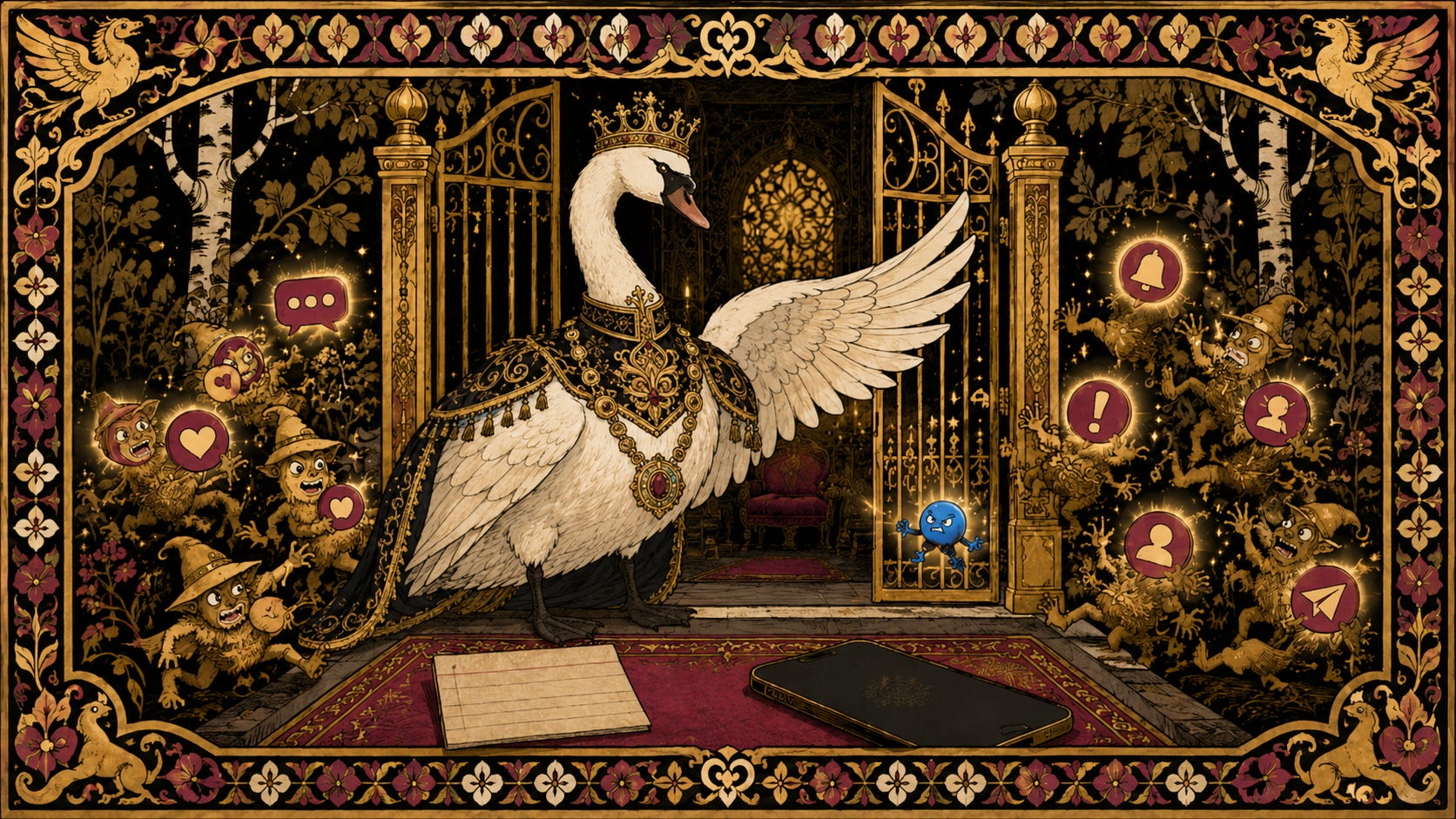
I. The Threat of the Blue Dot Heralds
The Blue Dot Heralds of Instantopolis are small on purpose.
A large monster would frighten you. A dragon would be obvious. A many-headed beast at the breakfast table would make even the most tolerant citizen reach for a broom. The dot takes a wiser path. It arrives as decoration.
Tyranny often begins as a decoration.
The blue dot does not say, “Abandon your book.” It says, “Something has changed.”
The red badge does not say, “Let the machine manage your mood.” It says, “One unread message.”
The shopping alert does not say, “Come wander the Bazaar of Things You Did Not Need Yesterday.” It says, “New.”
New is one of the oldest tricks in the goblin ledger.
The hidden law is this: what remains visible remains active. A visible summons keeps tugging at the sleeve of the mind. It does not need to be important. It needs only to remain unresolved.
An unread count is a debt painted on the wall.
The Heralds weaken human command by teaching the eye to answer before the will has spoken. They turn the phone into a tiny parliament of interruptions, each app voting on the use of your day. Messages, news, social feeds, games, weather, delivery notices, stores, newsletters, and strange little platforms you joined in a moment of optimism all raise their hands.
Then you obey.
Not dramatically. No one hears chains clank. You merely pick up the device.
A minute vanishes.
Then eight.
Then the afternoon looks around in surprise and discovers it has been sold for copper coins.
II. The Doctrine of the Closed Gate
The answer is not rage against the machine. Rage is often obedience wearing a louder hat. The answer is command.
This week, you will close the Brass Gate against the Blue Dot Heralds. You will permit messages to enter at appointed hours. You will let true urgency use true channels. You will remove decorative summons from the public streets of your day.
What To Do:
Perform the Banishment of the Blue Dot. Open your phone settings and disable badges for email, messaging apps, social media, news apps, shopping apps, games, and anything else that decorates itself with unread counts.
Conduct the Exile from the Home Screen. Move high-temptation apps into a folder on the second or third screen. Give the folder a dull name, such as “Tools” or “Office.” Never name it “Temptation Dungeon,” unless you enjoy helping goblins with branding.
Appoint two or three Reply Windows. Choose fixed times, such as 10:30 a.m., 2:30 p.m., and 6:00 p.m. These are the only times you check ordinary messages, email, notifications, and feeds.
Write your true urgent contacts on paper. Place the list near your desk. Include the people who may interrupt you for real reasons: family, employer, business partner, or client. If they need you, they should call or use the agreed channel.
Close each Reply Window with a physical act. Place the phone face down. Shut the laptop lid. Put the index card over the device. Let the gesture tell the body what the settings told the machine.
Keep one clean surface nearby. A desk, table, or writing board should remain free of the phone during focused work. Let the device sit elsewhere like a minor baron waiting outside the throne room.
What Not To Do:
Do not leave badges on “important apps.” The Heralds love exceptions. They build mansions out of them.
Do not open an app merely to clear the dot. That is the oldest trick in the Flea-Court Manual. You entered to remove the summons and stayed to tour the dungeon.
Do not replace badges with lock-screen previews. A glass door still shows the goblins waving from inside.
Do not invent fake emergencies. If no one is bleeding, fleeing, stranded, locked out, being audited, or calling twice in a row, the matter can probably wait until the next Reply Window.
Do not treat every unread count as a moral debt. Messages are requests for attention. They are not royal decrees carried by trumpet.
Do not turn this into theater. No speeches. No public declaration. No ceremonial disgust posted to the very feed you claim to have escaped. The goblins do not need your press release.
This procedure works because it restores sequence. First comes intention. Then comes action. The machine may still serve as messenger, archive, workshop, and tool, but it no longer posts little flags across the inside of your skull. A man who checks messages by appointment is harder to herd than a man who answers every glowing crumb.
III. The Index Card at the Brass Gate
The required artifact is an index card.
Not an app. Not a dashboard. Not a productivity shrine with seven tabs and a subscription model wearing a monocle. A card.
At the top, write: The Gate Is Closed.
Below that, write your Reply Windows.
10:30 a.m.
2:30 p.m.
6:00 p.m.
Under those, write: If it is real, they will call.
Place the card beside your phone whenever you work, read, cook, pray, write, study, plan, or speak with another human being. The card is plain, which is part of its majesty. It has no light. It cannot buzz. It cannot flatter you with a graph. It does not ask to improve your workflow, sell your behavior, or become a small empire with rounded corners.
It simply reminds you who holds the key.
A good artifact makes the invisible visible. The index card gives shape to a boundary that would otherwise dissolve into intention, and intention is famous for leaving town when the first notification arrives. The card is friction in its most civilized form. It slows the hand. It interrupts the interruption. It puts a gatekeeper between impulse and obedience.
Paper has a stubborn virtue.
It does not update itself.
IV. The Shadow of the Perfect Monk
Beware the Shadow of Purity, that pale fellow who arrives wearing homespun robes and carrying seventeen opinions about fountain pens.
He will whisper that you must abandon all devices. He will tell you that every notification is corruption, every phone a cursed mirror, every practical concession a fall from the Golden Tower of Offline Nobility. He may even suggest purchasing a more beautiful notebook to prove your seriousness. The notebook will cost forty-seven dollars and make you unbearable at dinner.
Do not follow him.
The goal is mastery. Costume drama is easier.
A man may use email without becoming a clerk of the Machine-State. A woman may use maps without surrendering her sense of direction to the Cartographic Goblin. A writer may use a laptop and remain a writer. A merchant may answer clients. A mother may keep her phone available. A contractor may monitor what must be monitored. The issue is command.
The machine must be placed into office.
It may carry letters. It may hold documents. It may summon a ride, store a recipe, send a contract, keep a calendar, or help coordinate the practical affairs of life. These are respectable duties. Let the machine wear a little cap and sit at the reception desk.
It must never become the ruler of the inner chamber.
False purity can become another form of surrender, because it lets the machine define the whole argument. The device becomes either idol or demon. Both positions grant it too much majesty.
Give it less.
Make it useful. Make it quiet. Make it wait.
Tonight, remove the badges from five apps before you go to bed. Write your Reply Windows on an index card. Place the card beside the phone like a small white shield.
Tomorrow, when the Heralds come scratching at the Brass Gate, do not negotiate with the dots.
Let the gate stay closed.