

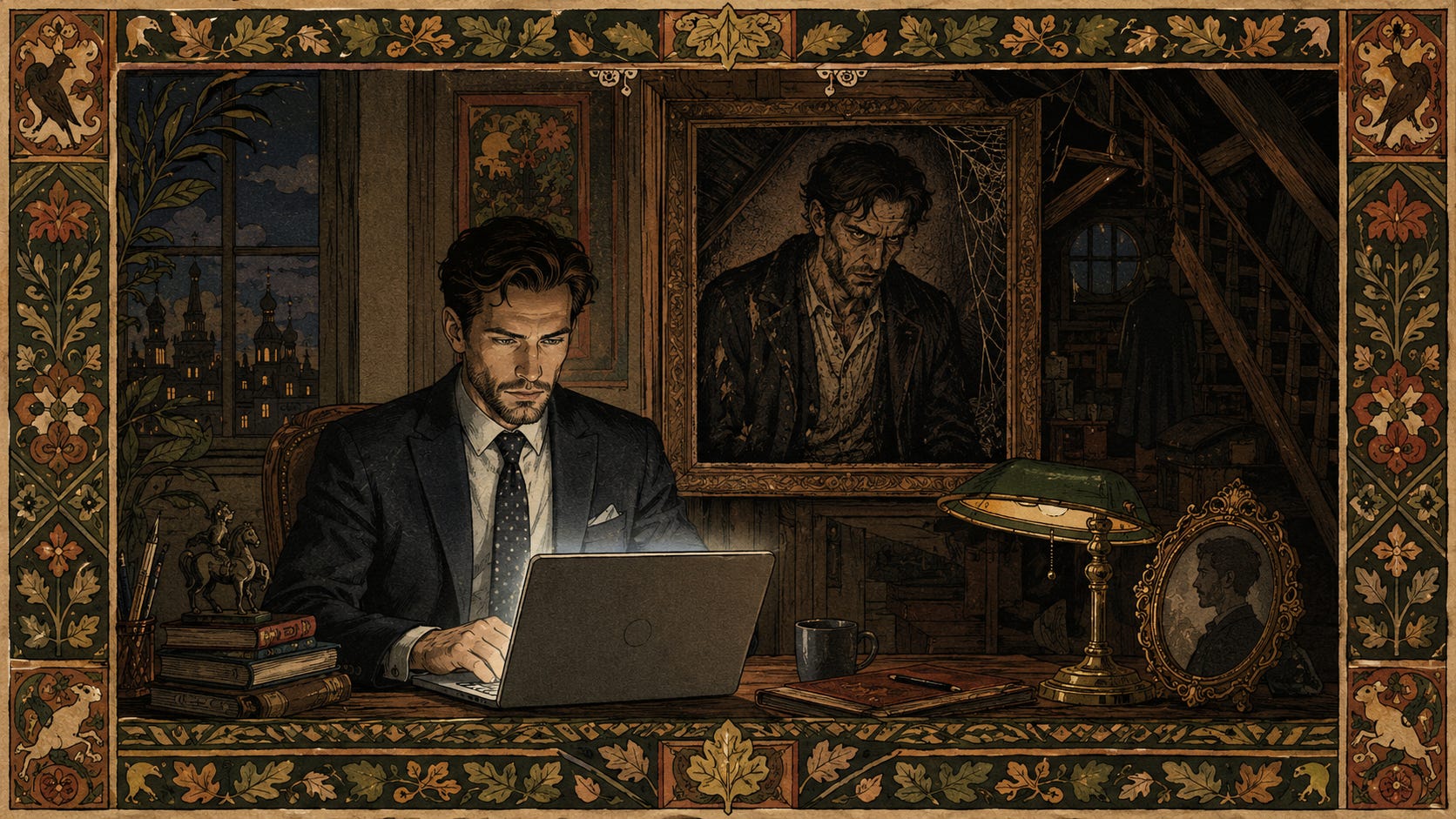
Here lies the man who polished his image
until the image outlived him.
His face remained composed.
His profile remained grateful.
His portrait told the truth.
He called ambition discipline,
fear humility,
and exhaustion growth.
The world saw a professional.
The attic kept the man.
May God have mercy
on every soul that learned
to speak in captions
before it learned to confess.
A man once had a face, a name, a trade, a family, a reputation, and a handful of people who knew whether he was brave, lazy, generous, cruel, or merely hungry before lunch.
Now he has a profile.
The profile smiles while he sleeps. It remains composed during layoffs. It speaks in verbs no living person would use over dinner. It announces lessons learned from humiliations that were, at the time, mostly panic and coffee. It is confident. It is polished. It is employable.
Somewhere behind it, the real man becomes less articulate.
This is the modern problem Oscar Wilde diagnosed long before the professional class began embalming itself in résumé language. The Picture of Dorian Gray is usually read as a story about beauty, decadence, and moral corruption. It is also a perfect story about public branding.
Dorian stays radiant while his portrait absorbs the damage. The visible self remains untouched. The hidden self rots.
That is LinkedIn with a velvet jacket and better prose.
Dorian Gray Discovers the Outsourced Soul
Dorian’s tragedy begins with a wish. He sees his painted image and understands, with horror, that the image will remain young while he declines. He wants the bargain reversed.
“How sad it is!” murmured Dorian Gray, with his eyes still fixed upon his own portrait. “How sad it is! I shall grow old, and horrible, and dreadful. But this picture will remain always young. It will never be older than this particular day of June... If it were I who was to be always young, and the picture that was to grow old!”
The modern professional makes the same bargain in smaller, socially acceptable ways.
The profile will stay pleasant. The profile will say “grateful.” The profile will describe every career wound as a growth experience, every corporate reshuffling as an opportunity, every tedious conference as a gathering of “brilliant minds.” One suspects the brilliant minds were mostly searching for the coffee table.
The visible self must remain young in spirit, positive in tone, and permanently available for opportunity. The hidden self can carry the exhaustion, envy, disappointment, anxiety, resentment, and boredom.
A man may lose his job, question his vocation, distrust his industry, and wonder whether his work has meaning. His profile says he is thrilled to share an update.
The portrait groans upstairs.
Influence Is the First Algorithm
Lord Henry corrupts Dorian through style. He gives him language before he gives him doctrine. He teaches Dorian to treat life as a performance, morality as a social costume, and the self as material to be arranged.
“There is no such thing as a good influence, Mr. Gray. All influence is immoral, immoral from the scientific point of view.”
“Why?”
“Because to influence a person is to give him one’s own soul. He does not think his natural thoughts, or burn with his natural passions.”
This is the quiet violence of professional branding. It gives a man thoughts that are not his own, then rewards him for repeating them with good lighting.
The branded self does not speak. It posts.
It does not confess ambition. It celebrates the team. It does not admit fear. It discusses resilience. It does not say, “I need money and status because I am terrified of becoming irrelevant.” It says, “I’m excited for the next chapter.”
A bad sentence can be a small prison. LinkedIn has built whole suburbs out of them.
Wilde saw that the danger of influence lies in imitation. A man begins by adopting a phrase. Then a posture. Then a morality. Then a soul.
The professional class rarely lies outright. It performs a narrow band of permitted sincerity until the permitted sincerity becomes the whole personality.
The Mask Eats the Face
Dorian’s outward beauty gives him social immunity. People cannot believe in his corruption because his appearance argues against it. His face becomes evidence, and the evidence lies.
“Even those who had heard the most evil things against him, and from time to time strange rumours about his mode of life crept through London and became the chatter of the clubs, could not believe anything to his dishonour when they saw him.”
This is the central power of the curated public self. It trains others to trust the surface.
The smiling headshot, the polished bio, the careful affiliations, the photos from panels, the soft moral language, the ritual gratitude. These things do not prove character. They prove competence at display.
Display has its place. A man should dress properly, write clearly, and avoid looking like he was assembled by raccoons in a server closet. The problem begins when display becomes substitution.
A reputation built through conduct is one thing. A persona maintained through constant announcement is another. The first grows slowly through obligation. The second can be edited before breakfast.
Dorian’s society sees the beautiful young man and excuses him. Our society sees the public-facing professional and assumes health, competence, and moral seriousness. The portrait, being less photogenic, receives fewer invitations.
The Hidden Portrait Always Keeps Records
The genius of Wilde’s symbol is that the portrait does not forget. Every indulgence, betrayal, vanity, and cruelty appears somewhere. Dorian can hide it, lock it away, and avoid looking at it, but he cannot persuade it.
“The quivering, ardent sunlight showed him the lines of cruelty round the mouth as clearly as if he had been looking into a mirror after he had done some dreadful thing.”
The human soul has this same inconvenient bookkeeping system. It is not impressed by public language.
A man can call cowardice “prudence” in public, but the inner portrait records cowardice. He can call vanity “personal branding,” but the portrait has an older vocabulary. He can call servility “being a team player,” and the portrait scratches another mark near the mouth.
The inner life is wonderfully rude in this way. It refuses the press release.
This is why the LinkedIn persona becomes spiritually dangerous. It does not merely hide weakness from others. It teaches the person to hide weakness from himself. The lie becomes easier because it is formatted properly.
Soon the man no longer knows whether he is grateful or merely afraid to sound bitter. He no longer knows whether he respects his leaders or wants to be promoted by them. He no longer knows whether he believes his own announcements.
The portrait knows.
The Cure Is to Reunite the Face and the Soul
Wilde does not offer a cheap moral lesson. Dorian’s attempt to destroy the portrait destroys him because the hidden self and visible self were never truly separate. The bargain was fraudulent from the start.
“It was his beauty that had ruined him, his beauty and the youth that he had prayed for. But for those two things, his life might have been free from stain. His beauty had been to him but a mask.”
The modern version is clear. The public self must be brought back under the discipline of the real self.
That does not mean professional self-sabotage. Nobody needs to post, “I am spiritually tired and suspect my industry is a ceremonial hamster wheel.” One may think it. One should perhaps not pin it.
The cure is simpler and harder. Speak like a human being. Let some achievements remain quiet. Refuse fake gratitude. Stop turning every defeat into a motivational pamphlet. Build a reputation among people who can observe your conduct without needing a caption.
The old world understood reputation as a social memory. The new world treats it as a dashboard. The dashboard is useful, but it cannot absolve you. It cannot love you. It cannot tell you when your face has begun to harden.
Dorian Gray warns us that the image we maintain may become the instrument of our corruption. The portrait in the attic is patient. It waits through every announcement, every polished update, every smiling lie.
Sooner or later, a man must go upstairs and look.
A brilliant and unique analysis of Dorian Gray for the modern world!
A most enlightening, edifying and entertaining essay—thank you. Continued success in your good musings on the platform.