

Here lies the old mercy of falsehood:
that a lie once left a mark,
that the crooked thing bent the body,
that the tongue betrayed the soul,
and that even a wooden boy
could be saved by the shame
of seeing his own nose grow.
Pinocchio survives because the world in Carlo Collodi’s tale still has moral architecture. It is stern, strange, and occasionally ridiculous, as all proper moral architecture should be. A puppet wants to become a real boy. He runs from school, sells his primer, follows frauds, ignores the cricket, chases pleasure, lies to the Fairy, and discovers that his body tells the truth even when his mouth refuses. His nose lengthens. The lie takes form.
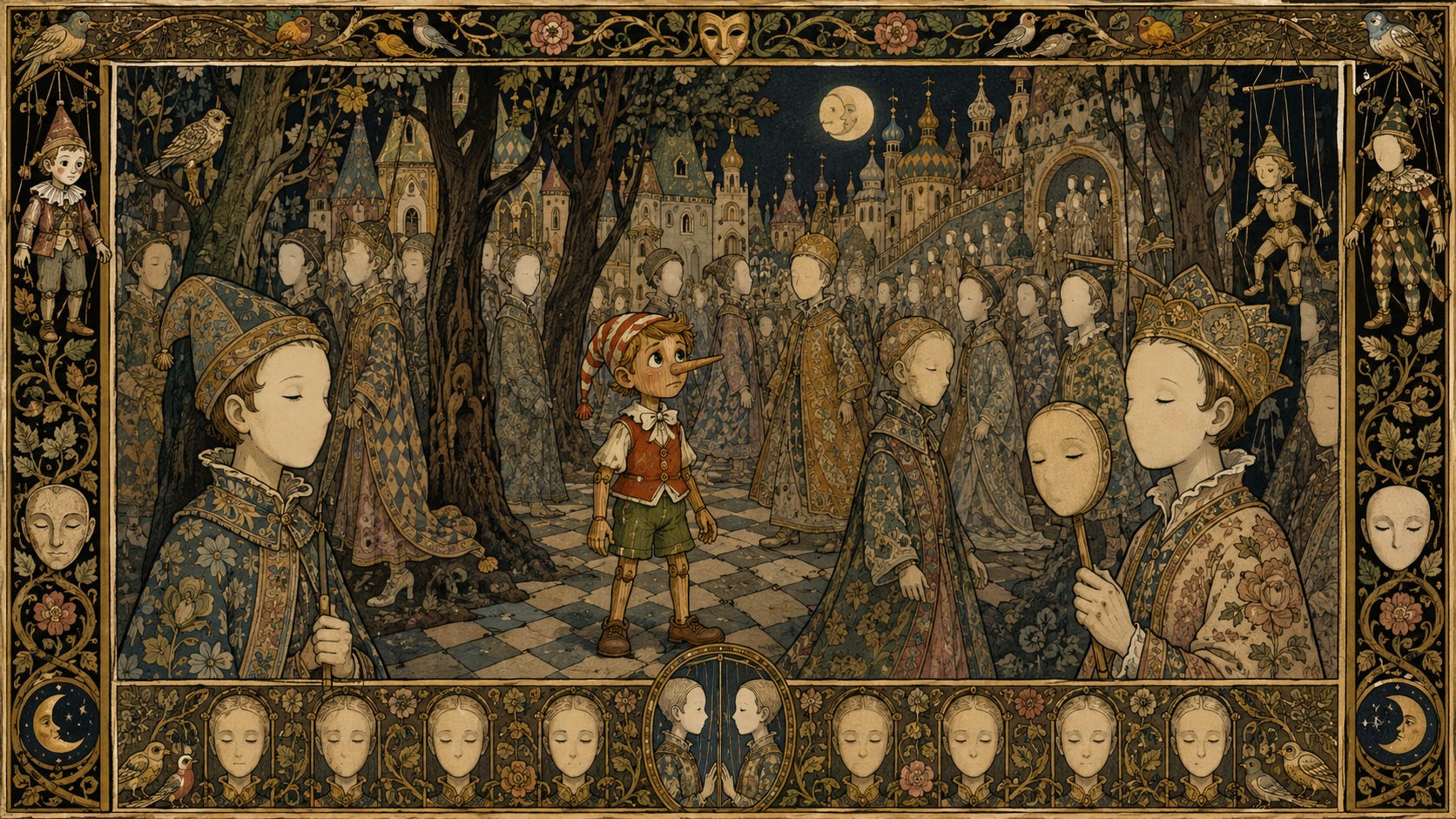
That detail is the hinge of the story. The nose gives falsehood a physical consequence. It does something cruel and merciful at once. It humiliates Pinocchio, yet it also saves him from the deeper disaster of successful deception. He cannot fully disappear into his lie because the lie appears on his face. In a world like that, truth has allies. Wood, skin, shame, and sight all conspire against fraud. Reality has teeth, and it uses them.
Deepfakes reverse the curse. They do not make the liar’s nose grow. They give the lie a better face.
A deepfake is Pinocchio’s dream after the wrong magician gets involved. It offers speech without presence, image without event, expression without soul. The machine studies the signs by which we recognize a person: the movement of the mouth, the tilt of the head, the grain of the voice, the pace of a pause. Then it rebuilds those signs apart from the person. The face remains. The witness vanishes.
That separation matters because human beings are creatures of recognition. We trust faces before arguments. We hear a familiar voice and lower the bridge before checking who is in the cart. A scam email may look suspicious; a phone call from what sounds like a son, a mother, or a boss arrives through a much older door. The Federal Trade Commission has warned that voice cloning makes requests for money or information more believable, which is a dry way of saying that the machine has learned where the family keeps its panic.
This is the mechanism deepfakes exploit. They lower the cost of impersonation while raising the emotional force of the impersonation. Older fraud required presence, craft, or risk. A man pretending to be another man had to stand somewhere, sweat under a collar, and hope no one noticed the shoes. A forged letter needed skill. A fake recording required equipment and patience. Synthetic media changes the arithmetic. The fraudster can borrow a voice, animate a face, and reach the target through the ordinary channels of modern life, where everyone is already tired and half the day arrives as an alert.
The target bears the punishment. In Pinocchio, the liar is marked. In the deepfake age, the victim is marked by someone else’s lie. A person can be made to appear guilty, obscene, foolish, cruel, or treasonous without ever doing the act. Afterward comes the second ordeal: denial. The victim must explain that the face was his but the act was not; the voice was hers but the words were not. This sounds evasive even when true. The accusation gets the trumpet. The correction gets the kazoo.
Law enforcement has already had to treat this as a serious criminal problem. Europol’s report on deepfakes and law enforcement describes risks ranging from CEO fraud and extortion to evidence manipulation and social engineering. This is where the fairy tale becomes less quaint. The Fox and the Cat no longer need to meet Pinocchio on the road. They can schedule a video call, wear the boss’s face, speak in his cadence, and ask for the transfer before lunch. Modern fraud has discovered office hours.
The deeper danger is stranger. Deepfakes do not merely make lies easier to believe. They make truth easier to deny. Once the public knows that audio and video can be fabricated, a guilty man gains a new spell: “That was AI.” The old evidence still exists, but its authority weakens. This is the liar’s dividend, the reward gained by liars when forgery becomes common enough that real evidence can be waved away as fake.
Pinocchio’s nose made private corruption public. Deepfakes make public evidence private again, locked behind doubt, expertise, delay, and factional convenience. The viewer must ask who posted the clip, where it first appeared, whether the account is real, whether the audio has artifacts, whether the lighting makes sense, whether some expert has weighed in, whether the expert can be trusted, whether the expert’s critics can be trusted, and whether everyone involved is engaged in some dreary palace intrigue with a ring light. By then the emotion has already done its work.
This is why the old story cuts deeper than a technical briefing. Pinocchio is about the education of appetite under truth. He wants the benefits of being real before accepting the duties of reality. He wants freedom without obedience, pleasure without cost, speech without consequence. His body becomes the classroom. Every punishment teaches him that personhood requires submission to the grain of the world.
Deepfake culture offers the opposite lesson. It invites men to escape the grain. It tells the liar he may speak through another’s mouth. It tells the coward he may accuse without appearing. It tells the mob it may enjoy the scandal first and evaluate the evidence later, which is like letting donkeys run the schoolhouse because they seem spirited.
The practical caution is plain. Trust must move from surfaces to procedures. A face on a screen cannot carry the authority it once carried. A familiar voice asking for money should trigger verification, not obedience. Families need callback habits. Companies need transfer protocols. Journalists need source discipline. Courts need evidentiary care. Ordinary people need the small, unfashionable virtue of waiting before sharing the clip that makes their enemies look monstrous.
None of this restores the old world. The nose will not grow back on command. Detection tools will help, laws will matter, and platform rules can reduce some damage, but a technical fix cannot replace a moral habit. Pinocchio becomes real because he learns that truth is a discipline before it is a slogan. He stops treating the world as a stage for his impulses. He becomes a son.
That is the warning deepfakes place before us. A civilization that trusts every face will be fooled. A civilization that trusts no face will become miserable and stupid in a more sophisticated outfit. The answer lies in recovering the older instinct that appearance must answer to reality.
Somewhere in the blue light, a puppet speaks with a borrowed mouth. His face is smooth. His voice is perfect. The crowd leans closer. On the table beside him, unseen and useless, lies the long wooden nose that would have saved us.