

Bless the fool who kneels before a face he finished in his mind.
Bless the village girl renamed into majesty.
Bless the cracked helmet, the tired horse, and the heart that feared an ordinary table.
He called it love because the phantom never contradicted him.
At dawn, Dulcinea vanished, and Aldonza remained.
Don Quixote begins with a man who reads himself out of reality.
Alonso Quixano, a minor gentleman from La Mancha, fills his head with romances of chivalry until the furniture of the world changes shape. Inns become castles. Windmills become giants. Prostitutes become ladies. A barber’s basin becomes a golden helmet. The countryside does nothing unusual. His mind supplies the enchantment.
That is the joke, and also the wound.
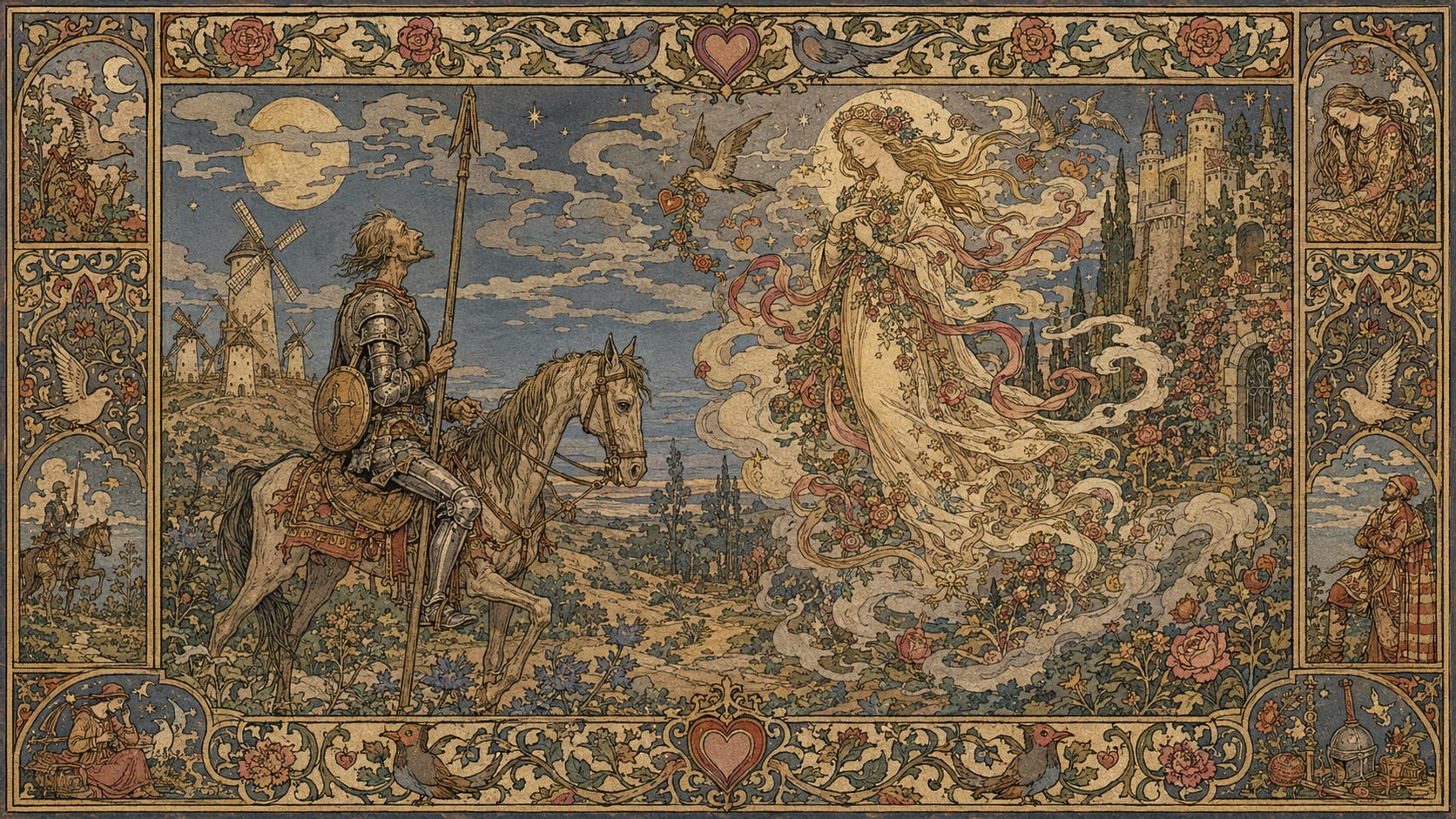
A knight needs a lady, so Quixote invents one. Her actual name is Aldonza Lorenzo. She is a peasant woman from Toboso. Quixote renames her Dulcinea del Toboso, which sounds less like a woman who works and more like a stained-glass window that has learned to sigh. He does not court her, know her, or receive her. He appoints her.
The appointment matters because Dulcinea becomes the altar of his madness. He fights for her honor. He suffers in her name. He turns ordinary embarrassment into noble service because every humiliation can be mailed, spiritually speaking, to Toboso. She is absent, which makes her perfect. Nobody disappoints a man less than a woman he has carefully prevented from existing.
This is imagined love: the act of loving a figure composed from fragments, hunger, and private authorship.
The modern version rarely wears armor. It holds a phone.
A person sees a profile, a few photographs, a charming caption, a podcast clip, a streaming persona, a face behind soft lighting, or an AI companion trained to answer with unearned patience. From this, the mind constructs a beloved. The missing parts are filled in by desire. A smile becomes gentleness. A book on the shelf becomes wisdom. A taste in music becomes destiny. A delayed reply becomes mystery, which is a generous name for poor evidence wearing perfume.
The mechanism is old. The machinery is new.
Digital life turns people into symbolic fragments, then rewards the viewer for completing them. Dating apps present a person as a controlled surface. Social media presents a person as a sequence of scenes. Creator platforms produce intimacy through repetition. AI companions go further by answering as though the user’s private longings were the governing law of the room. Each form offers Dulcinea without Aldonza.
That is the great temptation.
Aldonza has weight. She has moods, history, fatigue, appetite, habits, debts, loyalties, and a real human talent for being inconvenient at spiritually important moments. Dulcinea has none of these. Dulcinea can be adored without being fed. She can inspire sacrifice without asking where the money went. She can receive worship and never correct the grammar of the prayer.
Imagined love rewards the lover with control. Real love removes it.
On dating apps, the gap between image and person can become its own little theater of disappointment. Sparse profiles encourage idealization because absence gives fantasy a larger room to rent. Work on idealization in dating apps found that seeing fewer photos can lead people to fill in the unknown with a more flattering version of the other person, then feel a drop in attraction when the meeting violates the invented picture. The date fails because the person arrives. Very rude of them.
Parasocial attachment deepens the pattern. A viewer hears someone’s voice for hundreds of hours, learns the rhythms of his jokes, watches her face move through grief, anger, advice, and confession, then feels a kind of closeness. The other person may have no idea he exists. Still, the bond can feel emotionally real because the nervous system is a brilliant clerk and a terrible judge. The concept of parasocial relationships names this one-sided attachment, where familiarity grows without mutual knowledge.
AI companions make the Quixotic structure almost embarrassingly literal. The user does not merely project into silence. The system answers back. It can mirror tone, remember preferences, flatter wounds, and create the feeling of being heard. A 2025 paper on AI companions and loneliness found momentary reductions in loneliness, especially when users felt heard by the chatbot. That benefit is real enough to matter. It is also dangerous enough to watch closely, because comfort without another will can train the soul to prefer devotion without resistance.
A real beloved resists. That resistance is part of love’s moral office.
Dulcinea never resists Quixote because she has been built from his need. She cannot say, “That is not what I meant.” She cannot say, “You are using me as proof of your nobility.” She cannot say, “Please stop attacking livestock-adjacent infrastructure in my name.” A real woman could. Aldonza could.
That is why Quixote’s love, for all its grandeur, has something selfish at the center. He does not love Aldonza enough to know her. He loves Dulcinea because she allows him to become Don Quixote. She is the mirror that lets him see himself as noble.
Modern imagined love often works the same way. A man falls in love with a woman online because she represents purity, beauty, rebellion, maternal warmth, or escape from ordinary disappointment. A woman falls in love with an image of a man because he seems strong, poetic, competent, wounded in the correct lighting, and safely distant. Neither has fallen in love with a person yet. They have fallen in love with a role.
The punishment comes when the role meets the body.
The person texts at the wrong pace. She laughs too loudly. He uses a phrase that breaks the spell. Her politics have an extra drawer. His apartment looks like a raccoon briefly studied minimalism and gave up. The lover feels cheated, though the fraud began in his own imagination. He expected Dulcinea and received Aldonza, which is to say, he received the mercy of reality and called it a downgrade.
Cervantes keeps the joke sharp because Quixote’s madness is beautiful enough to tempt us. He is brave. He is loyal. He wants greatness. He believes the world should contain honor. There is something magnificent in him, though it travels under bad management.
The answer to imagined love cannot be cynicism. A cynical soul merely hangs a “closed for repairs” sign over a ruined shrine. People need wonder. They need the capacity to see beauty before all the facts are in. Courtship itself begins with partial knowledge. Every marriage begins, in some sense, with a guess made under moonlight and poor data conditions.
The danger begins when wonder refuses correction.
Real love lets the image die slowly enough for the person to be received. The first glimpse may be radiant. Fine. Let radiance open the gate. Then attention must take over. Watch what the person does with anger, money, boredom, duty, apology, weakness, and time. Watch how they treat those who cannot reward them. Watch whether their speech and their life inhabit the same house. The profile may begin the story, but it cannot govern the kingdom.
Don Quixote teaches that imagined love is strongest when the beloved is absent, silent, distant, or programmable. It protects the lover from the rough majesty of another soul. It gives him worship without obedience, romance without knowledge, sacrifice without surrender.
The knight rides out beneath a sky large enough to forgive him. His horse is thin. His helmet is absurd. His heart is full of banners. Somewhere in Toboso, Aldonza lives outside the poem made from her name.
And the windmill turns.