
The Enchanted Quill and the Borrowed Voice
A spell for writers using AI drafts without losing their own cadence, judgment, or strange little habits of phrase.

Jonah had thirty-eight minutes before the newsletter had to go out.
His desk looked like a minor paper kingdom after a border war: coffee rings, three open books, a notebook with one useful sentence circled twice, and a laptop bright enough to accuse him. He had promised his readers a sharp essay on old libraries and new machines. What he had written so far sounded like a man dragging furniture across gravel.
So he opened an AI tool.
“Draft an essay in my voice,” he typed, then fed it two paragraphs from last week’s piece.
The answer arrived at once. It had structure. It had polish. It had the warmth of soup served in a plastic helmet. Worse, it sounded almost like him, the way a scarecrow almost sounds like a farmer when the wind is feeling theatrical.
Jonah felt the temptation. Send it. Clean it later. Nobody will know.
Except he would know. The page would know too.
The Tool on the Table
AI writing tools can generate outlines, paragraphs, headlines, summaries, scene sketches, character descriptions, emails, essays, scripts, and full drafts. A writer gives the tool a prompt, sometimes with samples or instructions, and the machine predicts what text should come next. It is fast because it has learned patterns from enormous bodies of writing. It knows what a pitch sounds like, what a sermon opening often does, how a fantasy scene usually bends, and where a blog post tends to place its little tray of biscuits.
Writers use these tools to get unstuck, test angles, rephrase clumsy passages, create rough outlines, and produce first drafts when the blank page has grown antlers. This can be genuinely useful. A tool that gives you ten possible openings can help you discover the eleventh, which is usually the one worth keeping.
The danger is mimicry. AI can produce a version of competence that arrives before thought has ripened. It may sound fluent while saying little. It may flatten the writer’s private cadence into public mush. When asked to write “in my voice,” it often notices the obvious signals: sentence length, favorite words, recurring themes. It misses the harder matter: conscience, taste, restraint, memory, and the odd music of a mind under pressure.
The tool can hand you a ladder. It can also hand you a costume and call it a face.
The Enchantment Beneath the Interface
The AI draft is an enchanted quill. It scratches across the page before the writer has finished breathing. Ink appears. Paragraphs gather. The room seems brighter for three dangerous seconds.
A quill that writes by itself is a marvel, but marvels have appetites. This one hungers for permission. It wants the writer to say, “Begin for me.” Then, “Continue for me.” Then, “Sound like me.” At last comes the small surrender, barely audible: “Think for me.”
That is where the mischief enters wearing clean boots.
The writer’s voice is more than style. It is memory under discipline. It is what the writer notices, what he refuses, where he pauses, what he will not cheapen. Voice is made from childhood weather, books half-remembered, arguments lost, prayers muttered, humiliations survived, and sentences revised after midnight because one word smelled false. No machine can carry that bundle. It can imitate the wrapping paper.
The enchanted quill becomes good when it is made to serve the workshop. Let it make rough lumber. Let it produce bad openings, dull transitions, title variants, or summaries of what a piece appears to be saying. Let it hold up a mirror. But the living line must pass through the writer’s hand.
A borrowed voice may get applause. A true voice can bear judgment. That is the difference between a mask and a face.
The Spell Diagram
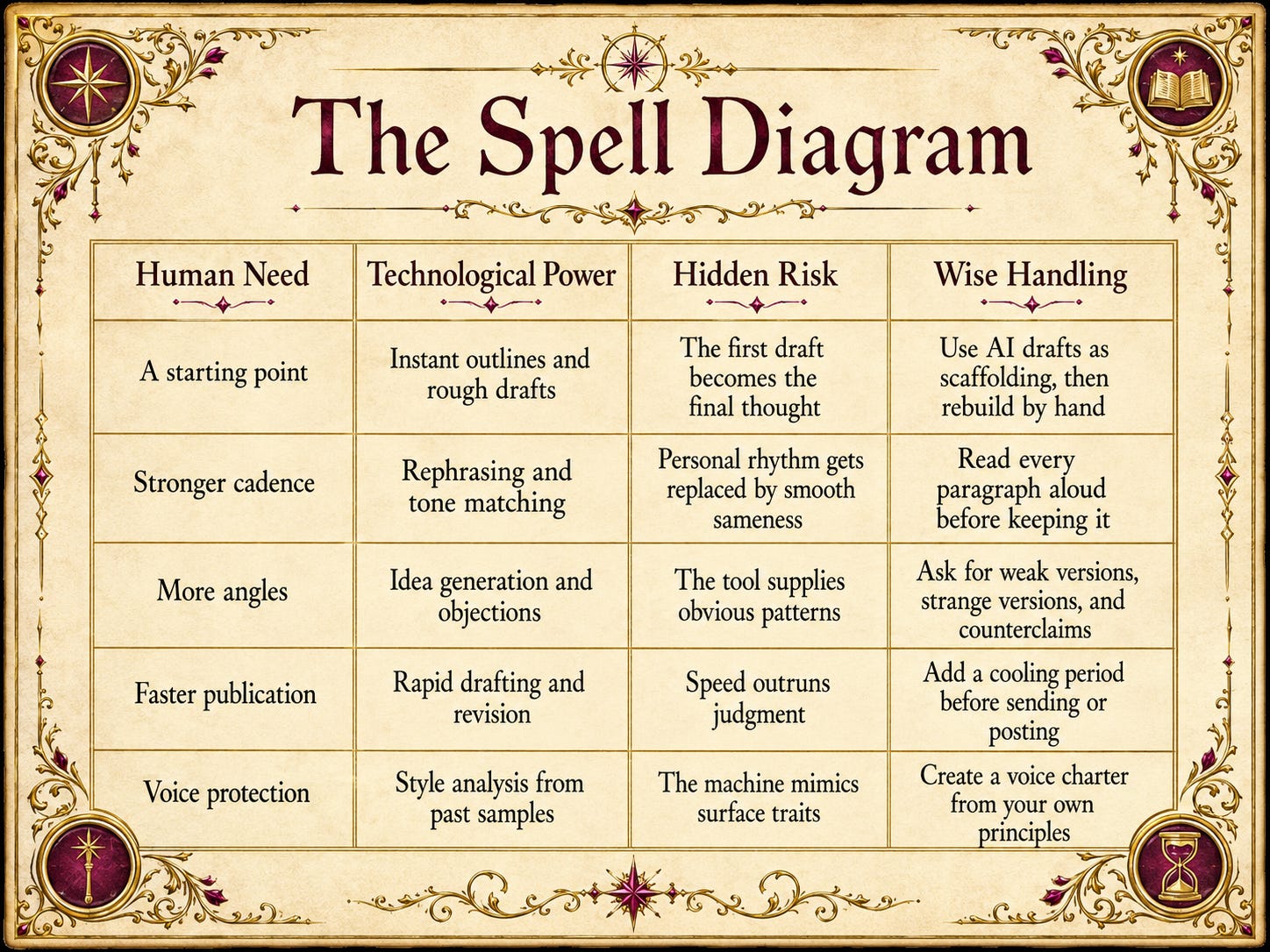
The diagram reveals the central bargain. AI can help a writer see possibilities faster, but it cannot decide which possibility deserves ink. The tool is strongest at producing options. The writer remains responsible for selection, pressure, and final shape. If every sentence sounds acceptable, the piece may already be in danger. Acceptable prose has a way of entering the room quietly and stealing the silver.
The Spell Itself
Create a “Voice Charter” before asking AI to draft anything in your style. Write one page describing what your prose does when it is alive: preferred sentence length, humor level, moral pressure, favorite images, banned phrases, and the kinds of claims you refuse to soften. Keep this in a notes file and paste it into prompts when needed.
Never prompt, “Write this in my voice,” by itself. Use a narrower command: “Give me three possible openings that preserve a plainspoken, slightly wry tone. Do not imitate my exact phrasing. Do not use ornate abstractions.” The narrower the leash, the fewer chickens the familiar eats.
Ask AI for bad drafts on purpose. Try: “Give me a deliberately rough version with clear structure but no polish.” A rough draft is easier to revise honestly. A polished draft seduces the tired mind. It arrives with candles, slippers, and a forged passport.
Keep your original paragraph beside the AI version. Use a split screen or two open documents. Highlight any sentence in the AI draft that says what you meant better than you did. Then rewrite that sentence yourself from scratch. Borrow the insight, not the fingerprints.
Read the revised passage aloud. Your ear will catch counterfeit voice faster than your eye. If a sentence sounds like it belongs in a software brochure, strike it. If it sounds like you after too much committee tea, strike it twice.
Use AI to ask questions before it offers answers. Prompt it with: “What is unclear here?” “Where does this argument feel thin?” “Which sentence sounds generic?” “What would a skeptical reader challenge?” This turns the tool into a lantern rather than a ventriloquist.
Protect private material. Do not paste client manuscripts, unpublished contracts, student writing, family confessions, passwords, private journals, or sensitive notes into a tool unless you understand the platform’s data settings. When in doubt, summarize the issue without exposing the substance.
Build a revision folder for each serious project. Keep files named “original,” “AI notes,” “human revision,” and “final.” Save prompts that produced useful feedback. Future you will bless present you with the solemn gratitude of a man finding dry socks in a flood.
Add a final human mark. Before publishing, insert one sentence only you would write: a remembered image, a precise judgment, a small joke, a local detail, or a phrase with bite. If no sentence bears your fingerprint, the piece may have wandered out wearing your coat.
The Miscast Spell
The miscast spell begins with fatigue. A writer is tired, late, anxious, or hungry for approval. The AI draft appears with neat paragraphs and good manners. It asks for nothing obvious. That is how it gets expensive.
Soon the writer stops making difficult choices. The piece becomes assembled rather than authored. The language grows smooth, then vague, then weightless. Readers may not spot the exact machinery, but they sense the absence of a person. A page without a person is a banquet with painted food. Handsome. Useless at supper.
There is also a quieter injury. The writer loses tolerance for the awkward beginning. Yet awkward beginnings are where many strong pieces are born. A half-formed sentence can contain a real discovery. A machine-polished paragraph can hide an empty room.
Handle the quill badly, and it teaches you to prefer convenience over craft. Handle it well, and it becomes a patient apprentice that sweeps the floor while the master does the work no broom can do.
The Closing Charm
Let the enchanted quill scratch, chatter, and offer its little bundle of possible roads. Then close your hand around the pen.
The writer’s task is to choose what deserves a sentence, what deserves silence, and what must be said in a voice no machine can inherit.
A grand world awaits.