
The Client’s Mirror Goblin
A spell for graphic designers whose clients bring AI mockups to the table and mistake the glittering thing for a brief.

The Ordinary Trouble
Mara sits at her desk with a mug of coffee gone cold enough to qualify as office furniture. On her second monitor is a client email. On the first is an AI-generated logo: a wolf, a mountain, a coffee cup, a lightning bolt, and what appears to be a ribbon, although the ribbon has begun negotiations with a serpent.
The client loves it.
They write, “We’re thinking something like this, but cleaner.”
Mara stares. The colors fight. The type looks melted. The wolf has three ears, which may be symbolic, though probably by accident. Yet beneath the mess is something useful. The client wants ruggedness. Speed. A little danger. A brand that says “premium outdoor coffee” without sounding like a man in a flannel shirt yelling at a sunrise.
She could mock the image. Tempting. Very tempting.
Instead, she opens a new document and writes: “What this image tells us.”
A goblin has entered the room, but at least it brought clues.
The Tool on the Table
AI image generators let clients make visual mockups before they hire a designer. A person can type a phrase like “luxury camping coffee logo with wolf and mountains” and receive a polished-looking picture in seconds. The image may look finished at first glance. That is the trick. It has surface charm, like a cake iced by a raccoon with aristocratic ambitions.
Clients use these tools because they help them express taste when they lack design vocabulary. They may know they want “bold,” “rustic,” “clean,” “premium,” or “friendly,” but they struggle to describe composition, contrast, typography, balance, negative space, print constraints, brand systems, or file formats. AI gives them something to point at.
For graphic designers, this brings both trouble and opportunity. The trouble is obvious. A client may confuse a generated mockup with actual design direction. They may ask the designer to copy artifacts, impossible forms, fake lettering, or incoherent brand signals. They may undervalue the work because the machine produced something quickly.
The opportunity is quieter. The AI image can become a diagnostic object. It reveals what the client likes, what they fear, what they cannot name, and what story they hope the brand will tell. Handled well, the mockup becomes the beginning of a better brief.
The Enchantment Beneath the Interface
The client’s AI mockup is a mirror goblin.
It reflects desire, but crookedly. It rummages through the great visual attic of the internet and returns wearing stolen hats. A bit of Patagonia here. A coffee roaster there. A startup badge, a tattoo flash wolf, a mountain lodge menu, a label from a bourbon bottle, all stitched into one small creature with a suspicious grin.
The goblin’s danger is mimicry. It tempts the client to believe that style is made by piling symbols until the screen looks expensive. It whispers, “You already have the answer. Ask the designer to polish me.” That way lies the swamp of half-authorship: the client thinks the machine designed it, the designer feels reduced to cleanup, and the final brand inherits the soul of a thrift-store spell.
Yet the goblin can be useful. Fairy-tale creatures often are, once properly fenced.
A designer must refuse two bad paths. The first is contempt. Laughing at the client’s mockup may feel righteous, but it burns trust. The second is obedience. Copying the mockup gives the client what they asked for while denying them what they hired you to know.
The wiser path is translation. The image becomes testimony. It says, “Here is the mood. Here is the aspiration. Here is the confusion.” The designer’s task is to extract the human need from the machine’s costume. That is where craft begins again.
The Spell Diagram
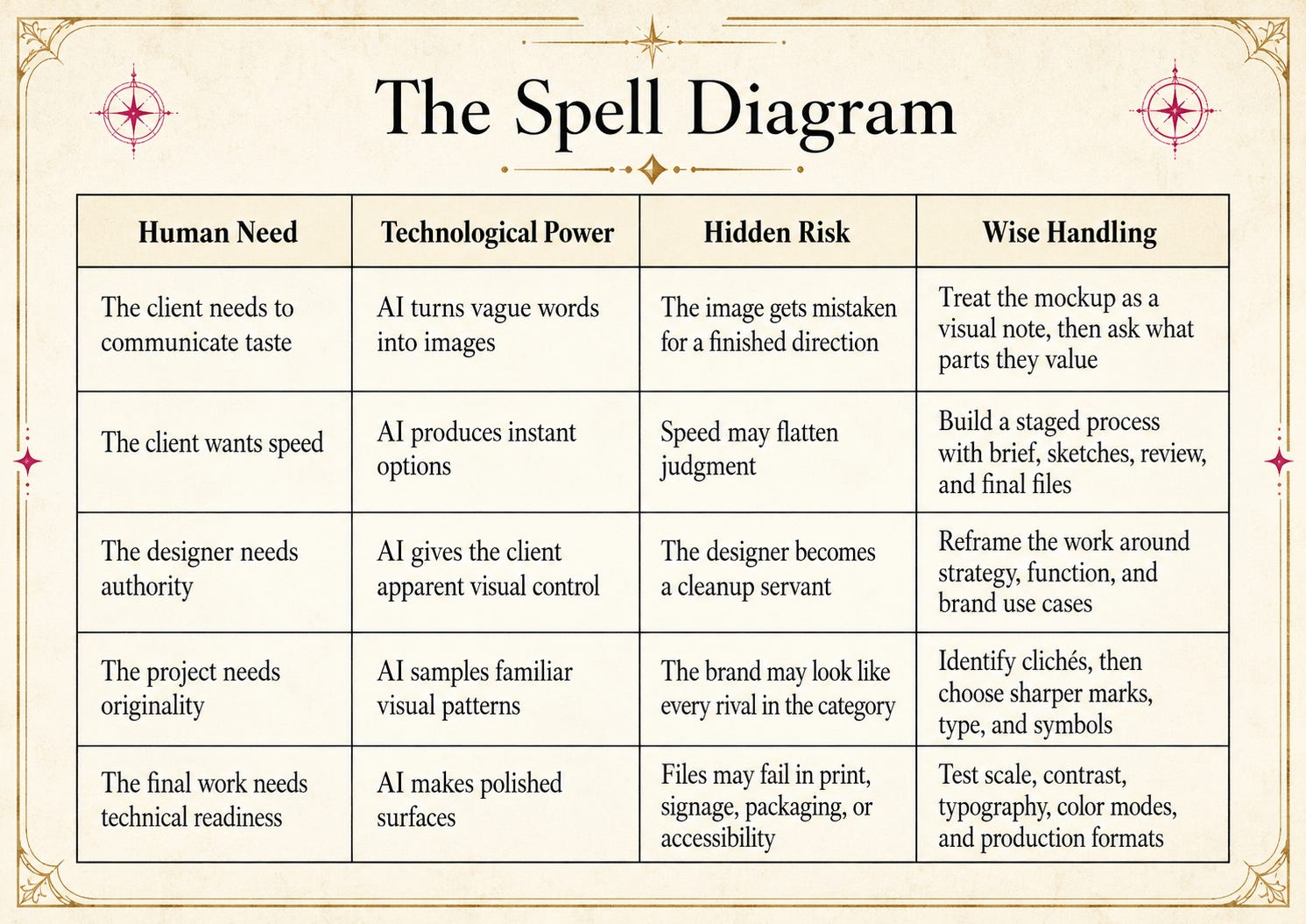
The pattern is plain. The AI mockup helps the client speak, but it cannot judge. It gives form to instinct without sorting the good instinct from the bad one. The designer must separate preference from instruction. A wolf means strength, perhaps. A mountain means endurance. A gold texture means premium. A warped ribbon means the goblin got into the pantry again.
The table also reveals a professional boundary. The designer is not being paid to obey pixels. The designer is being paid to make a working visual system: a logo that reads at small sizes, type that carries tone, colors that reproduce properly, layouts that guide the eye, files that vendors can open without summoning a support-ticket demon.
AI gives the client a torch. The designer still draws the map.
The Spell Itself
Ask the client to send the AI mockup along with three plain sentences: what they like, what they dislike, and where the design will appear first. A social avatar, storefront sign, coffee bag, law firm website, and trade show banner all demand different handling. The goblin must declare its battlefield.
Create a “translation brief” before opening Illustrator, Figma, Photoshop, or InDesign. Pull out words such as rugged, clean, premium, playful, local, fast, traditional, ceremonial, or friendly. Then convert each word into a design choice: heavier type, warmer palette, spare layout, hand-drawn mark, wider spacing, or simpler icon.
Mark the AI image in layers of meaning. Use a screenshot and annotate it. Circle the parts that signal mood, such as lighting, color, texture, and symbol. Cross out defects such as broken type, cluttered shapes, fake badges, tangled marks, strange anatomy, and unreadable forms. This turns the client’s image into a workshop document instead of a throne decree.
Build a small reference board with real sources. Include competitor logos, historic packaging, typography samples, signage photos, print examples, and two or three “avoid this” images. Label each item by function: color, type, composition, symbol, texture, or tone. Pretty pictures without labels are moths in a jar.
Write a boundary into the proposal or contract. State that AI mockups may guide mood and direction, but final design decisions, file preparation, licensing review, and production readiness belong to the designer. The sentence should be calm. Steel wrapped in linen works better than a lecture.
Show the client two paths in the first presentation. One can stay close to the mood of the AI mockup while fixing hierarchy and craft. The other should move farther away while preserving the underlying desire. This gives the client a choice between familiar and better. Many clients need to see both before they understand the difference.
Keep a project folder with the client’s AI mockup, notes, screenshots, drafts, source files, exports, font licenses, stock licenses, and approval emails. Name files clearly: “Client_AI_reference,” “Moodboard_v1,” “Logo_sketches,” “Presentation_round1,” “Final_exports.” Future-you deserves a clean desk, even if present-you is wrestling a pixel badger.
Test the final design against actual use. Shrink the logo to favicon size. Print it in black and white. Place it on a mock package, business card, website header, invoice, social profile, and email signature. Check contrast and legibility. If the mark only works in a dramatic mockup, it is stage armor made of pie crust.
Ask one closing question before final approval: “Does this design solve the business problem better than the reference image?” That question moves the room away from taste combat and toward purpose. It also reminds everyone that the goblin was a messenger, not the monarch.
The Miscast Spell
The spell goes wrong when the designer treats the AI mockup as either trash or treasure. Both errors deform the work.
Contempt makes the designer brittle. The client feels mocked, retreats into defensiveness, and begins protecting the goblin like a beloved family pet. No great brand has ever been born from a client clutching a malformed wolf logo in fear.
Obedience is worse. The designer becomes a servant of machine residue. The work inherits every vague symbol, every familiar trope, every slick but hollow surface. Soon the portfolio fills with designs that look “almost right” in the same way wax fruit looks almost edible. The eye is pleased for half a second. Then the soul notices the fraud.
The hopeful path is professional mercy. Treat the client’s mockup as a first attempt at speech. They are trying to say something. Help them say it with form, restraint, memory, and skill. The machine can cough up a mask. The designer must carve a face.
The Closing Charm
When the client brings you a mirror goblin, do not smash it on the conference table.
Put it under a lamp. Study its pockets. Ask what it stole and why. Then send it back to the forest and make something worthy of the name.
A grand world awaits.