
KingCobraJFS and Charlie Kirk
Rousseau Was Right About the Lolcows

I. Gio Panachietti and the Art Right’s Lone Gentleman
Gene (reading Gio’s note): …What’s a lolcow?
Among the few on the cultural Right, Gio Panachietti stands alone.
He is one of the few figures whose aesthetic sense is matched by moral seriousness. Most have either abandoned beauty for tribal spite or clung to manners while recoiling from the world. Gio, instead, mourns what should be mourned. That makes him rare.
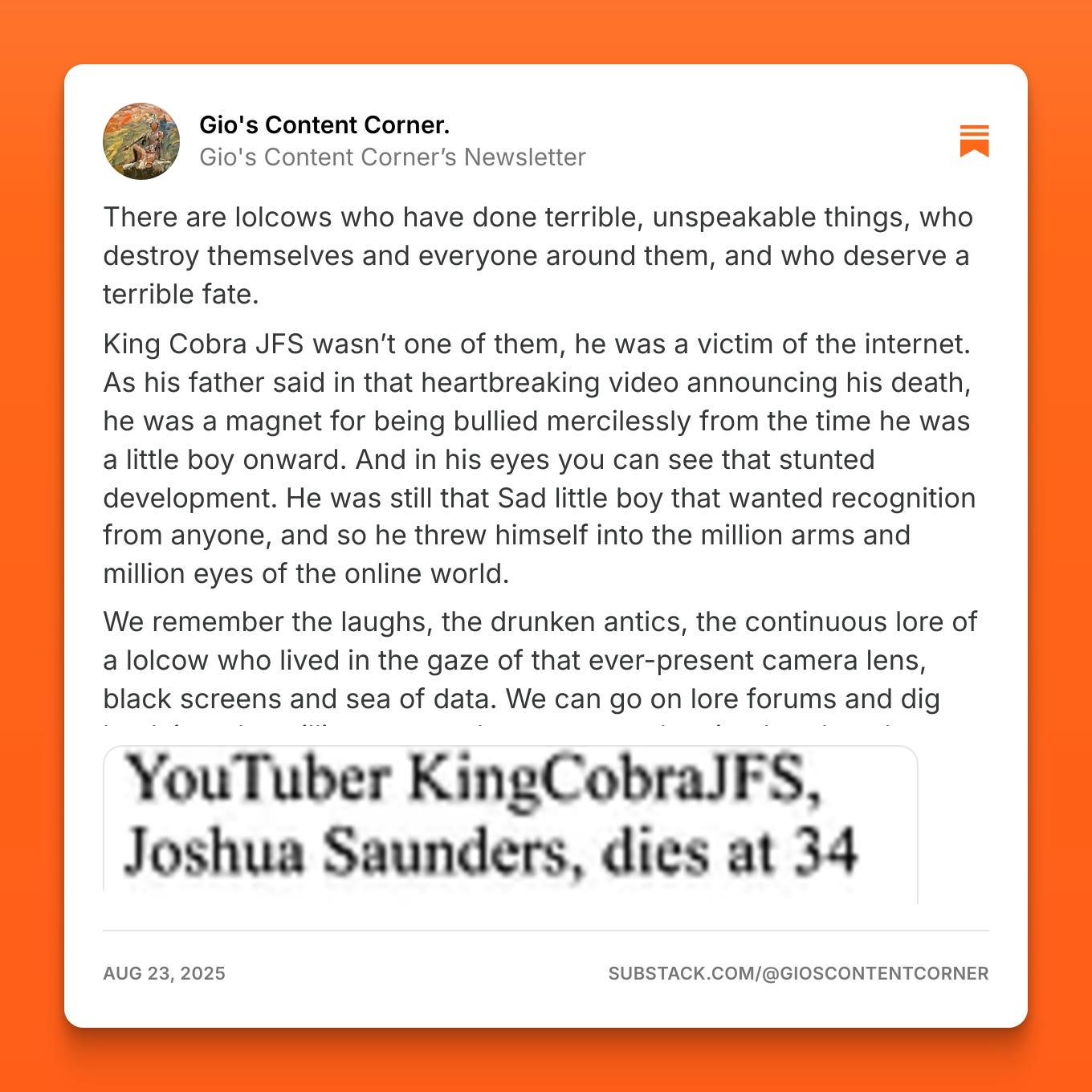
When news broke that KingCobraJFS had died, it was Gio—not the pundits, not the priests, not the self-anointed “defenders of the West”—who grasped that something important had been lost. A man had died, alone and mocked, after years of digital crucifixion. Gio’s reaction was not performative. It was elegiac. And in that elegy, one could hear the faint echo of something older than content cycles: dignity.
His post was short. Grief made it clear. And it did something that nothing else online managed to do—it broke the feedback loop of cruelty. For a moment, the tide of ridicule hesitated. A few others paused. Some even reconsidered.
It takes a certain kind of man to cry over a gothic YouTube outcast. And it takes a better kind of Right to understand why that matters. The fact that Gio stood out for doing so is more than a compliment to him. It is an indictment of everyone else.
Before the Right can reclaim anything worth defending, it will have to remember how to weep for strangers. If it cannot, then it deserves every desecration it endures.
Gio's Content Corner. for candor.
II. A Death I Didn’t Expect to Notice
Gene (bothering to investigate who KingCobraJFS was): …Youtube….lolcow…goth… Wait… goth, you say? Well… I do like The Cure. Perhaps I can take this more seriously.
I had never heard of KingCobraJFS until I read Gio’s note.
He was, it turns out, a gothic YouTuber with a long history of strange videos, deranged rituals, and obsessive viewers who tuned in mostly to watch him fail. He had become a kind of digital whipping boy, kept alive for the entertainment value of his collapse. I would have ignored it like everyone else—another online casualty of self-inflicted ruin—if Gio Panachietti hadn’t said something.
Gio didn’t moralize or theorize. He simply mourned. In a space filled with sarcasm, cruelty, and fraud, that grief felt foreign. And in its foreignness, it revealed a vacuum. Nobody else seemed to care. They didn’t even pretend to.
This wasn’t about Josh Saunders, the individual. It was about what his death showed. He’d been tormented for years, publicly humiliated in full view of a society that claims to defend dignity. The Right, which prattles on about tradition, virtue, and protecting the weak, had nothing to say when one of the weakest men in America drank himself to death under their gaze.
His self-destruction was consumed like content. When he died, it was shrugged off like a broken toy. The silence was instructive.
This is what the Right has become: eager to preach about moral order, reluctant to extend it to anyone who makes them uncomfortable. They defend the normal, the clean-cut, the well-dressed. Everyone else is fair game.
A culture reveals its soul by how it treats its failures. This one doesn’t have one.
III. The Goth Clown of YouTube
A child needs to know what getting shat on relentlessly for thirty years in a row feels like. It builds character!
-Maxim #3 of the Tard Right
KingCobraJFS was not a villain, nor a prophet, nor a symbol of anything grand, wizardry notwithstanding. He was a visibly strange man with a webcam and an audience that grew by feeding on his eccentricities.
His real name was Josh Saunders. He wore black nail polish, chanted fake spells, drank to excess, and made wands out of dollar-store materials. In a previous era, he might have lived out his days as a town eccentric, largely left to his own devices. In an ancient one, he would have been a priest. But the modern internet doesn’t allow people like that to fade into obscurity. It preserves them, studies them, mocks them. It builds shrines of cruelty around them.
Josh became a lolcow—a person milked endlessly for entertainment by anonymous mobs. Every slurred word, every failed spell, every bizarre meal was clipped, remixed, and passed around like a cursed relic. The more he degraded himself, the more they watched. His worst moments became his most profitable.
He played along, in a way. But the performance was never clean. It was equal parts defiance, confusion, and resignation. He knew he was being watched, but he didn’t know how to leave. So he kept performing, and they kept laughing. It was the digital version of a public execution, extended over years.
The spectacle depended on a fragile man never leaving the stage. And when he finally did—when his body gave out from the rituals they encouraged—they acted surprised.
But it was never meant to end differently. Tragedy is comedy’s secret. And Josh was a funny man.
IV. King Priam and the Sad Father
Classics 101: The Greeks attacked Troy. Priam was its king. Hector was his son. Hector challenged Achilles to heroic combat. Achilles killed Hector. He mutilated the corpse to humiliate the Trojans. Priam saw. He asked Achilles to return Hector’s body. Achilles saw the sad man. He realized his own father would mourn his death. This made him sad. Achilles felt empathy for the first time. He returned Hector’s body to Priam.
This is how The Iliad ends — and how Greece began.
Behind every public humiliation is a private grief.
Josh Saunders had a father. His name is Clint. Unlike the anonymous spectators who turned Josh into a joke, Clint never stopped seeing a son. In his voice, you can hear the bewilderment of a man who thought love might be enough, only to learn it isn’t. The audience wanted a freakshow. Clint wanted his son to live. And the gap between those two desires is the measure of our decline.
Clint watched the same grotesque parade everyone else did, but he saw a different figure at its center. Where the mob saw a clown to jeer at, Clint saw the boy he had raised, the one whose first words he remembered and whose pain he could still feel as his own. The contrast between those two visions is the measure of our sickness: a world laughing at what one man would give anything to protect.
There is an image from The Iliad that lingers here. King Priam, humiliated and broken, kneels before Achilles to beg for the body of his son. It is the moment when hatred falters, when even the greatest warrior must see the humanity of the man he has slain. Clint did not have such a moment. There was no Achilles to beg from, no enemy to face. Only an anonymous swarm without faces or names, no one of whom feels guilty because all of them did it together.
Cruelty hides behind irony. It tells itself that everything is content and that no one really gets hurt. Clint’s face exposes that lie. It is the face of every parent who has had to bury a child they could not protect from the world.
Even in death, Josh was mocked. But somewhere in Wyoming, a father wept over a body that had once been small enough to carry.
V. Rousseau Saw This Coming
Gene: Ugly people are antisocial because you treated them like shit because they were ugly.
Autistic Wigger: Wait! There are studies that show mutations correlate with antisocial behaviors! Ed Dutton says—
Gene: I know how to judge people by what they look like. I know it better than you. I also know that mutations correlate with unattractive physiognomies, which people mock. That mockery yields resentment. You know it too. But you conveniently ignore it so you can continue to excuse your cruelty. That is why killing you is not murder.
The story of Josh Saunders was written long before he was born.
Rousseau, despised by the kind of people who would later mock Josh, saw it clearly: men are not ruined by nature. They are ruined by other men. They are broken by ridicule, bent by the pressure to conform, and hollowed out by the need to matter in the eyes of a crowd that does not care whether they live or die.
Josh did not set out to become a circus act. The crowd made him one. They dangled attention in front of him like bread before a starving dog, and he learned to perform for it. They jeered when he failed and jeered harder when he tried. They built the cage, handed him the bottle, and then called him weak for crawling inside. And when he finally died inside that cage, they sighed about “personal responsibility.”
They always do. The mob delights in ruin and lectures the ruined about their choices. It mocks a drowning man for gasping and blames him for being wet.
Rousseau warned that society manufactures its own victims and then despises them for existing. Josh was the predictable result of that process: a man warped by constant derision until he became the thing they wanted to laugh at. And then, when the laughter killed him, they shrugged.
It was never about choice. It was about cruelty. And cruelty is funny here. But not There.
VI. The Predictable Tragedy of Josh Saunders
Nobody cared who I was until I peed my pants on Youtube. Yes, I knew it was derisive. But the warmth I felt in my nethers could hardly compare to the warmth I felt in my chest as, for the first time in my life, people started to notice. And with enough likes, I could forget their need for humiliation. I could finally believe—if only for a little while—that they liked me.
-MCPeepants69, The Pee in my Pants (p. 68)
Josh’s story followed a grimly familiar arc. It began in childhood, long before the cameras ever turned on. He was socially awkward, the kind of boy who never quite fit in, and that was enough to make him a target. The same small cruelties that hound such boys in hallways and classrooms followed him into adulthood. The internet simply gave them a louder stage.
The shift from real-world bullying to digital torment did not mark a new chapter. The names changed, the medium changed, but the appetite for humiliation remained unchanged. And Josh, still desperate for some form of connection, kept returning to the very people who despised him. The cruelty became the only relationship he could count on.
This is how predictable tragedies unfold: slowly, repetitively, almost mechanically. Each insult erodes another layer of resistance. Each baited stunt lowers the threshold for what feels normal. By the time Josh was drinking himself unconscious on camera, the audience had trained him to do it. They had written the script. All he had to do was act it out.
And when the inevitable happened—when the years of humiliation, addiction, and despair converged into a death certificate—the same crowd that had driven him there turned philosophical. They called it fate. They said it was always going to end this way.
They’re right, but not for the reasons they think.
It was always going to end this way because they were never going to stop.
VII. Alcohol, Sadism, and Public Ritual
Public humiliation is a disgusting feminine cruelty best reserved for disgusting feminine people.
Josh did not drink for pleasure. He drank to endure.
The bottles piled up because they dulled the jeers, softened the shame, and blurred the edges of a world that had never given him a place. Alcohol was not his rebellion; it was his surrender. And the mob loved it. Every swig made him more pathetic, and therefore more entertaining. They weren’t watching a man self-medicate. They were watching a man disintegrate, and they were delighted to be part of it.
Soon, drinking became a performance in itself. Viewers egged him on to mix vile concoctions and swallow revolting meals, the more nauseating the better. They treated his body as raw material for their amusement, pushing him toward self-harm and calling it “content.” It was a slow-motion suicide, crowd-sourced and monetized.
There is something deeply religious about cruelty at that scale. It takes on the structure of a ritual: the sacrifice placed before the altar, the congregation chanting its approval, the offering consumed. Josh’s degradation became a shared ceremony for people who lacked meaning and found it in someone else’s ruin.
And he played his part. He raised the glass because it was the one gesture that still won him attention. They watched because watching made them feel powerful. The whole thing was obscene, and they all knew it. That was the point.
By the time his liver failed, the ritual had gone on for years. They hadn’t expected him to die. They expected him to keep dying forever.
VIII. Death by Design
The algorithm is a murder weapon.
Josh Saunders was killed by a thousand hands that will never admit they were holding the weapon.
His death was not a freak accident, nor the random consequence of bad decisions. It was the predictable endpoint of a structure that had been built around him brick by brick. Every cruel comment, every mocking video, every baited stunt was part of the architecture. The crowd did not stab him, but they shaped the blade and pressed it into his hands.
They called it entertainment, but it was engineering. They constructed a feedback loop designed to keep him spiraling. The worse he became, the more they watched. The more they watched, the worse he became. It was profitable for them, ruinous for him, and no one ever questioned the terms.
The most obscene part is how easily it could have gone another way. A fraction of the energy poured into mocking him could have lifted him from the spiral. A handful of people treating him as a man rather than a spectacle might have changed the trajectory. But cruelty is addictive, and once it grips a crowd, mercy feels like weakness.
So they kept laughing. They kept prodding. And when the body finally failed, they called it inevitable. It was not inevitable. It was inflicted.
Josh’s death was designed. It was assembled piece by piece by people who thought they were harmless. And they will never feel guilty, because guilt would require them to see him as human.
IX. Who Did This?
We don’t know who bullied the goth kid to death. But… We know exactly who bullied the goth kid to death.
Cruelty has many fingerprints, but some are clearer than others.
Josh was openly goth. He wore black eyeliner, cast fake spells, and styled himself like a character from a world that most people never enter. That alone painted a target on his back. In America, there is one political tribe far more likely to sneer at the strange, mock the theatrical, and treat aesthetic difference as moral defect: the Right.
They despise what they cannot categorize. Anything too feminine, too flamboyant, too weird provokes a reflexive contempt. And Josh embodied all three. He was easy prey for people who believe that strength means muscularity and that mockery is a form of virtue. The more they derided him, the more righteous they felt.
The Left, for all its malevolencies, does not usually direct its bile toward men like Josh. It often patronizes them instead. The cruelty he endured bore the unmistakable tone of right-wing mockery—scornful, moralizing, self-congratulatory. To them, Josh was not a person in pain. He was a lesson in how not to be a man.
It is tempting to say that everyone shares the blame, that cruelty is a bipartisan vice. And there is truth in that. But some groups cultivate cruelty more deliberately than others. Some make it a brand. The Right went beyond participating in Josh’s torment. They built their identity on ridiculing people like him.
They killed him, and they will deny it to their graves. Denial is their last defense.
X. The Balance Shifts
Leftist Freak: Wait! We don’t know that it was a trans person! It had to have been—-
Gene: Whatever, vermin. We’re not playing that game. Charlie Kirk was murdered by a trans kid.
Not long after Josh Saunders died alone, Charlie Kirk was shot dead in public.
The details barely had time to settle before the narratives hardened. Kirk, the polished face of a certain brand of American conservatism, was quickly declared a martyr. His death was framed as proof of leftist violence, as evidence of cultural decay, as a reason to double down. And yet, beneath all that noise, there was a fact too uncomfortable for the Left to admit: the man who killed him belonged to a world adjacent to Josh’s.
He was not a mirror image, but a near-neighbor—part of the same family of subcultures that the Right spends its time ridiculing. The kind of person they would mock for how he dressed, how he spoke, how he lived. The kind of person they had spent decades turning into a punchline.
There is a symmetry in that. A man from a subculture they despise died under their mockery. Then one of their idols died at the hands of someone from that same world. No one planned it. No one orchestrated it. But the symmetry is real and bitter.
The Right would never admit that the two deaths belong to the same story. But they do. They form a pair, like cause and consequence, humiliation and reprisal. One man was hounded into a grave. Another was forced into one. And somewhere in the distance, a balance long ignored began to settle itself.
XI. Christian Virtue, Flouted for Fun
The dominant religion on the Right is 90-IQ Protestantism. At no point does it intersect with Christianity.
The symmetry between the two deaths should have provoked repentance. Instead, it revealed how hollow much of the Right’s faith has become.
The same crocodiles who wept over Charlie Kirk’s body had laughed at Josh Saunders’s suffering. They spoke of “Christian civilization” while turning the torment of a broken man into group entertainment. They quoted Scripture while encouraging cruelty. They claimed to cross themselves on Sunday morning and mocked a drunk goth on Sunday night.
Orthodox tradition calls that pharisaism: the outward show of piety with none of its inner substance. Real faith is measured in how we treat the lowest among us, not the highest. It is not tested in our reverence for icons, but in our mercy toward the disfigured. And Josh, disfigured as he was, was still an icon of God. His soul bore the same image as the martyrs they venerate. They could not see it, because cruelty had made them blind.
They found it easier to mock him than to see him. Easier to sneer at his weakness than to consider their role in deepening it. Easier to laugh than to love. And so they did all three, loudly, repeatedly, and without shame.
The Right loves to speak of restoring Christian order. Yet when handed the smallest opportunity to live it—to offer patience to a man who received none, to clothe one naked soul in dignity—they refused. They chose mockery over mercy. They chose the crowd over Christ. And they called it virtue.
XII. Hollow Tears for Charlie Kirk
Can we film the operation? Is the head dead yet?
You know, the boys in the newsroom got a running bet
Get the widow on the set!
-Dirty Laundry, Don Henley
When Charlie Kirk died, the Right erupted into mourning. Tributes poured in, speeches were made, and hashtags bloomed like funeral flowers. They spoke of his courage, his faith, his service. They called him a martyr for their cause. But beneath the noise, something rancid lingered: the same people who shrugged at Josh Saunders’s death now wept theatrically over Kirk’s.
It was not compassion. It was spectacle. Their tears were not born of love but of utility. Kirk’s death could be woven into a narrative, polished into rhetoric, weaponized for politics. Josh’s could not. He was too awkward, too embarrassing, too far from their image of what a man is supposed to be. His suffering offered them nothing. His death taught them nothing. So they ignored it.
This is what happens when virtue becomes performance. It bends itself toward usefulness. It values the deaths that serve a purpose and discards the ones that shame us. Kirk was useful. Josh was not. One received eulogies, the other memes.
The parable they pretend to cherish tells a different story. It praises the Samaritan who tends the broken stranger, not the priest who passes him by. And yet the Right has chosen the priest’s path, dignifying those who look like them and stepping over those who do not.
Kirk’s death could have been a moment for reflection, a chance to reconsider the cruelty that preceded it. Instead, it became one more excuse for the Right to congratulate itself while leaving the wounded in the ditch.
XIII. Twin Martyrs of a Moral Collapse
A preamble to the Goth Martyrs
The deaths of Josh Saunders and Charlie Kirk could have become a shared lesson. They could have revealed two sides of the same sickness and shown a way out of it. One man, tormented into oblivion, could have become a martyr for the rejected. The other, killed in his prime, could have become a martyr for the ideals his movement claims to uphold. Together, they could have formed a parable about cruelty and repentance, mockery and mercy.
But that would require honesty, and honesty is in short supply. It would mean admitting that Josh’s death was not a random misfortune but a slow execution carried out by a jeering mob. It would mean admitting that Kirk’s death, too, was shaped by that same atmosphere—a culture of hatred that feeds on humiliation until humiliation bites back. To do that would risk seeing the two stories as connected, and that is precisely what the Right refuses to do.
They would rather keep their martyrs in separate boxes: one they can parade, the other they can forget. One fits the image they want to project. The other reminds them of what they have become. And so the pairing that could have been redemptive becomes accusatory instead.
Two men are dead, each revealing the other’s tragedy. One died because cruelty was easy. The other died because cruelty came home. Until that is faced, both will remain symbols of a civilization that cannot look itself in the mirror.
XIV. The Sadism Will Continue
The mob is not eternal. But it was there after the beginning. It will remain with us until the end of the age.
There will be no reckoning. There rarely is.
The same crowd that mocked Josh Saunders into an early grave will return to their routines unchanged. They will find a new target—another misfit, another vulnerable soul—to feed the appetite that Josh once satisfied. Cruelty is a habit now. It is how they bond, how they entertain themselves, how they feel strong. They call it humor, they call it realism, they call it anything but what it is: sadism dressed as virtue.
Charlie Kirk’s death will not soften them either. It will harden them. They will wield it like a club, a reason to hate more intensely, to sneer more freely, to crack down harder on anyone who does not look or act like them. They will pretend that vengeance is justice and that mockery is discernment. And in that pretense, they will keep producing the very monsters they claim to fear.
This is how civilizations decay: not through great acts of evil, but through small acts of cruelty repeated endlessly. The mob learns nothing, because learning would mean admitting guilt. And guilt would demand change. But conservatives hate change.
Josh’s death should have shamed them into silence. Kirk’s should have frightened them into reflection. Instead, both will become fuel for the same furnace. Cruelty is easier than repentance. And a culture that prefers ease to effort will always choose the lash over the mirror.
The mob does not mourn. It hungers. And hunger is never sated.
XV. Two Tragedies, No Lessons
No more lessons need to be learned. We know what we need to know. The challenge is to live it.
We now have two bodies and nothing to show for them. One was a broken man who died under the weight of mockery. The other was a public figure whose death was instantly woven into tribal myth. Both deaths could have forced a reckoning, but neither will. They will pass through the public mind like weather: briefly noted, quickly forgotten, leaving the air no cleaner than before.
Josh Saunders’s death warns of what happens when cruelty is normalized. Charlie Kirk’s warns of what happens when cruelty comes home. The first shows how contempt destroys the weak; the second shows that contempt cannot be contained once unleashed. Together they offer a complete picture of a society that cannot stop harming itself. Yet no one wants to look at that picture, because it would require them to see their own faces in it.
The Right will canonize Kirk and forget Josh. They will use one corpse as a banner and leave the other in the ditch. They will tell themselves stories about responsibility and evil and order, stories that absolve them of having to learn anything. Reflection is dangerous; it might require change. Far easier to point and shout.
So the cycle will continue. More Joshes will die, mocked into oblivion. More Kirks will die, struck down by forces they helped unleash. And each time, the lesson will slip through their fingers again. We will drown in tragedies that could have saved us, if only we were willing to learn.
XVI. A Word from The Word
Every tragedy is an opportunity. Every opportunity has a question. Two exist: “What did you do?” and “Why didn’t you do it?”. Answer well. You will have to do it twice.
When his disciples asked why a man had been born blind, Christ answered, “This has happened so that the works of God might be displayed in him.” It was not an explanation in the ordinary sense. It was a call to look differently—to see suffering not as punishment or mistake but as an opportunity to reveal something higher.
Josh Saunders’s life and death could have been such a revelation. His humiliation could have exposed the rot beneath our moral posturing. His suffering could have shown us what our cruelty really does. Charlie Kirk’s death could have pierced through the slogans and reminded his admirers that every human being, even those they despise, stands on the same mortal ground. Together, their stories could have stripped away illusion and forced us to confront the works of God in ourselves—and horror at their absence.
But we refuse that invitation. We cling to narratives that flatter us instead. We say Josh deserved it. We say Kirk was murdered by evil itself. Anything to avoid the harder truth: both deaths reveal who we are. And who we are is not good.
Christ’s words were not meant to comfort. They were meant to correct. They remind us that suffering exposes the soul of a people. Ours is exposed now, and it is hollow. The works of God are waiting to shine through us. They cannot while we cling to mockery and malice like lifelines. Jesus weeps.
XVII. Troy Burns Again
A song was sung at the beginning of creation such that all the heavenly hosts, from the mightiest of the seraphim to the meekest of the cherubim, joined in the chorus established by God. Each was apportioned a melody and intensity suitable to their degree. Yet such is the capacity of the Almighty that even the least of His Creation could be perceived amidst the grand harmonies. He perceives still.
There is an old lesson buried in the ashes of Troy: the man you hate is still loved by someone. Even the most reviled has a father who mourns him, a mother who remembers his first steps, someone whose world collapses when he falls. Priam walked through the Greek camp to kiss the hand of the man who killed his son. That gesture, humbling and terrible, still reverberates across the centuries.
Josh Saunders had such a father. Clint loved his son with a love that refused to break, even as the world laughed at him. To the mob, Josh was a punchline. To Clint, he was the boy he had raised, the one he still prayed would find peace. That gap between how the crowd saw him and how his father did is the measure of our depravity. We mocked what another man cherished.
And above even that earthly love is another, one we refuse to acknowledge. Josh was loved not because he was strong or successful or admirable, but because he existed. That should have been enough. It was not.
This is the part the mob never understands. Cruelty always looks smaller when you realize someone grieves for the person you despise. Somewhere, someone is walking through the camp to ask for the body you mocked. And when that happens, the joke dies, and the laughter curdles. Troy burns again, and this time we are the Greeks, standing over a ruin we made.
XVIII. Real Sacrifice Looks Like This
Wigger Rightist: I was deeply distraught when I learned of Charlie Kirk’s death. He was an American icon and I feel as though a part of me has died with him.
Gene: But you couldn’t just be distraught, could you? No. You had to make sure the internet knew.
There is a difference between dying for those who spit on you and dying for those who cheer you. One is the shape of redemption. The other is the shape of politics.
Jesus died hated. He was mocked, scourged, betrayed, and abandoned. The crowd jeered as He stumbled under the weight of the cross. No one believed He was winning anything. No one praised His courage. His death was obscene and humiliating, and it accomplished everything precisely because it was. He gave Himself to those who would never thank Him, and that is why His sacrifice redeemed the world.
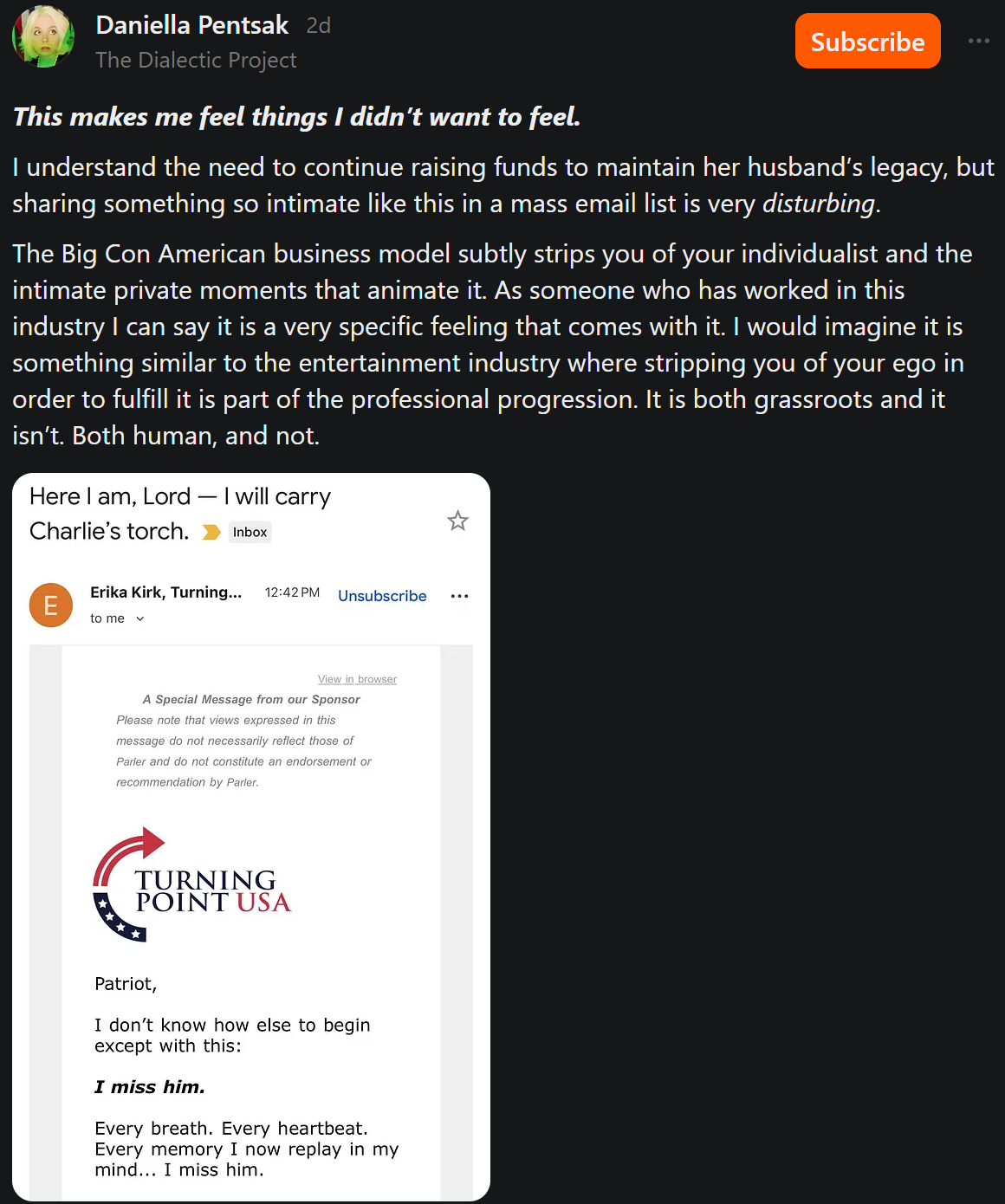
Charlie Kirk died loved. He was surrounded by allies who will build monuments to him, who will make his death a rallying cry, who will use it to feel more righteous than they did before. It will be woven into speeches, campaigns, and fundraisers. It will be clean and useful. But it will not be sacrifice. It will be confirmation. He died for a crowd that already adored him. There is no glory in that. Only sentiment.
The contrast is brutal. Christ offered His life for those who hated Him. Kirk’s death asks nothing from anyone who does not already agree. Christ’s death demanded that His followers look inward and change. Kirk’s will demand nothing more than applause.
One death remade the world. The other will be merchandised. One speaks of love without condition. The other is a feedback loop of loyalty and branding. They share the same word. Death. But not the same weight.
Daniella Pentsak for candor.
XIX. No More Martyrs
Somebody already died for these people. No further sacrifices are necessary.
The blood has been spilled, the price has been paid, and the lesson has been written in letters large enough for even a blind culture to read. Yet we keep demanding new bodies. We demand them from men like Josh, driven into self-destruction for the sake of our amusement. We demand them from figures like Charlie Kirk, whose deaths are turned into props for our endless tribal theater. We demand them because we do not want to change. It is easier to bury someone else than to confront ourselves.
The truth is that redemption is not cumulative. It does not grow stronger with each corpse. It does not deepen with each round of mourning. It has already been offered in full. The rest is noise. Blood spilled to excuse our refusal to repent.
Josh did not need to die for us to learn mercy. Kirk did not need to die for us to rediscover virtue. Those lessons were given long ago. We ignore them because they are inconvenient, because they demand too much, because they require us to treat even the despised as sacred. And so we keep manufacturing martyrs to spare ourselves from obedience.
But there will be no salvation in this ritual. No amount of spilled blood will wash away the cruelty that we refuse to abandon. The sacrifice is finished. The rest is desecration.
XX. The Society Without Heroes
America was founded in rebellion. Rebellion has an angel.
America was founded on rebellion against order, and rebellion remains its only real faith. It sneers at hierarchy, mocks authority, and flinches at anything that asks for reverence. This is no place for a hero. Not because there are no men of virtue, but because there are no people able to receive them. Heroism demands a society that can recognize greatness and submit to it. We have neither.
This is the hidden truth behind both deaths. Josh Saunders could have been redeemed if there were people capable of seeing the worth of a broken man. Charlie Kirk could have been mourned without spectacle if there were people capable of grieving without turning grief into a brand. But a culture built on rebellion has no use for either. It knows only how to mock and to market.
And so we are left with corpses and commentary. We build no altars, learn no lessons, change nothing. We scroll past the weak until they destroy themselves, and we canonize the strong until they are useful no longer. Then we move on, emptier each time.
Yet somewhere in the rubble, a faint possibility lingers. Perhaps to die for the despised in a land of rebels is the first step toward rebuilding the capacity for heroism. Perhaps the path back to order begins not with banners and battles, but with a single act of mercy toward someone the world has taught us to hate. That road is long, steep, and mostly abandoned. But it still leads to the Light.
That’s what’s up today.
I had not even heard of Josh Saunders until this article, but i think the diagnosis is accurate. Our rotted society has created a very army of outcasts, and thus far the right has only been able to feed and fuel it. And the final observation about America I feel is also spot on. I think was Nick Land I saw recently said that the founding principle and spirit of the U.S can be summed up by Milton's famous line: "Better to reign in Hell than to serve in Heaven."