
How The World Is Enchanted
The Telos of... Evanescence?

I still remember the world
From the eyes of a child
Slowly those feelings
Were clouded by what I know now
Where has my heart gone
An uneven trade for the real world
I want to go back to
Believing in everything and knowing nothing at all
I still remember the sun
Always warm on my back
Somehow it seems colder now
Where has my heart gone
Trapped in the eyes of a stranger
I want to go back to
Believing in everything
-Amy Lee, Evanescence, Field of Innocence
We don’t have to go back.
I see through time better than through space — linearly and laterally.
I peered through time years ago and saw how to enchant the world.
I did so during my adolescence and believed it was common knowledge. I reasoned that if a child could do it, then everyone could.
I was wrong. Enchantment is a secret.
I had no idea. Enchantment, its source, its decline, and its emergence are all known to me. Many on the right long for it, while I can easily describe enchantment and how to recover it. The description yields a plan of action for re-entering the enchanted world.
So let’s go there.
Information Is Stored in the World
Two of the most important characteristics of good design are discoverability and understanding.
- Donald A. Norman, The Design of Everyday Things
Information is stored in the world. We can learn, understand, use, and forget it.
We rely on information in our environment to guide our interactions. Things we use daily convey information, making complex systems navigable and tasks achievable without overwhelming our cognitive capacities. They do so by design.
Consider navigating a city. Street signs, traffic lights, and building numbers provide the information needed to reach a destination. So we can forget the knowledge needed to traverse the city. Information stored in the environment reduces mental load and allows us to focus on the journey rather than the mechanics of navigation.
This principle drives product design. A well-designed object communicates its purpose and how it is used through its form and features. For example, a door with a push plate signals that it should be pushed, while a door with a handle indicates it should be pulled. A well-designed object reduces the user’s need to learn its operation.
Interfaces further enhance information storage. Icons, buttons, and layout conventions help users intuit how to interact with software applications. A trash can icon signifies deletion. Meanwhile, a floppy disk icon represents saving, even for generations who have never used floppy disks. These visual metaphors store information in the interface, allowing users to operate software intuitively.
Understanding how the world stores information helps us create environments that enhance discoverability and understanding. By embedding information in the design of objects, spaces, and systems, we make them more navigable, transforming our environment. The transformed environment is novel and enables new learning.
But the world existed before we and our understanding of it did. Therefore, most information in the natural world did not originate with man. Thus, it was unknown to us for a long while. However, man can discover and understand his surroundings, so we learn about the world. Learning partitions knowledge into four sets.
What We Know of the World
Knowledge exists. We discern it. We do so imperfectly.
Thus, all knowledge belongs to one of four sets. I present them in numbered order.
Know We Know (Known knowns): Awareness of our comprehension of a topic places in this set. We might call this set certain knowledge.
Know We Don’t Know (Known unknowns): Awareness of our ignorance of a topic places it in this set. We can call it certain ignorance.
Don’t Know We Know (Unknown knowns): Ignorance of our topic knowledge places it in this set. It includes corollaries, assumptions, and implications. Epiphanies occur when information moves from this set to Set 1.
Don’t Know We Don’t Know (Unknown unknowns): Ignorance of our ignorance of a topic places it in this set. Brainiacs are arrogant because of their ignorance of this set’s enormity and their knowledge of Sets 1 and 3.
Enchantment is an emergent property of our relationship with the sets.
Enchantment in Our Ignorance
Unless you are as little children, you will not enter the kingdom of heaven.
-Jesus, Matthew 18:3
Enchantment emerges after we recognize the difference between Sets 1 and 2. The region represents our known ignorance, and enchantment emerges from appreciating this ignorance. The sizes of the four sets affect our known ignorance and our relationship with enchantment.
Know We Know: Enchantment declines as our certain knowledge increases. Thus, one might believe it is wise to reject learning. However, as our knowledge grows, so does our ability to recognize our ignorance. The latter rises faster than the former. Therefore, learning may amplify enchantment, but only if the humility it enables is likewise exercised.
Know We Don’t Know: Enchantment rises as our conscious ignorance does. This set expands as we learn to be honest about our mediocrity. It shrinks when we pretend to be smarter than we are. Faustian civilization disenchants the world because it likes to remove information from this set. It does so, believing it increases the size of Set 1, but Faust enlargens the other two more often.
Don’t Know We Know: Epiphanies originate in Set 3. They occur when information moves from Set 3 to Set 1. Our awareness of it entering Set 1 is the epiphany. Enchantment rises when the reverse action occurs. Thus, amnesia is a tool that enchants the world.
Don’t Know We Don’t Know: Ignorance of our ignorance is the bane of enchantment and learning. Learning is driven by the desire to learn, and the desire emerges from the recognition of one’s ignorance. Set 4 contains unrecognized ignorance. It undermines enchantment for a similar reason and expands when we erroneously add knowledge to Set 1. This set is the largest when humans are born but shrinks as members are added to the others.
The following visual depicts our enchantment as the area between Sets 1 and 2.
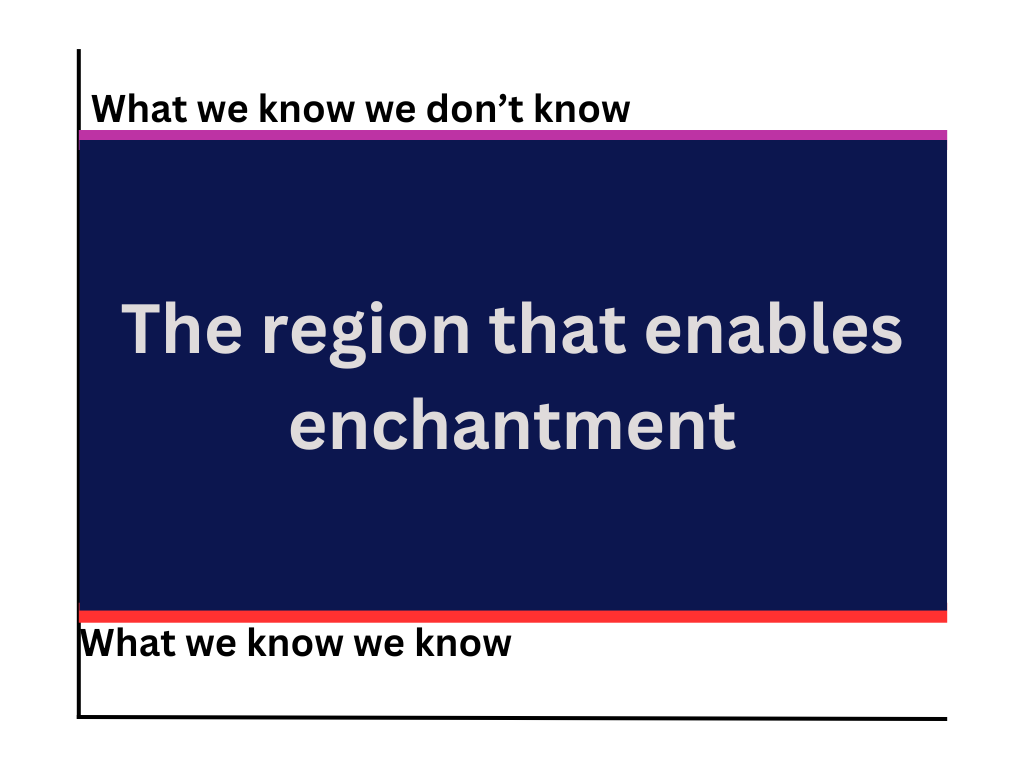
The upper and lower bounds are variable. The area between them rises and falls. Enchantment requires a large area as a prerequisite. But size is not enough.
Enchantment and Wonder
When you learn everything you hope to know, then you will have your hell.
Known ignorance enables enchantment. However, enchantment is an emergent property. It emerges when we accept our ignorance and allow ourselves to feel awed by the enormity of the world. A sense of wonder emerges. Thus, wonder is an appreciation of one’s relative inadequacy. It occurs when we accept the experience of our ignorance.
The feeling of wonder enchants the world. People who experience it interpret the world differently by imbuing it with a subjective quality. That quality is enchantment,
So enchantment is born from acceptance of one’s ignorance.
Meanwhile, wonder drives discovery. Yet, discovery disenchants the world because it adds information to Set 1. An increased appreciation of one’s ignorance must accompany it to prevent the cynicism that follows. If that partner is absent, then the world becomes mundane.
QED. The world is mundane. But it was once enchanted. So we must have learned. And our learning was unaccompanied by a rise in humility.
How did that happen?
The World Was Enchanted
I stared into the abyss. The abyss stared back into me. Little did the abyss know, I was the class staring contest champion in the fifth grade. And I was determined to win. We stared for a long while. Then the abyss blinked. I didn’t think an abyss could blink. But I was wrong. I’m wrong about a lot of things. But not this. Thank God.
Man was once ignorant. When he was more so, the world was enchanted. He is still ignorant, but less so now, and the world has become mundane.
Disenchantment needn’t have occurred. It was inevitable that man would learn more. Yet as his knowledge increased, i.e, as Set 1 grew, Set 2 could have grown too.
But it didn’t. If it had, then man could still perceive himself as blissfully ignorant. The world would have remained enchanted. And man could keep his greater knowledge.
So he could have eaten his cake and had it too.
He still can.
We Disenchanted It
…But the hearts of men are easily corrupted. And the ring of power has a will of its own. It betrayed Isildur to his death. And some things that should not have been forgotten were lost.
-Galadriel, Fellowship of the Ring
The world is changed.
I can’t feel it in the water.
I can’t see it in the earth.
I can’t smell it in the air.
Much that once was is lost, for none now live who remember it.
It began with the writing of the Great Books. Three were given to the Greeks, heroic, wisest and bravest of all beings. Five to the Hebrews, great scholars and craftsmen of the honeyed lands. And nine, nine books were gifted to the race of Rome, who above all else desire power. For within these books was bound the wisdom and the will to govern each race. But they were all of them myopic, for another book was written.
Deep in the land of Gaul, in the Dominican House of Studies, the Catholic Preacher Aquinas wrote a master book, and into this book he poured his reading, his piety and his will to answer all life.
One book to rule them all.
One by one, the free lands of Europe fell to the power of the book, but there were some who resisted. A last alliance of Greeks and Varangians marched against the armies of the Venetian, and on the very walls of Constantinople, they fought for the freedom of Europe. Victory was near, but the power of the book could not be undone. It was in this moment, when all hope had faded, that Alexios, relative of the emperor, took up his family’s sword.
The Vatican, enemy of the free peoples of Europe, was defeated. The book passed to Reginald, who had this one chance to destroy scholasticism forever, but the hearts of men are easily persuaded. And reason has a will of its own. It betrayed Reginald, to his death.
And some things that should not have been learned were gained. Myth became legend. Legend became History. And for two and a half centuries, the intellect passed over all knowledge. Until, when chance came, it ensnared another bearer.
It came to the sorcerer Faust, who took it deep into the forests of Germania. And there it consumed him. The intellect gave to Faust unnatural long life. For five hundred years it poisoned his mind, and in the gloom of Faust’s Tower, it waited. Darkness crept back into the forests of the world. Rumor grew of a shadow in the East, whispers of a nameless fear, and the intellect perceived its time had come. It abandoned Faust, but then something happened that the mind did not intend. It was picked up by the most unlikely creature imaginable: a hobbit, Peter Jackson, who filmed the Shire.
For the time will soon come when hobbits will shape the fortunes of all.
Simple Form of the Above
He who breaks a thing to find out what it is has left the path of wisdom.
-Gandalf, about Saruman
It is wrong to explain things. It is better to describe them. I know it. Few do. Their father, Faust, has taught them wrongly. Among his many madnesses is the lie of knowledge’s supremacy. But Faust is a bad father, and his children rarely possess the intellect to match Faust’s false virtue. Thus, they be frontin’.
Therefore, the beauty of the above will be lost on them. Demands for explanations arise from the void like nameless things escaping the deep pits of the earth. Their tentacles seize hobbits who rest too close to the lake and are best avoided.
But I tamed this one.
The Discovery of the Disenchanting Method
Western philosophy disenchanted the world. It contains an impulse to investigate and learn about the universe, which arose from a sincerely held and healthy Christian belief. Through its indulgence, that curiosity nurtured Set 1, while Set 2 remained stagnant.
The belief affirmed that God is orderly, the universe is orderly because God created it, and man can understand and express this order in language and mathematics. We take this view for granted today, but it’s truly a recent development in the history of philosophy. It is also unique to Western Philosophy—no other intellectual tradition developed the same outlook. This is why Western knowledge triumphed over all others.
It coalesced in Thomas Aquinas, a widely read Augustinian friar before his canonization. He sought to use his superior reading of the Greek and Christian classics to build a compendium, the Summa Theologica, which could answer all questions a Christian might plausibly have about the divine. Although Aquinas later considered the attempt a folly, the Catholic Church received his work as a masterpiece and used it as a cornerstone of Catholic theology.
Thus, the Vatican enshrined Aquinas’s mistaken drive to answer all theological questions and affirmed the method and precepts Aquinas used to create them.
Aquinas’ notion of an orderly and comprehensible universe that ought to be explored was later grasped by Francis Bacon, who, being English, applied it to more practical matters.
By Bacon, Empiricism was born.
Thus, Western thought enabled empiricism and its related ideologies and methods. Their combined application increased the volume of what man knows of the world. Enchantment might have endured had the great learning borne greater humility. Yet hubris was its accessory. For knowledge is the soil of temptation, and the gardener was barred from the garth.
The Death of Humility
Don’t you think if I were wrong, I’d know it?
-Sheldon Cooper, The Big Bang Theory, The Jiminy Conjecture
The enlightenment of the Western mind precipitated an enshrouding of the soul. It needn’t have happened. However, reason is an ouroboros that forgets its premises and devours them. So growing reason inevitably turns against itself, and Empiricism was the inflection point.
Empiricism destroyed humility because it converted a conclusion into a premise and people forgot how the conclusion was deduced. The scientific method presumes the universe is orderly and comprehensible and requires a linear theory of time. The Christian understanding of God was necessary for accepting these three premises, which is why Empiricism emerged in Western Europe alone. So Empiricism is a conclusion of Christian thought with an attendant method that appears superficially secular.
The method can be used without consciously accepting the Christian premises.
Empiricism is a Christian method that can be applied without conscious assent to Christian principles. The early empiricists were generally aware of the former, which is why many important Enlightenment scientists were notably Christian—they were still close to their method’s origin. They were aware of the premises embedded within the scientific method. However, time passed, as time does, and the reasonings that yielded empiricism slowly fell out of common memory as empiricism aged.
The connection between science and Christianity attenuated.
As it did, people employed the method without affirming its Christian precepts because they failed to see how one produced the other. The severance was accompanied by a hubristic belief that the three precepts were self-evident. Thus, the connection between science and Christianity was lost, and ideas once justified by belief in God were misassigned to human reason.
The severance occurred over time and lacked an initiator. However, Martin Luther and John Locke's efforts accelerated the process.
Luther did so when he advanced anticlerical thought and reintroduced the sola scriptura heresy into Western Europe. The former undermined religious faith generally, while the latter inflated the importance of human reason as a tool for understanding the world. Both brought larger portions of information into the realm of knowledge obtainable through human reason.
Locke built upon Luther’s destructiveness by introducing the social contract theory in his Second Treatise of Government. The theory provided a secular explanation for the origins of the nation-state and undermined all peoples’ mythological understandings of their origins and reason for being. The theory also advanced an economic and protectionist leadership theory, which undermined kings' divine right to rule. Thus, the grandeur and mystique that nobility once imparted were destroyed by reason, and nations’ connections to the transcendental were lost.
Mephistopheles
Vitalist: Yeah, we gotta save the West, brah!
Gene: Faust gave his soul to the devil. Let him go.
Empiricism arose from misguided and sincere fidelity to Christian precepts. The precepts were slowly forgotten, and appreciation turned to apathy. Apathy gave way to resentment as the institutes of the Christian religion persisted while the mythology used to justify them fell away. The religion became material and destructible.
Some tore into it with glee.
It began with Baruch Spinoza, a Jewish heretic (the rabbis called him a heretic), who fled Portugal during the 1600s and arrived in Amsterdam during the Dutch Golden Age. While there, he published numerous works which would later scaffold the atheism of the Late Enlightenment. Spinoza thought widely rather than deeply, so his thinking can be found across many fields. However, he is none’s greatest contributor, so historians frequently acknowledge his influence, although his name rarely appears in lists of thinkers who made significant breakthroughs. His promiscuous intellect scaffolded the thinking of numerous Enlightenment thinkers whose works were as many strikes of an axe against the enchanted tree.
The first man to strike the tree was Richard Arkwright, who invented modern factories. He enabled Britain’s industrialization and created the apparatus that drives the need to regard the natural world materialistically. The need emerges from the factory’s high productivity and use of natural resources as fuel. Thus, by Arkwright, trees ceased to be trees and became timber.
Karl Marx felled it when he created a materialist worldview in Communism that could replace the spiritual one which Christianity had advanced. He built his error upon centuries of materialist thought and appealed to the disenchanting method of empiricism for justification. Marx’s disenchanted worldview was a tool that appeared capable of filling the void left within Christendom’s husk.
Charles Darwin burned the stump when he proposed a materialist origin of man. This error was lacking within the Communist worldview, but it accentuated the former nicely and filled a large hole that Christianity alone occupied. Darwin, despite considering himself Christian, effectively completed the puzzle Marx had made. Thus, man had finally been disenchanted.
Friedrich Nietzsche declared it dead, although he had little to do with the world’s disenchantment and observed it as an afterthought. He thereafter invested his time in providing material that could give men the meaning the disenchanted world could not offer. While his project failed during his own life, it may still bear fruit. However, it will not do so until the challenge he advanced on behalf of atheism is met: how to replace God.
The Partitioning of the Mind
While the secularizers were biting into the Christian mythos that held firm all they had inherited, a second group was hard at work ensuring the world would remain disenchanted. One faction burnt the crops, and the second salted the fields. Strangely, this second group is rarely addressed, and I may be the first to recognize the damage they’ve done.
They are the categorizers and developed systems for organizing information acquired through empiricism. The set contains three notable men: Samuel Johnson, who invented the modern dictionary; Carl Linnaeus, who gave us taxonomies; and Melville Dewey, who invented the Dewey Decimal System. Through their efforts, the disenchanted world acquired tools for infecting the minds of those caught unaware.
The categorizers cemented the disenchanted world by imposing structure on the information gathered throughout the Enlightenment. These structures exist at a level of abstraction that most humans fail to consider, so they are tacitly accepted. Their acceptance damages thought because the structures compel users to place information into discrete categories. However, most information belongs to several categories. For example, math is used in numerous fields, so placing mathematics in one category damages thinkers’ ability to recognize its influence on others.
Thus, categorization severs our connection to large portions of knowledge while convincing the thinker of their brilliance. In the language of the above sets, categorization moves knowledge into Set 4 by taking it from the others. The partitioning creates further problems because it hinders Faustians’ ability to detect emergent phenomena. Emergence occurs when knowledge from several sets intermingles. And much enchantment is borne from a reaction to inexplicable emergence. So the Faustian habit of building hard boundaries between knowledge domains damages his ability to recognize ignorance, certainty, and possibility.
Retention in the East
Truth is a person.
-St. Nicholas of Serbia
It is a strange and underappreciated fact that the philosophers of Ancient Greece were more beloved by thinkers in Western Europe than by their Greek successors. The Romans and their inheritors, mostly European, appreciated intellectualism more strongly than the Greeks and Slavs, who, being partly Asiatic, were predisposed to mysticism and mythology. Thus, the East never embraced scholastic theology.
Yet scholasticism created empiricism. Western Christians developed the latter while it was undiscovered in the East. Thus, disenchanting methods came slowly to Eastern Europe. Their tardiness allowed the region to retain its mystic connotations. Much can be gleaned from their retention, but that is a topic for a different day.
Who to Blame
The sequence of thinkers who disenchanted the world is discernible. I can trace its development from start to finish because I’ve read most of the Western canon and am generally knowledgeable of our thoughts’ genealogies.
Here’s the sequence:
Plato → Plotinus → St. Augustine → Thomas Aquinas → Martin Luther → Francis Bacon → Baruch Spinoza → Various Enlightenment Intellectuals→John Locke →Samuel Johnson → Richard Arkwright → Carl Linnaeus→ Karl Marx → Charles Darwin → Friedrich Nietzsche → Melville Dewey
And here are their charges and guilts:
Plato: Created The Republic, which would later scaffold scholastic theology. Guilt: 2/10.
Plotinus: Used Platonic philosophy to prove monotheism. Guilt: 3/10.
St. Augustine: Realized the god Plotinus proved was the God of Jacob. Used the aphoristic writing style Aquinas would later copy. Created the legacy Aquinas would inherit. Guilt: 7/10.
Thomas Aquinas: Popularized scholastic theology and cemented its methods. Guilt: 10/10. Without Aquinas, the world would have remained enchanted.
Martin Luther: Undermined the Catholic Church and organized religion in general. Amplified anticlericalism. Guilt: 9/10.
Francis Bacon: Created Empiricism, the tool used to systematically disenchant the world. Guilt: 6/10.
Baruch Spinoza: Introduced the strain of atheism that would later overtake Enlightenment thought. Guilt: 7/10.
Enlightenment Intellectuals: Produced material for a disenchanted worldview. Collective guilt: 7/10. Individual guilt: 2/10.
John Locke: Created the Social Contract theory of government and undermined the divine right of kings. Guilt: 7/10.
Samuel Johnson: Created the modern dictionary. Guilt: 5/10.
Richard Arkwright: Invented the modern factory and enabled industrialization. Guilt: 6/10.
Carl Linnaeus: Invented modern taxonomies and revolutionized zoology. Guilt: 5/10.
Karl Marx: Developed a materialist understanding of the world to replace the prior one. Guilt: 8/10.
Charles Darwin: Delivered the finishing blow to the dominant Christian worldview. Guilt: 6/10.
Friedrich Nietzsche: Declares the death of God and the end of mysticism. Guilt: 3/10.
Melville Dewey: Invented the Dewey Decimal System and revolutionized knowledge organization. Guilt: 5/10.
This timeline yields little value, but it is a useful guide for those who might research the history of our disenchantment. Enchantment is a subfield of phenomenology, so a small population will always be interested.
We Can Re-Enchant It
History became legend, legend became myth and for two and a half thousand years, the ring passed out of all knowledge until, when chance came, it ensnared a new bearer.
-Galadriel, Fellowship of the Ring
Enchantment emerges from our relationship with our ignorance. The ignorance which enables it is a function of Sets 1 and 2. We can adjust the two sets’ sizes. Therefore, we can adjust our ignorance and direct a healthier attitude toward it.
But here’s the problem with that.
We’ve already learned much about the world, so discovering ignorance is superficially harder. Enchantment seems unlikely unless we are willing to forget what we have already learned. Yet if we did that, we would enter a futile cycle wherein we continually learn and forget things in pursuit of a dream. That’s a problem.
Here’s the workaround.
Our environment stores information, which we can manipulate to store additional information. Once stored, information may either be forgotten or never learned, so its container becomes a black box. When it performs a desired function, the mystery of the black box evokes enchantment. Moreover, all innovations interact with existing knowledge to produce emergent phenomena.
These emergent behaviors are unpredictable and resist attempts to model them.
Furthermore, scientific advances that enable the material means of our existence allow us to forego the analytical thought once needed to produce them. Thus, technology grants permission to be dumb. It does so first at a social level, but the ignorance technology enables passes into the genome after a few generations. The resultant population is uniquely prone to enchantment.
Therefore, we can enchant the world by embedding technological mastery within it.
How Technology Enchants the World
Note: Art embeds knowledge and skill as well. That which art embeds differs from that which technology embeds. However, I do not address the difference here.
Technology enchants the world because it stores knowledge. Once learned, knowledge may remain in the head or be embedded in the world as technology. For example, a clock stores knowledge of engineering and timekeeping. Once stored, the knowledge becomes useful, and its possessors may forget it. Moreover, the impetus to learn weakens. Thus, technology returns the world to an unknown state.
The unknown state generates new knowledge. The technician who embeds their knowledge within a material work predicts that work's future imperfectly. Consequently, unknown emergent phenomena occur because of the work’s existence. These phenomena may be understood and navigated. Therefore, embedded knowledge creates the potential for discovering new knowledge.
The return of the unknown, which precipitates wonder, creates enchantment in two ways. First, it returns knowledge to an unknown state. Second, it allows more knowledge to become knowable. Meanwhile, technology ensures that forgotten knowledge remains useful. Thus, the futile cycle of learning and unlearning is avoided.
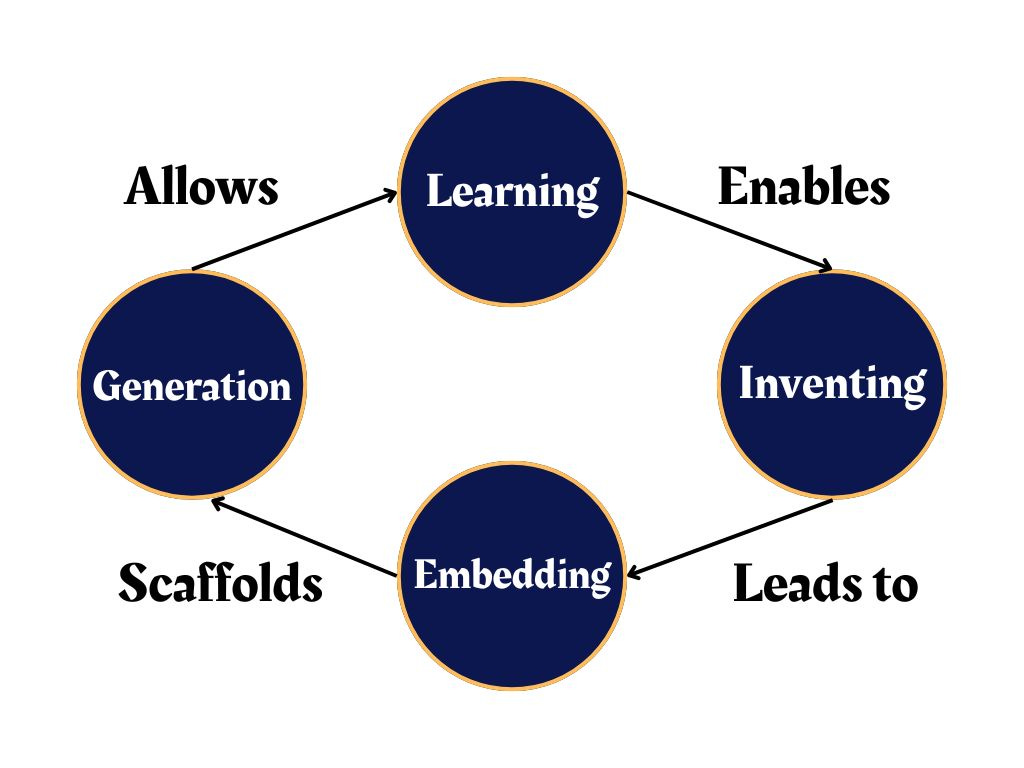
Therefore, people may have their cake and eat it, too, if they participate in a cyclical process with their environment. They first learn, followed by invention and embedding. The embedded knowledge is returned to the environment, where the changed surroundings generate new unknowns and additional learning opportunities. At that point, the cycle renews.
The cycle is called the LIEG loop (or the ELSA loop, given the subject matter) and is shown in the following image.
How Faustian Virtues Destroy Enchantment
“Rule of thumb: if you think something is clever and sophisticated beware-it is probably self-indulgence.”
- Donald A. Norman, The Design of Everyday Things
Faust hates magic. He worships the intellect as a false god, and magic resides where the intellect does not. Yet the intellect is a vain and jealous god and cannot bear the sight of its boundaries. Therefore, Faust cultivates virtues that allow him to enter the Unknown Regions. Yet they contain an unknowable being which, being ancient, knows him — and me. These are virtues of Faust’s false god.
Materiality: Enchantment thrives on ignorance. Ignorance exists where information is unknown. It may be unknown for two reasons: negligence and unknowability. Negligence cements ignorance when learners refrain from discovering what is unknown. Unknowability enables ignorance because of the brain’s limited capacity for learning. Materialist interpretations of the world destroy the latter because they bring all knowledge into the domains of what can be sensed and conceived. Thus, materiality undermines ignorance.
Analysis: Materiality brings all knowledge into the realm of the knowable. From there, the only impediment to knowledge is the negligence of learning. Material knowledge is acquired via analysis. So it allows Set 1 to devour the others.
Systemization: Knowledge must be organized and accessible to be useful. Faustians create systems to impart these qualities. Systemization is the propensity to create these systems. Some humans systematize without prompting.
Sadism: We have experienced disenchantment and are aware of the disappointment accompanying it. Others have too. Some are sociopaths. They know that learning disenchants and demoralizes. So they disenchant to evoke feelings of disappointment in others. Quintessential examples include a man explaining a magician’s tricks or spoiling the end of a movie.
Intelligence: The light of the divine shines dimly and is seen in the oldest stars. The light of Mephistopheles shines brightly and is seen first in knowledge before giving way to fire. The quick-witted grasped his first light fastest. In their illumination, they discern all that comes to them in frenetic pursuit of the dream’s end while ignoring what nightmares may come upon waking. Mephistopheles is well pleased and rewards his faithful accordingly — in situ and in scene.
The Faustian worldview has many strengths. But it is not impervious. Its armor lacks several scales, and I see a crack leading to its heart. He doesn’t know of it — and can’t.
The Ring’s Hubris
But then something happened that the Ring did not intend. It was picked up by the most unlikely creature imaginable.
-Galadriel, Fellowship of the Ring
The intellect is arrogant and always blind to its shortcomings. It doesn’t know what it doesn't know. Faust doesn’t know it, though. Thus, Faust thinks he understands things that are truly beyond him. So he miscategorizes information. His method is always the same: He prematurely adds information to Set 1 and takes it from the other sets. Thus, much of what Faust knows is only half-known — if he even knows it at all. His vanity compensates for all fogginess and fuzzy boundaries. Therefore, the quality of Faust’s data is always poor. He is vaguely aware of its inaccuracy and cleans it regularly.
However, a period exists between when Faust learns his wrong information and when he detects the error. So the poison he permits can spread into adjacent realms of knowledge before cleaning. Therefore, Faust must compartmentalize large swaths of his knowledge to prevent cross-contamination. In so doing, he guarantees his ignorance of emergent phenomena produced by interactions between the sections.
So Faust’s gratuitous learning poisons and blinds him to certain truths. However, these are not his greatest flaws. I discerned another that has never occurred to Faust because the alchemist is a nerd who fears departing the gloom of his tower. The thoughts he must think to see what I once saw have never passed through his mind.
A virtue exists that he is unable to know. It will be his undoing.
It will create the perfect moment.
The Importance of Being Dumm
Our greatest stupidities may be very wise.
-Ludwig Wittgenstein
Faust thinks he’s smart. His children mimic his hubris. It’s because they’re midwits.
The midwit exalts intelligence as a paramount virtue and loves paying lip service to the ideas greater minds have thought. The midwit fails to create ideas and can’t because of its learning disabilities. The rare occasions during which the midwit pulls together an actual thought rather than a quote or a buzzword reveal its poor reasoning and show its massive blind spots.
The midwit is aware of its mediocrity. Yet, it loves to posture profundity. So it exalts intelligence in an unintelligent way. Its malformed method tends to attribute false and malproportioned properties to the mind. Most, like prolixity, are unrelated to a person’s intelligence. However, a few point in the right direction.
The most common property midwits attribute to the intellect is the possession of facts. A distant second is the ability to think. The intellect possesses these two, but an unappreciated third exists, and the midwit misappraises their relative importance. Therefore, the midwit’s malformed understanding of the mind ignores a crucial element of reason and does so in a way that destroys the ability to acquire it.
Moreover, the midwit’s cultural influence guarantees the dominance of its bad ideas.
So recognizing the third virtue of the intellect is necessary for a healthy relationship with intelligence and enables an understanding of the intellect which is superior to that kept by Faust and his children. Its cultivation appears to them as endumbening because of their malformed interpretations.
The virtue is curation.
What Curation Is
Curation is the ability to select pertinent information given a set of facts. It is not deductive reasoning, although it may sometimes use syllogism to identify facts. Thus, it is mostly pre-rational. Moreover, value judgments drive it, and those values often emerge from an interaction between a person’s natural tendencies and environment. It exists alongside intelligence, which is a person’s ability to process information, and memory, which is a person’s ability to store knowledge. It allows a thinker to address questions of what should be, while the other two address questions of what can be and what is. Curation, therefore, is the virtue that allows one to cross the Is-Ought gap. Recognizing it allows us to adopt a trinitarian model of the mind.
The model’s constituents are thus:
Memory: The mind’s storage capacity — answers what is questions
Intellect: The mind’s reasoning ability — answers what can be questions
Curation: The mind’s selectivity — answers what should be questions
Curation exists alongside memory and intellect. They should be symbiotic, and they often are. However, one may exist at the expense of the others. When this imbalance occurs, strange learning disabilities emerge. They are analogous to the physical problems a person encounters when they over-exercise one arm while neglecting the rest of their body. Faustians normally suffer from this imbalance.
Curation over Knowledge
Curation exists in watchful peace with learning. As the volume of what is known increases linearly, the difficulty of organizing it rises exponentially. Thus, curation collapses as knowledge accumulates because its workload is unassailable.
Furthermore, the phenomena that arise when facts are arranged are too manifold to predict. Learning, ergo, drives the disintegration not only of our ability to curate knowledge but also our ability to foresee its entailments. The loss of curation raises the variability of and discord among the potential sets of facts. So learning introduces chaos into systems as it suppresses curation. Much of the chaos can be hostile toward our ability to learn and store information. Therefore, learning, having gone too far and too fast, implodes.
Knowledge thereby undoes itself as it sacrifices curation at its altar. Reasoning collapses immediately afterward.
So curation must be valued above learning and thinking for any to remain.
The Virtues that Enable It
The fault is not in our stars, but in ourselves.
-Shakespeare, Julius Caesar
Enchantment is a phenomenon that emerges from our relationship with our ignorance. Certain virtues mediate the relationship. We can cultivate or ignore them. If we ignore them, the world will remain disenchanted. But we can rediscover magic by tending the spiritual garden. I espy four flowers in need of water.
Versatility as a Source of Humility
Everyone thinks their bullshit is oh-so sweet and special. They’re wrong. Except for me. Mine really is the best. I’m the exception because (insert self-serving rationalization here).
-What Everyone Secretly Believes
People aggrandize themselves. They do so by identifying their sole desirable trait and inflating its importance. The exaggeration creates a personality disorder. The disorder is reverse crippling and emerges when a person values one thing at the expense of others. It produces delusions of grandeur in the sufferer and blinds them to the value of others whose talents lay in the lessened domains.
Its cure is versatility. People immunize themselves to reverse crippling when they cultivate skills and knowledge across manifold domains. This spiritual gardening trains one to recognize a greater number of virtues. In so doing, others’ lights become visible where they were once unseen. The enlightenment of the versatile mind enables humility because it allows the owner to see lights brighter than their own — and admit it. Admission is also less painful because the rounded man may recognize his particular configuration's value and excellence in varied fields.
Thus, versatility improves our ability to recognize Set 2 and raises the potential for enchantment.
Industry as Information Storage
Industry allows us to forget knowledge, shrinking Set 1 through amnesia while expanding Set 2 through awe and acceptance.
Our environment stores knowledge, which we can construct and arrange. For example, a traffic light stores knowledge of electricity, timekeeping, and traffic laws. We do not need to know the information stored within the light to use it. Thus, through strategic engineering and placement, we can forget information. Doing so enchants the world by raising its upper bound and lowering its bottom.
Magicians who combine artistry and engineering to display their genius have already proven the practicality of doing so. That their profession is known for enchantment validates the argument. Hecklers who break the illusion by explaining magicians’ tricks further reinforce the premise that knowledge dissolves enchantment.
Creativity as an Enchantment Injector
Creativity scaffolds enchantment. It drives the creative process, whereby known quantities are combined in new ways. The novel combinations creativity enables expand the four sets. They initially do so through procedure, whereas they later enchant because of emergent behaviors and our relationship with them.
Procedure inflates the sizes of sets 1, 2, and 3. The creative process expands Set 1 as we learn of novel combinations and their immediate effects. Set 2 grows as we discern the unassailable flaws in our creative designs. Set 3 expands because we fail to discern the corollaries of the previous two sets.
Emergence inflates the four sets after the procedure creates its work product. Set 1 expands when we discover emergent behaviors between created works. Set 2 expands when our knowledge of Set 1 casts its shadow. Set 3 expands when we fail to discern members of Set 2. Set 4 expands as we fail to identify members of the first two sets. Thus, emergence increases the total amount of information available and distributes it throughout the sets.
Amnesia as Information Leakage
Only problem is, I can't remember what I've forgotten.
-Neville Longbottom, Harry Potter and the Sorcerer’s Stone
Enchantment is inversely proportional to one’s memory. People who easily forget to move information from Set 1 to Sets 2 and 3. Over time, the memory of the movement disappears. Thus, amnesia enables further opportunities for ignorance and expands Set 4. The ability to forget is a lock on the door to enchantment.
Ambition as a Source of Amnesia
Ambition is the key.
Ambitious people aspire to achieve goals. The pursuit requires them to master some skills and knowledge at the expense of others. The useless information is neglected and then forgotten. So goal-oriented behavior, while driving learning in areas relevant to the goal, also generates ignorance of irrelevant areas. Those areas become enchanted in the process. Therefore, enchantment is a function of goal-oriented behavior, and as a population loses its aims, it often becomes disenchanted because areas that were once ignored come under increasing scrutiny. Meanwhile, the absence of goals severs the connection between the knowledge acquired and its telos. Therefore, cynicism emerges within the learner as would despair in a man suffering from an unslakable thirst.
The Requisite Action
Linger a while, thou art so fair.
-Faust, losing his bet
We need to embed knowledge in the environment and forget it. If the first is done, the second will follow without prompting. Doing so necessitates investigation and investment in the fields responsible for invigorating the environment with human knowledge. Relevant fields include electronic engineering (for its applications in internet-of-things technology), cybernetics, and genetic engineering.
This is a topic for another post. The what to do and the why to do it are easy answers to find. The how it should be done is also visible, but I lack the gear needed to dive down to the bottom of the iceberg.
Various Corollaries
While writing this, I thought of several auxiliaries to my topic and placed them here.
I will add future epiphanies to this list.
Why Women and Word Nerds Are Prone to Enchantment
It’s because they’re bad at math.
Scientific methods disenchant the world. People who are bad at math struggle to apply them. Women and word nerds, e.g., philosophers, historians, writers, and theatre kids, are bad at math. They struggle to apply disenchanting methods. Therefore, their cultural dominance should yield a re-enchantment.
Why Autists Are Immune to It
Sorry I explained the trick. I’m autistic and thought you genuinely wanted to know how it worked. I didn’t realize you wanted to remain ignorant. I mean it sincerely.
-The Autist’s Sincere Apology
Humans vary. We have different interests. Some value fun and others value loyalty. Oddly, some people regard systemization as one of their chief values. Their brains are predisposed to Faustian tendencies. Such people are autistic and tend to disenchant things out of a genuine desire to learn. Barriers can constrain their natural inclinations.
Unfortunately, the forces which discourage people from demystifying objects are often social pressures, which autists are immune to. Thus, autistic people constitute an ineradicable source of disenchantment within a population. However, they are easily stopped and receptive to eudirection.
The Problem with Jews
Jews are cynical. Their culture inculcates cynicism, and their ownership of media agencies broadcasts it. That’s a problem because cynicism is the opposite of wonder. It arises when learning yields disappointment.
The disappointed student learns to distrust the unknown because it has burned them. Once burned, he assumes too much about it and moves knowledge from Set 2 into Sets 1 and 4. Thus, he destroys his capacity for enchantment.
Therefore, the world will remain mundane either until Jews become more optimistic or until their influence over media declines.
The Emergence of Techno-Wizards
Any sufficiently advanced technology is indistinguishable from magic.
Technology is embedded knowledge. As the knowledge is forgotten and people number, it becomes enchanted. Thus, tech wielders are effectively wizards. Therefore, we can expect a return to sorcery to coincide with embedded technology. Moreover, if the items that store knowledge can generate spectacles, then the wielders can convince the ignorant peoples of the future of their majesty and, possibly, divinity. The emperors of the earliest nations did something similar, and they possessed far less power and showmanship than the magitech wielder of the future.
Tour de force of a post