
Freedom and Its Opposite
An Intro to the Misconfigured Dichotomy

People model the world with dichotomies without being instructed to. The preference for dichotomous models exists subconsciously, and the ability to construct more complex models is a function of IQ. Many people use dichotomies because they genuinely lack the abstract thought needed to use higher-order models. Others use them because they are lazy.
Dichotomies are useful. Most of the time. A large portion of the world can be effectively modeled using dichotomies, and even nuanced systems often have two primary forces that drive their behavior. So many complex models can be reduced to dichotomies with a negligible loss in utility.
However, dichotomies can be misconfigured. A misconfigured dichotomy exists where one thing is set against another that is not its opposite. These differ from false dichotomies because the model of a two-part macrostate of the system is correct, but one part was misidentified.
I contend that freedom exists in a misconfigured dichotomy. It is contrasted against slavery, which is the apparent opposite. However, there are many ways in which the opposite may be understood. Another understanding places obligation as the opposite of freedom. If you must do one thing, then you are not free to refrain from doing it. So, two potential dichotomies exist and shape how we think about their members. Others exist as well, but they are outside this post’s purview.
The dichotomy selected from the set of potential dichotomies is chosen for ideological reasons. The liberal order favors the freedom-slavery dichotomy (FSD), and its preference drives atomization and degeneracy. However, a healthier and more conservative model is the freedom-obligation dichotomy (FOD) because it is necessary for rebuilding social capital. The FSD must be replaced by the FOD to overcome the social decay enabled by modernity. However, I have not observed any thinkers addressing this issue, so I will explain its importance here.
The Freedom-Slavery Dichotomy
The FSD is inferior to the FSO. Liberalism favors it, so Western countries adopt it. Their populations make tradeoffs accordingly, and we are poorer for it. What we gain in freedom is conceived of as a movement away from slavery, yet it is really a dissolution of social obligations. So freedom is purchased at the cost of group membership, and the loss of community torments people.
What It Is
The FSD presents questions of freedom as conflicts between individuals. Where one person’s freedoms rise, another’s fall. One man’s freedom to do conflicts with another’s freedom to deny — and denying bad deeds is good if we want to have nice things. Yet the FSD automatically assigns moral superiority to the side of freedom because of the word slavery’s connotations. Therefore, the FSD encourages the delusion that destruction and degradation are good because their denial infringes upon the freedom to be antisocial.
The FSD also permits creation, but the number of aspirational and creative people is low relative to the number of psychopaths and scumbags. Hence, the influence of the latter is far more pronounced. Thus the net effect of the FSD is collapse wherever it exists.
Why Liberalism Favors It
Liberalism favors the FSD because it reduces the complexity of questions regarding freedom in a way that favors its expansion. Such a reduction is useful for a worldview that exalts the individual as the greatest good. However, it is also misleading and myopic. It is deceptive because it fails to present the cost of freedom. Myopia arises from the misrepresentation because the detriment imposed by the sustained costs to social capital is noticeable only after a long period of decline.
What Individuals Get
Individuals receive time, energy, and agency over their choices. A society that espouses the FSD as the default model grants moral superiority to people desiring freedom and demonizes their critics. So, members are free to abandon their obligations to social groups. Their abandonment is accompanied by increased free time, energy, and agency, which would have otherwise been spent on obligations.
Except, Not Really
People do not receive the proposed benefits of liberalism. In theory, they could. However, the conditions that must be met for the benefits to be realized are absent from modernity. Propaganda is to blame.
A microminority of men can generate their own values. But for the rest of mankind, values are assigned to them. They go where they are told to go, want what they are told to want, think what they are told to think, and hate to deviate from the norm. The great morass of mankind is directed by propaganda, and individual freedoms are unobtainable for them because of their susceptibility to brainwashing. Yet liberalism permits the creation of apparatuses that propagandize people; they take the form of corporate marketing efforts and news media.
Liberalism promises time, energy, and agency, but these do not benefit those who receive them. They are repurposed for the benefit of propagandists, who are more impersonal and less altruistic than the societies that would have taken them instead.
So, liberalism fails to keep its promises, replacing one set of constraints with a more insidious one.
What Individuals Lose
The FSD condemns people to lose others, their community, and themselves. The preoccupation with personal freedom permits them to abandon their obligations and sense of propriety toward others and, if exercised, leave the free person atomized.
Yet atomized people are easily brainwashed. So, the person who loses others loses himself. The propaganda takes him — like a hawk grabbing a snake in the open grass.
However, even people who resist the brainwashing lose their ability to leverage their newfound freedom. They secure the time and energy promised, but their agency declines because the number of options available to them does. The options disappear because many activities require a healthy society for us to access and enjoy them.
For example, if you want to use your freedom to go to the pool, and if everyone is exercising their freedom to defecate in the water, you would not use the pool. Alternatively, if you wanted to go to the movies, and if all the seats in the theater were sticky because sloppy people kept spilling food and drink on them, then you would stop attending. All organization-sponsored pastimes require the existence of people who have renounced their freedom to be antisocial to form a functional society.
So, people who resist brainwashing are still less free because the set of activities that they might perform shrinks. This is the real reason for our increasing insularity.
The Social Consequence
The social consequence is the dissolution of all bonds, which require the sacrifice of freedom on behalf of others.
Churches lose members who no longer feel obliged to serve them and sacrifice their old god at the altar of freedom.
Marriages disintegrate as one party exercises their freedom to throw the other away — often denigrating the discarded partner in the process. The consequence is usually prolonged misery for both because the discarding partner is typically a woman whose sociopathy follows her and destroys future relationships as well.
It dissolves the bonds between parents and children, too. Parents begin by abdicating their responsibility to raise the young in favor of their own gratification. Their offspring, never having bonded with their parents, return the favor in their old age and ignore the people who neglected to raise them when they were elderly.
Communities dissolve as the antisocial behaviors permitted by freedom transform social capital, such as libraries, bars, pools, and theatres, into wretched hives of scum and villainy.
Ultimately, the loss of community in its many forms, which is the consequence of sacrificing obligation at the altar of freedom because it was mistaken for slavery, destroys incentives to participate in a society that exalted freedom as the highest good. So, people withdraw, and death and decay follow.
The Freedom-Obligation Dichotomy
The FOD is superior to the FSD. Feudalism favors it. I use the term feudalism to describe what others might call conservatism or tradition because it is a more accurate word due to the wide variance in the other two. The FOD model restores social capital at the expense of individual freedoms and leaves people more felicitous than the FSD. Ironically, it is more effective at delivering the promises of the FSD than the FSD while also keeping its own.
What It Is
The FOD is a model for describing freedom and its opposite. It is superior to the FSD because it introduces tradeoff analysis to questions of freedom and its expansion.
The FSD lacks such an analysis because freedom’s purported opposite is immediately demonized in all cases. So, all malicious activities done in the name of freedom are permitted unless they violate a person’s rights. Yet rights are meant to protect contentious freedom, so the apparent conflict is one between freedoms and lacks a potent countervailing force.
However, the FOD is more sincere and potent at limiting freedom’s malevolent effects because the social obligation is a genuine and defensible counter. This makes the FOD a better model for facilitating a healthy society.
Why Feudalism Favors It
Traditional societies are stable systems of systems. The presence of many subsystems is good because they varied hierarchies that allow for self-actualization. They also pull against one another and ensure that no one system becomes too powerful; this protects the people of that society from tyranny and promises them a social network and its attendant benefits.
Furthermore, the system of systems constitutes a social balance of powers. The balance among subsystems ensures the leaders of each can remain secure in their position and plan for the long-term health of the people over whom they are stewards. Thus, the energies that would be spent acquiring and preserving power can instead be invested in cultural and aggrandizing works.
However, this balance of social forces can only exist in a society where obligation is a powerful motivating force. Obligation ensures loyalty and reciprocity. It produces loyalty because obligation is the force that compels the virtue. It also enables reciprocity because one may act for the good of another while knowing the other is obliged to do them good in exchange.
So obligation secures leaders’ positions, provides the populace with the community while protecting them from tyranny, and permits the creation of works that glorify the whole.
What Individuals Get
People benefit from increased representation of their interests in a society regulated by obligations. The people feel obliged to serve their superiors dutifully so their rulers can trust them. Thus, these same rulers can comfortably expand their power and improve the living conditions of their subjects without fearing their abuse or retribution. A more symbiotic form of government emerges because of reciprocity.
Families also require an acceptance of obligation to one’s partner and to one’s children in order to exist. The failure to recognize this obligation has resulted in the widespread dissolution of families, and legions of semi-feral children, deadbeat fathers, and miserable mothers have been the product. Thus, obligation is the obvious solution to the problem of disintegrating families. Still, it cannot yet be applied because all attempts to do so violate the parents’ freedom to be loose.
Religion serves as a framework for instilling a commitment to social obligations, benefiting individuals and society. When people feel a duty to divine principles or a spiritual community, they often develop a stronger inclination toward responsibility and service. This sense of duty reduces individualistic tendencies, prioritizing personal freedom over the common good and fostering community trust. In such environments, leaders can confidently build and improve societal infrastructure, assured that the populace will support and sustain these efforts.
Likewise, families flourish when members recognize obligations to each other. Religion often reinforces these bonds, stressing fidelity, care, and sacrifice, which are essential to keeping families intact. Without this sense of obligation, families suffer from disintegration, leading to unhappy, fragmented households that struggle to provide for children and each other.
Religious commitment also nurtures reliable social networks, such as community groups or volunteer organizations. In a culture focused on personal freedom, people may easily abandon commitments, leaving organizations with ambitious goals unfulfilled due to inconsistent participation. Religion reinforces reliability, helping people keep their promises and participate actively, making these groups more resilient and productive. In this way, a society that values religious obligations can address community needs and social projects more effectively.
The economy relies on a shared commitment to obligations, making it possible for transactions and investments to flourish in a climate of trust. When individuals and institutions honor their financial responsibilities, such as paying debts, delivering services, or fulfilling contracts, the market becomes more stable and predictable. This mutual reliability fosters growth and prosperity, as parties can engage in economic activities without constant fear of fraud or default. By upholding obligations, the economy grows and becomes a self-sustaining system of reciprocal trust.
In contrast, when obligations are disregarded for personal gain, economic relationships suffer from volatility, and transactions become fraught with risk. Individuals may hesitate to lend, invest, or even participate fully in the market without the assurance that others will honor their commitments. In such cases, financial systems break down, leading to a cycle of mistrust and economic stagnation. Thus, prioritizing economic obligation over unrestricted freedom strengthens the fabric of commerce, allowing an economy to remain resilient and supportive of communal prosperity.
The economy also benefits from employers’ sense of obligation to local communities, leading them to prioritize hiring local workers rather than outsourcing. When businesses invest in local talent, they reinforce the economic health of their immediate environment, creating job stability and promoting regional growth. This commitment nurtures loyalty within the workforce, as employees see that their community’s welfare is valued, making them more likely to stay and contribute productively.
Clubs and other recreational communities also become possible because obligation is the cure for flakiness. Modern people struggle with flakiness, i.e., unreliability, because they lack the discipline to keep to their word. So many organizations with grand goals cannot achieve their goals because if their leaders plan an event, and if 70 of their 100 members say they’ll show up, then only a dozen will arrive on the day of doing. For this reason, many respectable ambitions are unrealized. Yet such misfortunes are reducible, and a society that exalts obligation can do so more easily.
What Individuals Lose
When people place social obligations above their freedom, they often lose both agency and the time and energy they might have invested in exploring their potential. Each day becomes a routine of fulfilling duties, guided less by personal ambition and more by the expectations of others. This constant deference to obligation drains the freedom to pursue what genuinely matters, redirecting valuable hours into tasks that often feel externally imposed.
Over time, the energy spent on meeting these obligations leaves little room for creativity or self-expression. Personal passions and unique aspirations fade as family, culture, or community demands set the course. While the sense of belonging can be comforting, the sacrifice of personal exploration limits individuals’ ability to shape their destiny and uncover their talents. This continuous focus on duty over choice diminishes the spark that could ignite genuine fulfillment and self-discovery.
Moreover, prioritizing social duty over personal agency subtly reshapes identity. Decisions start reflecting communal values rather than personal values, creating a life deeply intertwined with social expectations but less connected to individual aspirations. As people place their goals second, separating personal dreams from collective needs becomes harder, often leading to a quiet dissatisfaction where one’s voice and potential are muted.
Why the Loss Is Acceptable
Choosing social obligation over personal freedom may seem limiting, but the stability and security it brings make the tradeoff worthwhile for many. People create bonds of trust within their families and communities that enhance their lives by dedicating time, energy, and agency to fulfilling social roles. This commitment can provide a steady framework where relationships flourish, resources are shared, and each person feels a part of something meaningful and enduring.
Moreover, honoring obligations shapes a reliable structure for future generations, allowing them to inherit security and shared values. Sacrificing certain freedoms for social duty also encourages a sense of purpose that individualism often lacks. The agency redirected from personal whims toward communal good fosters a deep-rooted sense of belonging and identity more resilient than fleeting personal pursuits. For those who value interdependence over autonomy, this alignment with duty offers a purpose larger than oneself—a rewarding compromise for the sacrifices involved.
The Social Consequence
The social consequence is society. All societies require people to uphold obligations to one another, and their fulfillment necessarily violates people’s freedom to be antisocial. Society is preferable to atomization because humans have finite and easily describable needs. The needs are lost by relying on the FSD but regained and preserved with the FOD.
Why People Need the FOD
People need the FOD because of Maslow’s Hierarchy of Needs (MHN) and its implications for happiness and contentment. It is expressed at varying levels of decomposition. The below image is a useful approximation.
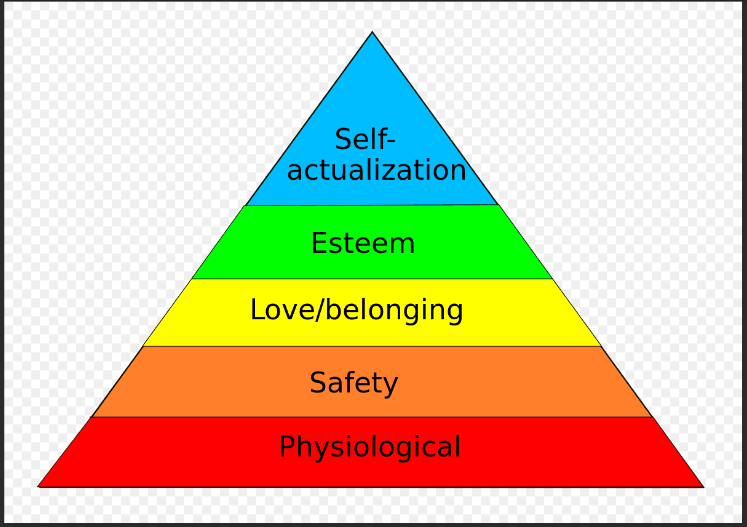
The hierarchy is useful because it allows us to identify needs and describe their position relative to happiness and contentment. Happiness occurs when a need is being met, and contentment occurs when the need is met. MHN describes the needs that must be met. Some require humans to have a community—it is non-negotiable. The need for love and belonging is the most obvious communal need, but the need for community spills into the other four.
Without community, humans are stuck in the bottommost levels of their needs and cannot ascend the pyramid. Therefore, freedom, which dissolves obligations and destroys communities, condemns the people who acquire it. So, the FSD must be replaced with the FOD to permit a better tradeoff analysis between freedom and obligation. Such a tradeoff is absent from the FSD because of the word slavery’s connotations.
The Change You Can Make
Philosophers are losers. Among them, cowardice, laziness, and incompetence are the norm. So, they are generally ignorant of how to do things. They may know a lot and be skilled at thinking and remembering, but their ability to convert the contents of their minds into specific actions is poor.
We should not be like them. Presenting an idea without attaching a feasible activity for enacting it is distasteful. The change in behavior and the attendant improvements are the fruits of the intellectual vine.
So, I propose the following adjustments deduced from the preceding reasoning.
Add the phrase Freedom-Obligation Dichotomy (FOD) to your vocabulary.
Say the word obligation where others would say slavery.
Frame questions of increasing and decreasing freedom in terms of strengthening and weakening relationships.
Identify the tradeoff analysis that must occur when one changes.
Justify tradeoffs in favor of obligations by asserting that people are worth more than freedom. Doing so presents freedom as selfish and obligation as altruistic.
These changes will ease the process of restoring social capital and alleviating the burdens imposed by modernity by replacing the one-sided FD with the more morally contentious FOD.
Final Words
The FOD offers a powerful corrective to the misguided assumptions underpinning the FSD. By reorienting social values to prioritize obligations over unchecked freedoms, we can counteract the social erosion caused by an excessive focus on individualism. The FOD acknowledges that meaningful connections, social cohesion, and collective well-being require a balance—one that sacrifices some personal freedoms to enhance community strength.
At the heart of this model is recognizing our human need for connection, trust, and shared purpose, values easily lost when social obligations are downplayed. In societies where people prioritize social obligations, individuals feel supported by a framework that values stability over fleeting desires. This allows for personal fulfillment rooted in community and tradition rather than the transient satisfaction from purely individualistic pursuits.
Ultimately, the FOD provides a vision of social harmony that doesn’t rely on restrictive authority but instead emphasizes the mutual benefits of commitment to each other. Embracing the FOD could cultivate a more robust, healthier society where freedom is not eradicated but wisely tempered by the deeper values of loyalty, service, and social integrity.
This has been Gene of the Space Guild.
End Transmission.