

The benches are splintered.
The harp is silent.
A cup lies turned in the rushes.
Outside, something listens.
Inside, men pretend it will pass.
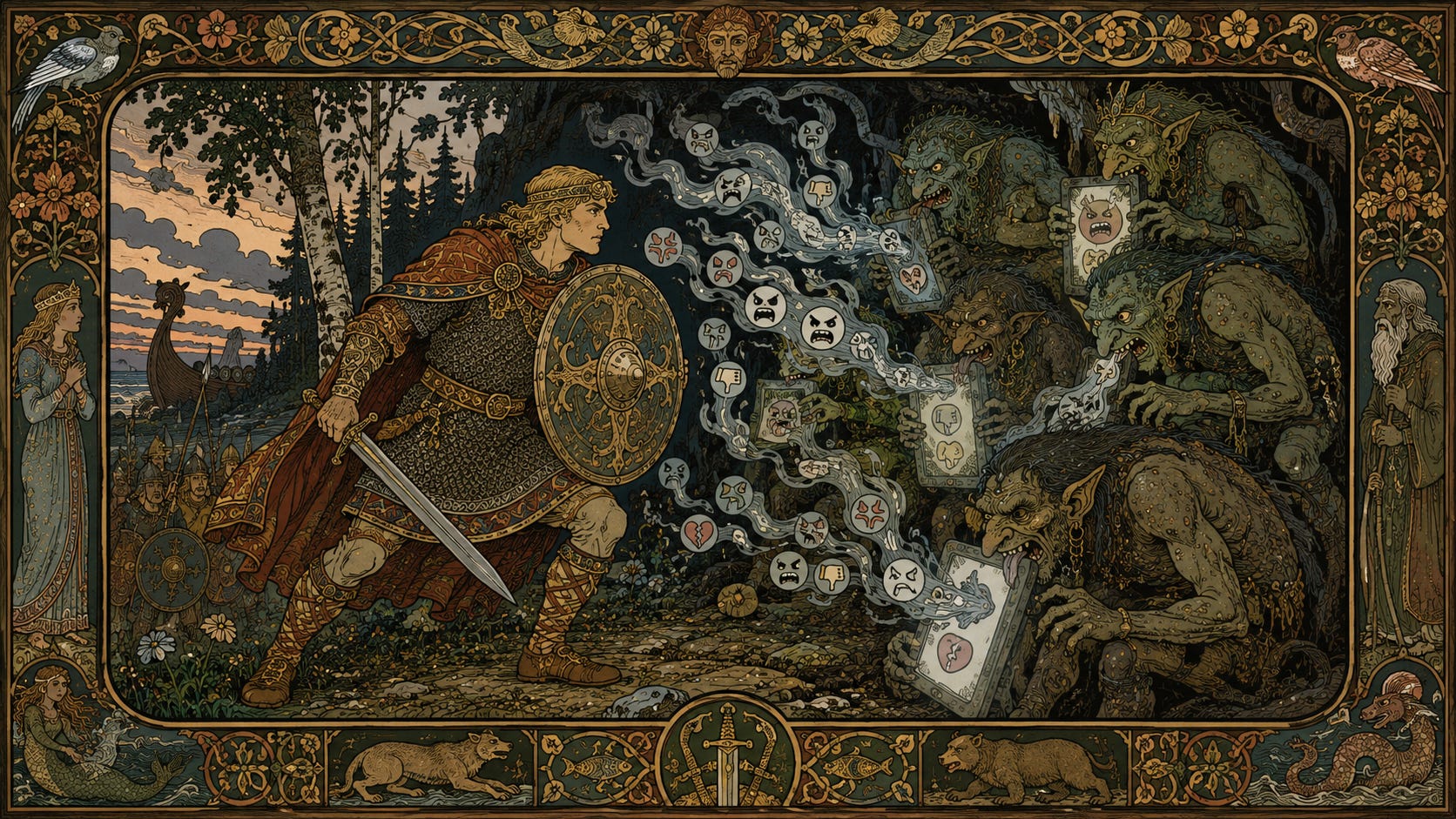
Beowulf begins in a hall. That matters. Heorot is a place of warmth, song, status, and fellowship. Hrothgar builds it as a visible sign of order. Men gather there to drink, speak, boast, remember, and belong. Civilization, in the old poem, is audible before it is political. It has music. It has ritual. It has people laughing too loudly after the third cup, which is how one knows the Danes had already discovered comment sections.
Then Grendel hears the noise.
He is not merely annoyed by it. He is spiritually injured by joy. The hall’s singing reminds him that he is outside the circle. He cannot join the feast, so he attacks the feast. Night after night, he enters Heorot, kills Hrothgar’s men, and turns the king’s great hall into a place of dread. The monster does not build his own hall. He does not offer a rival song. He feeds on the human warmth he cannot create.
That is the old shape of the internet troll.
The troll does not enter a conversation to improve it, correct it, sharpen it, or even win it. He enters to make the room colder. A creator posts a painting, an essay, a video, a prayer, a family photo, or some earnest little thought that still has its shoes on the wrong feet. The troll arrives with a club made of boredom. He sneers, misreads, provokes, humiliates, and waits for the hall to turn toward him. If the room becomes angry, he has eaten. If someone breaks composure, he has feasted.
This is why Beowulf gives us a better image than the usual therapeutic language. The troll is not primarily seeking attention, though he often is. He is attacking the conditions under which attention becomes noble. Heorot rewards song, courage, rank, loyalty, and shared memory. Troll culture rewards interruption, defilement, plausible deniability, and the cheap thrill of making sincere people look foolish. The mechanism is brutally simple: the more a troll can make the hall react, the more power he appears to have.
Grendel’s genius is that he fights at night. The darkness is part of the weapon. Modern trolling has its own darkness: anonymity, distance, speed, and the strange half-reality of the screen. In the online disinhibition effect, anonymity, invisibility, delay, and weakened authority lower the ordinary restraints that keep people civil when they must look another human being in the face. In plain English, the internet lets a man throw a stone while wearing a fog machine as a hat. A ridiculous outfit, yes, but very effective.
The old poem understands this before electricity ever learned to gossip. Grendel does not meet Hrothgar’s men in honorable combat beneath the morning sun. He comes when the warriors sleep, when reaction is confused, when fear spreads faster than judgment. The troll’s screenshot, quote-tweet, anonymous reply, or bait comment works the same way. It catches the victim off balance and drags the exchange into a theater designed by the attacker.
The reward system then completes the monster’s body. Platforms favor visible reaction. Anger is legible. Shame is legible. Pile-ons, replies, and quote posts all tell the machinery that something is happening. A quiet act of gratitude barely makes a ripple. A public humiliation rings the bell. The algorithm becomes Grendel’s mother with a clipboard, measuring how much noise the monster made before approving the next raid.
That machinery matters because the troll’s pleasure is often stranger and uglier than mere disagreement. Online cruelty has a recurring kinship with everyday sadism, the little domestic appetite for another person’s discomfort. This is why the troll may not look satisfied after making a point. He looks satisfied after making someone flinch. Grendel does not eat because he is starving. He eats because the scream seasons the meat.
Decent people often misread the bargain. They assume the troll wants to be persuaded, corrected, or educated. Hrothgar’s men might as well have offered Grendel a seminar on hall etiquette. The troll’s speech may look like argument, but the argument is bait. He says something crude enough to demand an answer, slippery enough to deny intent, and personal enough to wound. Then he waits for the victim to grant him the dignity of a debate.
Beowulf refuses that frame.
When he comes to Heorot, he does not give Grendel a better theory of fellowship. He does not open a dialogue with the swamp. He waits in the hall, strips away the monster’s advantage, and meets him without a sword. That last detail is strange and important. Beowulf fights Grendel by hand because Grendel has placed a spell against weapons. In the modern hall, the troll has a spell against ordinary discourse. Sarcasm feeds him. Outrage feeds him. Defensive explanations feed him. Moral lectures arrive pre-chewed.
The proper response is ritual control.
A healthy hall has rules of entry. It knows who may speak, how disputes are handled, when mockery becomes vandalism, and when a guest has become a threat. That can mean blocking, muting, banning, ignoring bait, refusing quote-post theater, or answering once with icy clarity before closing the door. The key is to deny the troll his chosen meal. No trembling apology. No 4,000-word defense to a man whose profile picture is a frog in sunglasses. No dragging the whole hall into a swamp trial because one creature outside the firelight began tapping on the wall.
Beowulf also teaches that the troll is defeated publicly. Grendel’s arm is hung in Heorot as proof that the hall can be defended. This does not mean cruelty. It means visible standards. Communities survive when members can see that disorder has limits. A troll thrives where hosts confuse openness with abdication. Heorot fell into terror because the king’s hall stopped feeling protected. Online spaces decay the same way. Once normal people learn that every sincere act will be punished with ridicule, they stop singing. They lurk. They self-censor. The benches empty, and the monster inherits the acoustics.
The deeper moral problem is envy of form. Grendel hates the hall because the hall has shape. It gathers men around a center. It gives speech a purpose beyond appetite. The troll hates any formed thing: a friendship, a craft, a tradition, a hierarchy of skill, a small community with manners. He experiences form as exclusion. Since he cannot bear the pain of being outside, he tries to make inside and outside equally miserable.
That is why the answer cannot be mere niceness. Niceness often becomes a tray of cakes carried straight into the cave. The answer is hospitality with walls. A hall that cannot welcome guests becomes sterile. A hall that cannot expel monsters becomes lunch.
The internet has made everyone a minor Hrothgar. Every page, channel, feed, forum, and group chat is a little mead-hall with its own firelight. The question is whether the host understands what the hall is for. If it exists for fellowship, work, wonder, or honest dispute, then Grendel must meet Beowulf at the door. If it exists for reaction alone, the monster is already seated, wiping his claws on the tablecloth.
Somewhere beyond the screen, the mere waits in the dark. The water is cold. The hall is warm. The song begins again, and the old arm still hangs above the door.