
Augustine Against the Narcissist Who Calls Possession Love
The soul can call many things love after it has forgotten how to love rightly.

A person survives a narcissist and often comes away unable to name what happened.
There was affection, at first. There may have been gifts, praise, shared secrets, dramatic promises, long messages at midnight, a sense of being chosen. Then the air changed. Affection became surveillance. Correction became humiliation. Confession became ammunition. The narcissist wanted access to the other person’s attention, conscience, memories, friendships, schedule, body, and emotional weather.
The modern setting gives this behavior many instruments. A phone becomes a leash with a glass face. Read receipts become moral evidence. Social media posts become loyalty tests. Family gatherings become courtrooms. Workplace meetings become little coronations in bad lighting. The narcissist demands reassurance while accusing others of selfishness. He says, “I care too much.” She says, “I only wanted honesty.” The language of love remains on the table, but the meal is poisoned.
What deteriorates first is usually the survivor’s judgment. The person begins asking permission internally before speaking, resting, laughing, posting, declining, dressing, or remembering an event accurately. This is one of the ugliest fruits of narcissistic control: it makes the victim participate in his own shrinking.
Augustine is a useful guide here because he knew that the human heart does not become wicked only by hating the good. It also becomes crooked by loving the good in the wrong order.

The Classic Diagnosis
Augustine’s great moral insight is the doctrine of ordered love. The human soul is formed by what it loves, how it loves, and in what rank it places its loves. In the Confessions and City of God, Augustine presents sin as disordered love: loving lower things as though they were ultimate, loving the self as though it were sovereign, loving possession more than truth, loving praise more than God.
This matters for surviving narcissism because narcissistic control often imitates love. It uses the gestures of closeness while pursuing ownership.
A rightly ordered love wills the good of the beloved. It can delight in another person without swallowing that person. It can receive affection without demanding worship. It can suffer correction without turning the room into a crime scene.
A disordered love says, “You exist for my reflection.”
That is the narcissist’s spiritual architecture. The other person becomes a mirror, servant, witness, audience, shield, and scapegoat. When the mirror reflects admiration, it is cherished. When the mirror reflects truth, it is punished. Here the soul has gone badly out of tune. Someone dropped the harp down a staircase and called it jazz.
Augustine helps clarify the difference between attachment and charity. Attachment can crave, fear, clutch, monitor, and consume. Charity seeks the good of the other under God. It has firmness. It has humility. It can say no. It can leave when staying would train both souls in falsehood.
The Governing Judgment
The narcissist who calls possession love has confused union with control.
Freedom is not the ability to keep another person emotionally available at all hours. It is the capacity to act according to truth and rightly ordered love. Appetite says, “Answer me now.” Love says, “Be whole before God.” Appetite says, “Prove you care.” Love says, “I will not make my fear your master.”
Convenience also plays its part. Modern communication makes constant access feel normal. A spouse can track location. A parent can demand instant replies from an adult child. A manager can send messages after dinner and treat silence as mutiny. The machine flatters the controlling soul. It says, “You can know. You can reach. You can interrupt. You can measure loyalty by response time.”
Augustine would ask a harsher question: what kind of love requires another person to become less human?
The survivor must recover the distinction between mercy and surrender. Mercy refuses vengeance. Surrender hands the keys back to the jailer. Forgiveness may release hatred, but it does not require fresh exposure to manipulation. Reconciliation requires truth, repentance, restitution, changed conduct, and time. The narcissist usually wants immediate absolution without judgment. He wants Easter morning while keeping the tomb rented.
A sane response begins by restoring moral order. God above man. Truth above mood. Duty above panic. Peace above appeasement. Memory above revision. Boundaries above theatrical guilt.
The Hidden Machinery
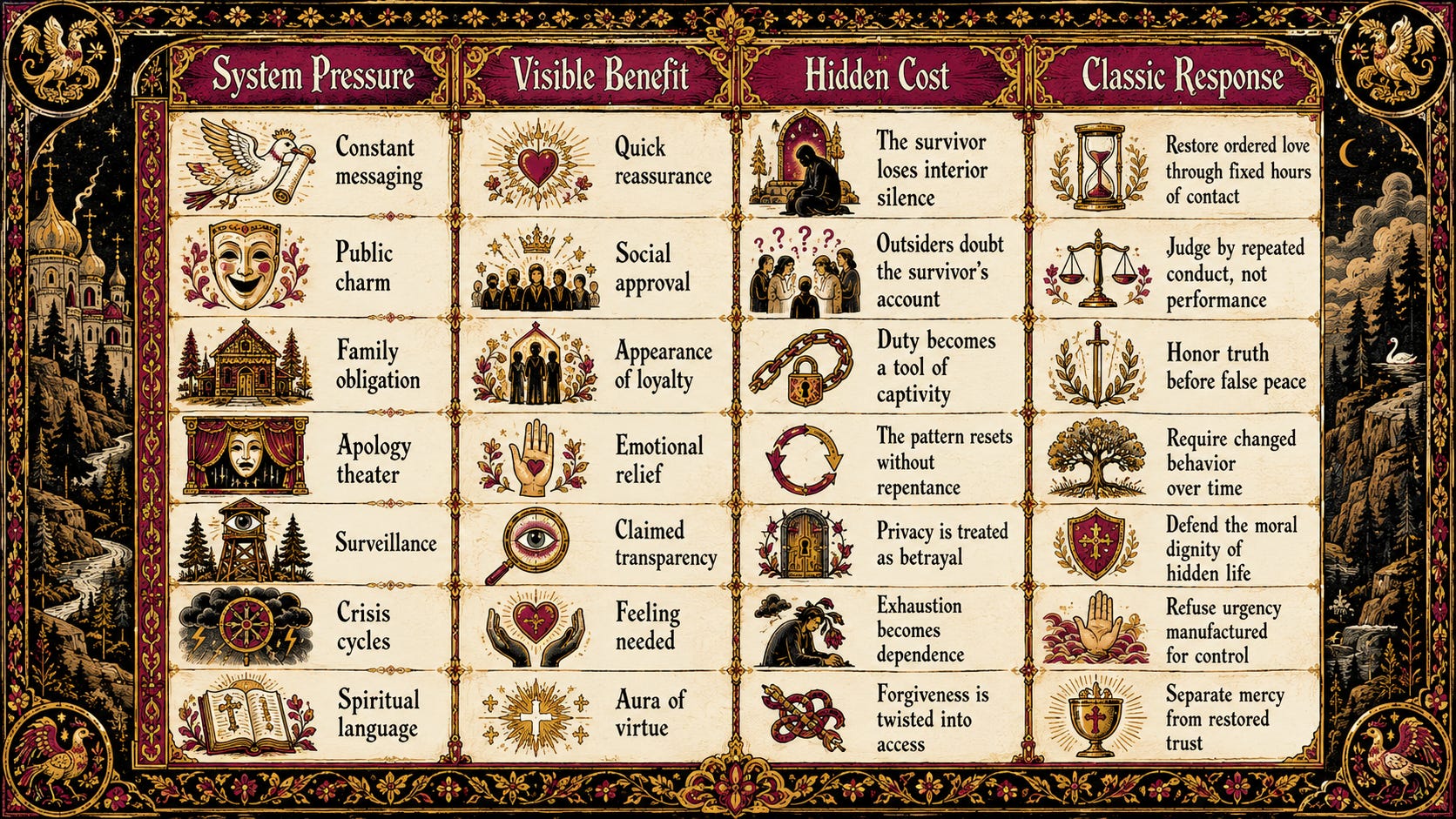
Narcissistic systems run on confusion. They blur care and control, privacy and secrecy, forgiveness and permission, loyalty and obedience, peace and silence.
The survivor is often pressured by people who prefer a tidy lie to an untidy truth. “But he seems so kind.” “She speaks so highly of you.” “Family is family.” “Every marriage has problems.” These sentences may sound gentle, but some of them arrive carrying a shovel.
The hidden machinery is maintained by fear. Fear of being smeared. Fear of losing friends. Fear of being called bitter. Fear of making the children sad. Fear of disappointing relatives. Fear of disobeying religious expectations. Fear of facing loneliness after escape.
Augustine would not treat fear lightly. He would ask what the fear loves most. Reputation. Familiarity. Approval. Safety. Control. None of these is evil in itself. Each becomes dangerous when enthroned.
The Discipline
Write a private record of concrete events for thirty days. Include dates, words spoken, witnesses, threats, apologies, and repeated patterns. Do not diagnose in the record. Describe conduct.
Choose one trusted person who has no dependence on the narcissist. Tell that person three specific incidents without exaggeration.
Remove instant access where possible. Turn off read receipts. Silence notifications. Set one or two fixed windows for replies. Use written communication when speech becomes a fog machine with shoes.
Stop defending your motives during circular arguments. Say, “I have answered that,” and end the exchange.
Refuse emergency language unless there is a real emergency. A wounded ego is not a house fire.
Keep private prayer, journaling, and counsel outside the narcissist’s reach. The interior life must have walls, windows, and a lock that works.
Name the difference between apology and repentance. An apology says words. Repentance changes patterns, accepts consequences, and stops demanding applause for basic decency.
Rebuild one neglected duty each week. Visit a friend. Return to church. Clean your room. Walk outside without the phone. Read ten pages of a serious book. Narcissistic control weakens when ordinary life regains its spine.
Seek competent pastoral, legal, or clinical counsel when the relationship involves marriage, children, threats, shared property, stalking, or violence. A battered gate does not repair itself by admiring hinges.
Do not announce every boundary. Some boundaries are spoken. Others are built quietly and used.
The point is not emotional purity. The point is truthful conduct repeated until the soul remembers its own shape.
The Final Temptation
The survivor faces several temptations after escape.
One is theatrical asceticism. The person becomes proud of needing nothing, trusting no one, and feeling above affection. This looks strong for about twelve minutes. Then it becomes another prison, only with cleaner walls.
Another temptation is nostalgia. The mind replays the first weeks, the beautiful apology, the rare tenderness, the old photograph, the one evening when everything seemed possible. Augustine would understand this ache. Memory can become a chapel or a trap. The question is whether memory serves truth.
There is also the temptation to become a little narcissist in reverse: to make survival the center of identity, to demand endless recognition, to read every disagreement as abuse, to mistake firmness for healing. Pain can educate. It can also crown itself king and start issuing decrees.
The Augustinian remedy is ordered love.
Love God first. Love truth more than emotional peace. Love the neighbor without surrendering conscience. Love the self as a creature under God, neither trash nor idol. Love memory enough to tell the truth about it. Love inheritance enough to stop passing disorder down the family line like a cracked silver cup everyone pretends is noble.
A person becomes free through repeated acts of rightly ordered love. The phone unanswered. The false accusation left unfed. The record kept. The prayer said. The friend visited. The child protected. The door locked. The apology tested by time. The past named without becoming a shrine to injury.
The narcissist who calls possession love must be answered by a soul that has learned love’s proper grammar. Love does not erase the beloved. Love does not demand worship. Love does not turn another person’s conscience into rented furniture.
Character is built by what one permits, what one refuses, what one remembers, and what one practices after the room gets quiet.
A grand world awaits.