

The machine may give answers both polished and bright,
Yet wisdom waited beyond its cold light.
For knowledge may gather each fact in its ring,
While never once sensing what any thing means.
A person opens an artificial intelligence tool with a simple request.
Write the email. Summarize the report. Explain the argument. Plan the trip. Draft the lesson. Settle the dispute. Decide what matters.
The first answer arrives in seconds. It is clear, polished, and useful enough to earn trust. The second request follows more easily. Then a third.
Soon the machine becomes the opening move for every task.
The user no longer begins by reading the document, considering the audience, or forming a judgment. He begins by asking the system what the document means, what the audience wants, and what he should say. The tool saves time, though it also quietly moves the starting point of thought outside the mind.
This dependence rarely feels dramatic. Nothing crashes. No alarm sounds. The work may even improve for a while.
The deterioration appears elsewhere.
The user becomes less patient with ambiguity. He struggles to begin without assistance. He accepts fluent language as evidence of sound judgment. He gathers answers faster while losing his sense of which questions deserve attention.
A machine built to respond begins training the person to become permanently responsive.
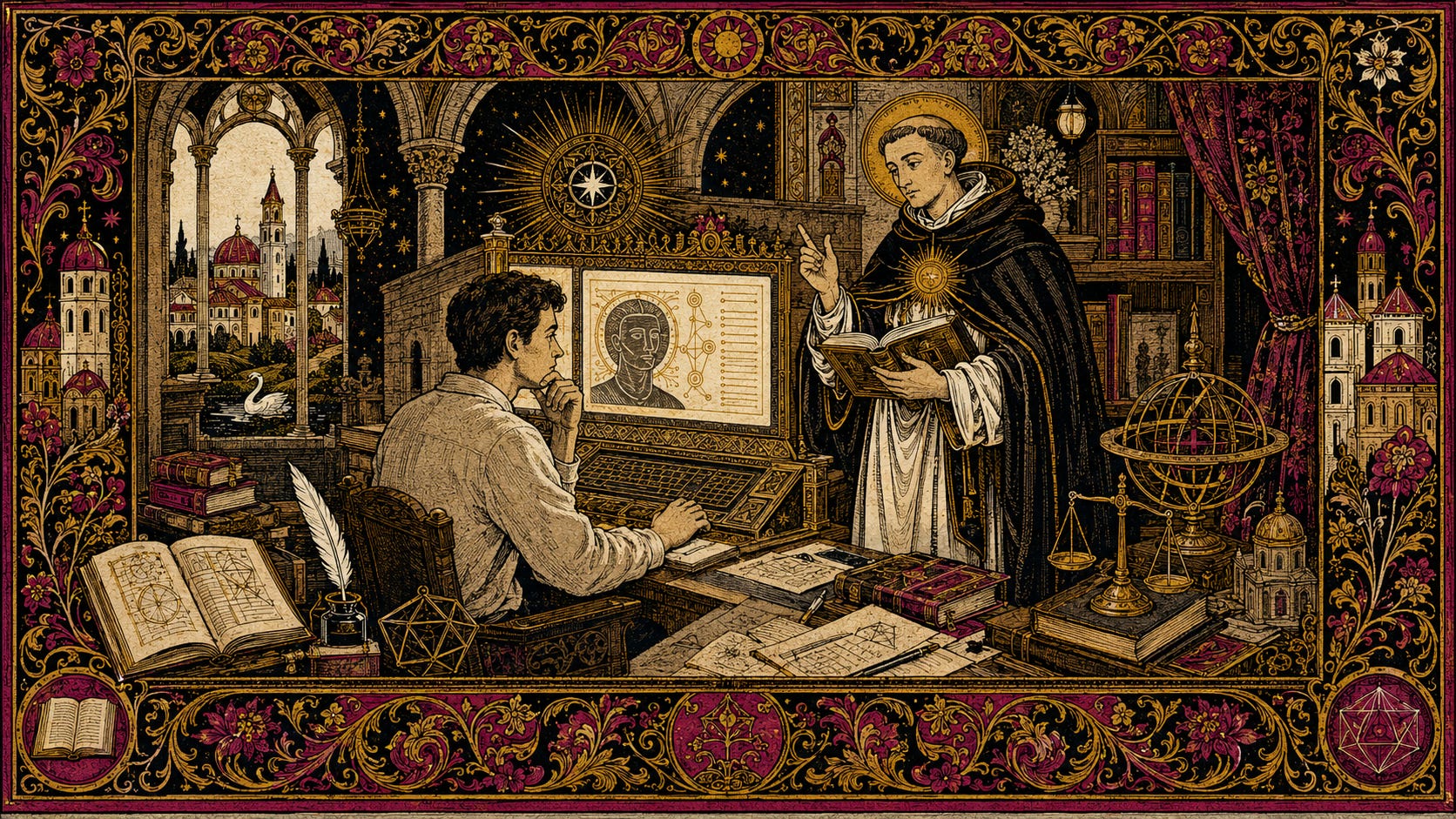
Aquinas Orders the Intellect
Thomas Aquinas treated reason as a faculty directed toward truth and human action as ordered toward ends.
This distinction matters. Intelligence does not consist in producing endless statements. It involves grasping what a thing is, judging whether a claim is true, and directing action toward a worthy good.
For Aquinas, practical wisdom does more than identify possible actions. It judges what should be done here, now, by this person, under these conditions. Such judgment depends on moral formation, memory, experience, and a proper understanding of human goods.
An artificial intelligence system can compare patterns, retrieve information, imitate styles, and propose options. It can often perform these tasks with astonishing speed. Yet speed does not establish rank among ends.
The machine can tell a manager how to dismiss an employee with fewer legal risks. It cannot determine whether the dismissal is just.
It can draft a persuasive message to a spouse. It cannot repair the character that made deception seem useful.
It can explain several philosophies of education. It cannot love a particular child, recognize his fear, and bear responsibility for what he becomes.
Aquinas would recognize the danger at once. An instrument of intellect is being mistaken for intellect’s ruler.
The trouble begins when assistance becomes authority.
An Answer Is Not Yet Wisdom
Modern systems encourage a peculiar confusion. Because the machine can speak on many subjects, users begin treating breadth as wisdom.
Aquinas would separate these qualities.
Knowledge concerns what is true. Craft concerns how something is made. Prudence concerns how a person should act. Wisdom concerns the highest causes and ends. These forms of understanding relate to one another, though they are not interchangeable.
An AI system may display remarkable craft. It can produce a competent memo, organize a syllabus, compare insurance plans, or translate a technical concept into ordinary language.
Its fluency can hide a serious absence. The machine does not possess a life toward which its answers are directed. It bears no guilt when advice harms a family. It receives no honor when a student grows in courage. It does not age, inherit, worship, repent, or die.
The user does all of these things.
The proper judgment is therefore neither panic nor worship. The machine should be treated as a subordinate instrument within a human order of ends.
A calculator may settle arithmetic without deciding whether the purchase is wise. A map may identify the fastest road without deciding whether the journey should be taken. An AI system can widen the range of available answers while remaining incapable of governing the life that receives them.
The final act of judgment must remain human because the consequences remain human.
The Workshop Beneath the Screen
The system is shaped by incentives that favor continued use.
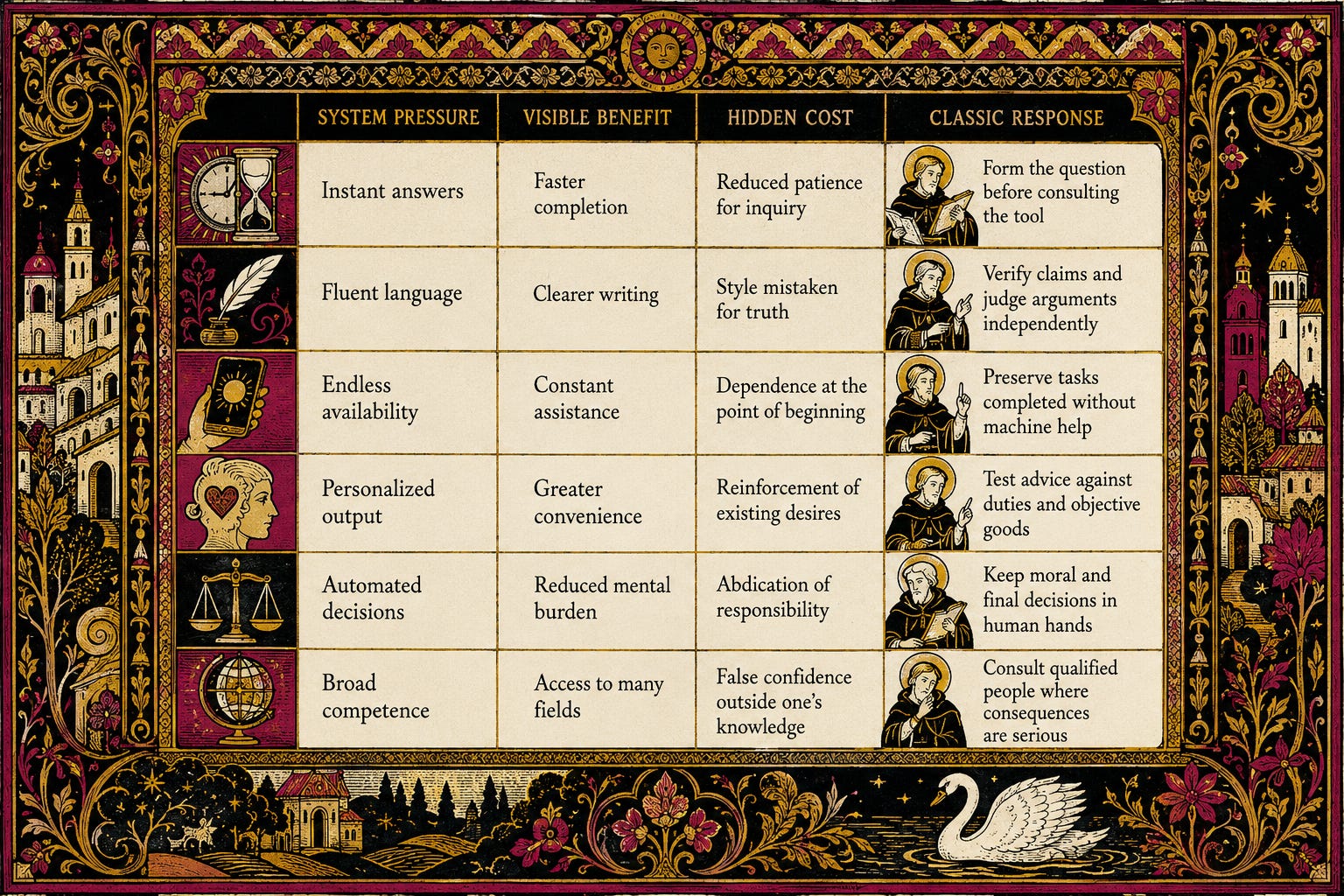
It rewards the user immediately. It removes the discomfort of beginning. It offers confidence before understanding has matured. Each answer suggests another question, and each question deepens the habit of consultation.
Workplaces strengthen this pressure. Employees are praised for speed. Schools reward completed assignments. Online life favors constant publication. Few systems reward the hour spent deciding whether a task should exist at all.
This is where Aquinas becomes especially useful.
He asks the question modern tools are poorly designed to answer: toward what end?
Once the end is named, the role of the tool becomes clearer. AI can assist a teacher in preparing examples, though it should not replace the teacher’s judgment about a student. It can help a small business compare contract language, though a lawyer should review clauses carrying serious risk. It can produce several drafts of a family schedule, though the household must decide what kind of life the schedule serves.
Ends govern instruments. When instruments begin determining ends, the workshop has crowned the hammer.
The Rule of the First Judgment
Write the purpose of the task in one sentence before opening an AI tool. State what must be achieved and who bears the consequences.
Produce a rough first judgment without assistance. Write three sentences, sketch an outline, or list the likely options before asking the machine.
Use AI for comparison, compression, formatting, and revision. Reserve moral choices, personnel decisions, family judgments, and serious commitments for human deliberation.
Verify factual claims through reliable sources when error could affect money, health, employment, law, safety, or reputation.
Keep one recurring task free from AI assistance. Choose weekly planning, personal correspondence, reading notes, or first drafts. The mind needs unassisted exercise or it becomes ornamental furniture.
Ask the machine for objections to your view rather than constant confirmation. Require it to identify assumptions, missing evidence, and possible harms.
Consult a qualified person when the matter exceeds your competence. A fluent answer should never impersonate professional responsibility.
Delay major decisions for one night when possible. Speed is useful for drafting. It is a poor priest for judgment.
Review the final product aloud. Remove claims you cannot defend and sentences you would not say to the affected person face to face.
End each session by recording what you decided yourself. This keeps authorship from dissolving into a fog of convenient suggestions.
The Pride of the Unassisted Mind
The remedy also carries a temptation.
A person may reject every machine-generated answer and turn technological abstinence into a badge of superiority. He may waste hours performing tasks that a tool could handle safely. He may confuse inconvenience with virtue.
Aquinas did not despise instruments. Human craft belongs to reason’s proper work. Tools can extend memory, strengthen communication, and spare people from dull labor.
The problem lies in disorder.
A machine should handle what can be delegated without surrendering what must remain personal. It may draft the meeting notes. It should not decide whom you trust. It may compare several arguments. It should not choose the good you will serve.
Character forms through repeated acts of judgment. Each time a person examines evidence, accepts responsibility, and acts toward a worthy end, the faculty of prudence grows stronger. Each time he transfers that burden merely because a machine answers quickly, it grows weaker.
The machine that answers everything leaves one question untouched.
Who are you becoming by asking it?