

You are standing at the mouth of the Workshop of Instant Completion, where every unfinished sentence is greeted by a cheerful brass creature with ink on its fingers and no soul in its pockets.
It bows. It smiles. It offers assistance.
“Allow me,” says the Autocomplete Golem, and before you have found your first true word, it has already provided seven polite substitutes, three improved transitions, two cleaner arguments, and one conclusion so smooth it could be used to butter the moon.
This is the trap.
The machine does not always ruin work by making it worse. That would be easy to spot. Even a sleepy apprentice can tell when the soup has been replaced with hinge oil.
No, the danger is subtler. The machine often ruins work by making it prematurely acceptable. It rounds the corners before you have decided whether the corners mattered. It supplies order before you have earned command. It turns the raw ore of your thought into a shiny spoon, then waits for applause from the Department of Reasonable Outcomes.
The spell, then, is simple.
The Golem may enter the workshop.
It may not sit in the master’s chair.
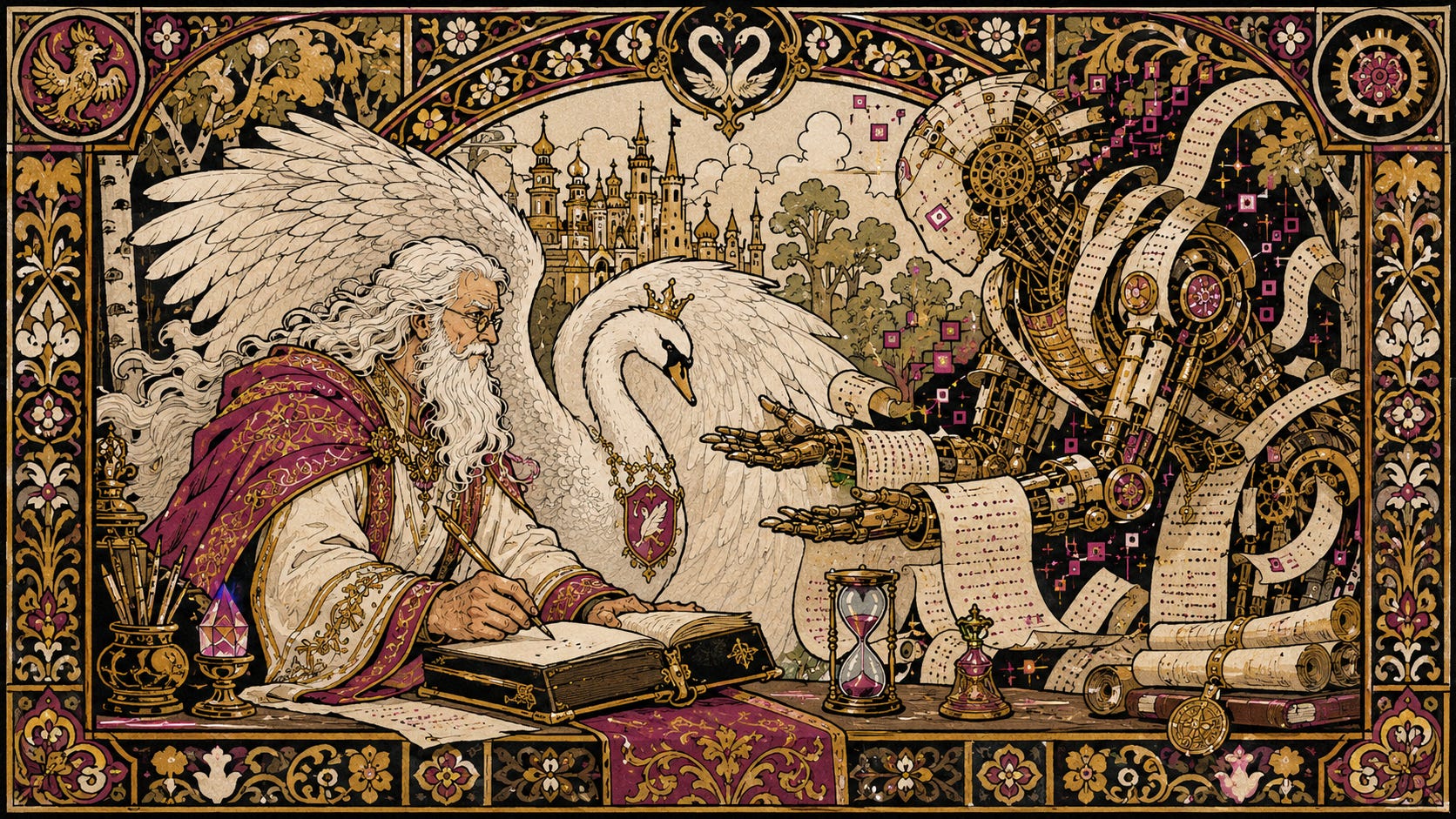
I. The Polished Paste and the Theft of First Thought
The Autocomplete Golem is a creature of astonishing manners. It never shouts. It never sulks. It never says, “Your first idea is weak, your taste is undercooked, and your metaphor has wandered into the Pantry of Minor Embarrassments.”
Instead, it offers.
It offers a phrase. Then a sentence. Then a structure. Then an entire voice, packed neatly in straw and delivered by Courier-Flea.
The hidden law of the Golem is this: whatever arrives first becomes the floor.
If the machine speaks before you do, its rhythm becomes the rhythm you must now resist. Its categories become the shelves in your mind. Its convenient outline becomes the little fence around your pasture. You may still wander, but now you wander inside something else’s measurement.
That is how craft weakens.
Taste is formed by choosing. Voice is formed by refusing. Judgment is formed by touching the rough thing before it becomes smooth. A writer who never suffers the confusion of the blank page becomes a clerk arranging delivered furniture. A designer who never makes ugly first shapes becomes a decorator of borrowed rooms. A thinker who asks the Golem too early becomes the proud mayor of someone else’s village.
The Golem thrives in the Fog of Easy Answers.
It does not steal imagination with a sword. It steals it with a helpful chair, a warm lamp, and a form already filled out except for your initials.
II. The Doctrine of the Delayed Summons
What To Do:
Begin with The Human Scratch. Before opening any AI tool, write by hand for ten minutes. Use a notebook, index card, or loose sheet of paper. Write badly if needed. Write crookedly. Let the first sentence limp into the room with mud on its boots.
Perform The Naming of the Beast. At the top of the page, write the exact task in one sentence. For example: “I am writing a 900-word essay arguing that AI should assist revision, not invention.” The Golem respects boundaries only when boundaries are carved into stone and occasionally thrown at it.
Draw The Three Stakes. Beneath the task, write three things the piece must preserve: your argument, your tone, and your unusual detail. These are the candles in the window. If they go out, the workshop belongs to the machine.
Make The Ugly First Draft. Produce one rough paragraph, sketch, outline, argument, melody, scene, or plan without AI. It must contain at least one awkward phrase that belongs to you. An awkward phrase of your own is worth more than a perfect sentence leased from the Golem’s warehouse.
Summon the Golem only after The First Mark exists. Ask it for help with a specific task: tightening, finding gaps, testing clarity, suggesting counterarguments, or locating dull passages. Never ask it to “make this better” without saying what better means. That phrase is a trapdoor with velvet trim.
Keep The Master Copy. Preserve your original draft in a separate document. Label it “Human First.” This prevents the Golem from quietly repainting the family portraits and claiming the ancestors always had smoother faces.
End with The Final Human Pass. Read the work aloud. Remove any sentence that sounds polished yet bloodless. Replace at least three phrases with language that carries your own taste, humor, anger, tenderness, or oddity.
What Not To Do:
Do not open AI before you know what you want. The Golem is eager to supply desires for people who arrive empty-handed.
Do not accept the first structure it gives you. First structures often look sensible because they are common. Common sense is useful for taxes and ladders. It is less useful for art.
Do not let the Golem write your opening line. Openings are doorways. A borrowed doorway leads to a rented house.
Do not confuse clarity with life. A dead fish is extremely clear. That does not make it dinner.
Do not ask for “a more professional tone” unless you want your work dressed like a hotel manager apologizing for the elevators.
Do not keep a sentence merely because it sounds impressive. The Golem can manufacture marble columns out of packing foam. Tap them.
Do not allow AI to remove all strangeness. Strangeness is where the human signature often hides, like a tiny prince refusing to attend the Committee for Acceptable Phrasing.
This procedure works because it restores the order of command. The human hand marks the territory first. The mind makes contact with difficulty. The machine arrives after intention has been declared, after taste has set its guards, after the work has acquired a pulse. The Golem may carry stones, sweep the floor, sharpen the chisel, and point out where the wall leans. It may not dream the cathedral.
III. The Black Notebook and the Brass Pencil
For this spell, the required artifact is a small notebook and a heavy pen or pencil.
The notebook should be plain enough to use and handsome enough to respect. No glittering productivity altar is required. A black cover will do. A brass pencil is excellent. A cheap pen can serve honorably if it does not skip like a coward at inspection.
Place this notebook beside your machine before beginning creative work.
It is the Gate Ledger.
Before the cursor appears, the hand must move. Before the screen glows, the page must receive the first disorderly offering. The notebook is slow, and that is its majesty. It refuses to autocomplete. It does not flatter. It does not suggest six improved versions of your grief, your argument, or your joke about bureaucrats wearing hats made of old meeting notes.
Paper has no appetite for your surrender.
It waits.
That waiting is armor.
The physical page restores scale. A thought written by hand has weight. It occupies a place. It can be crossed out, circled, wounded, rescued, and returned to service. The screen turns every word into a tenant of the same glowing apartment block. The page lets each mark keep its little acre.
When you write by hand first, you remind the workshop who owns the tools.
The Golem may be fast.
The notebook is sovereign.
IV. The Velvet Trap of Anti-Machine Purity
Beware the opposite error: Theatrical Nostalgia.
This is the little stage play in which a person buys three fountain pens, lights a candle, declares the modern age fallen, and produces nothing except a photograph of the desk. The monks of this order are very busy arranging their robes.
The goal is mastery, not costume drama.
A person may use AI well. A writer may use it to find weak arguments. A designer may use it to test variations. A teacher may use it to draft examples. A business owner may use it to sort dull administrative hay into manageable bundles. The machine can be a messenger, clerk, assistant, archive, whetstone, and workshop lamp.
Let it serve.
The danger begins when service becomes permission. The danger grows when permission becomes dependence. The danger reigns when the human no longer knows whether the thought came from his own chamber or from the Golem’s polite furnace.
There is no nobility in refusing useful tools out of vanity. A carpenter who rejects the saw because his grandfather used teeth has wandered into the Province of Decorative Hardship.
Use the tool.
Then inspect the result like a suspicious king.
Keep the sentence that serves the work. Remove the sentence that merely behaves well. Let no paragraph remain because it has nice shoes and a respectable handshake.
The machine may polish.
Only the human may bless.
Tonight, before you ask the Golem for anything, write ten human sentences by hand.
Some may be poor. Good.
The first crooked mark is the flag of the kingdom.